What Is Biweekly Pay? Calculate Your Paycheck and 3-Paycheck Months
Shanzay Arain·Jul 16, 2026
Starting a new job often means dealing with unfamiliar payroll terms. One of the most common questions employees ask is What is biweekly pay, and does it mean getting paid twice a month?
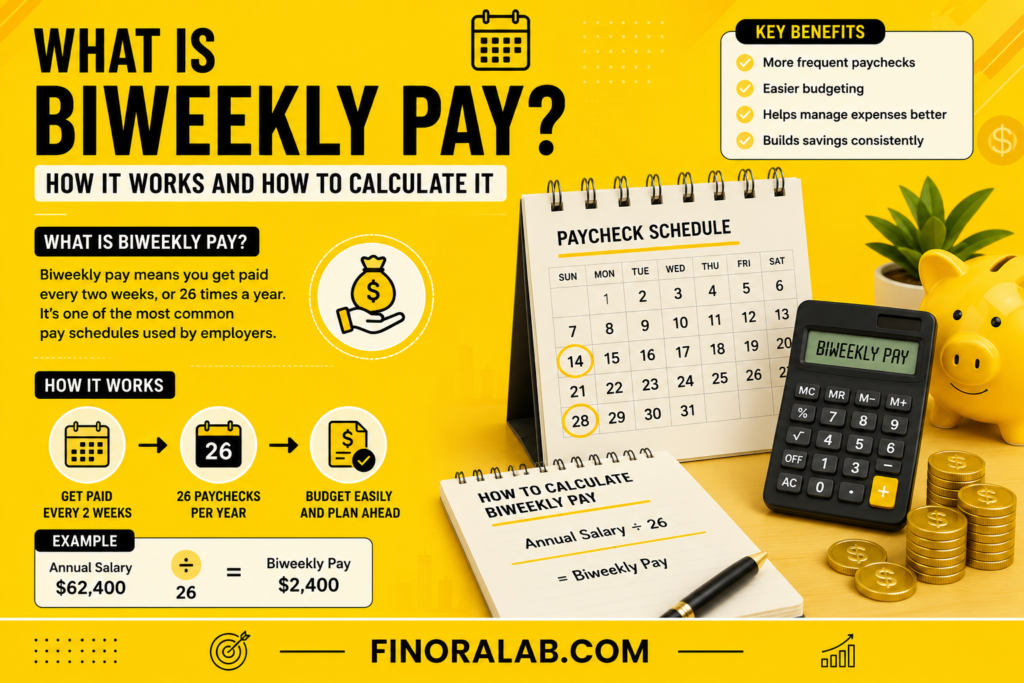
Biweekly pay means an employee normally receives a paycheck once every two weeks, usually on the same weekday. For example, an employer may pay workers every other Friday. Because a standard year has 52 weeks, a biweekly schedule normally produces 26 paychecks per year.
That sounds similar to being paid twice a month, but the two systems are not identical. An employee paid twice monthly usually receives 24 checks per year. Someone paid biweekly ordinarily receives 26 checks, which means there are normally two months with three paydays.
Understanding this distinction can help you evaluate a job offer, review your pay stub, estimate take home pay and build a budget that works with your actual payroll calendar. This guide explains how biweekly payroll works, how to calculate each paycheck and how taxes, deductions and overtime can affect the amount you receive.
What Is Biweekly Pay?
Biweekly pay is a payroll arrangement in which employees are paid once every two weeks. Each pay cycle generally covers a 14 day period, although the payment may arrive several days after the pay period ends because employers need time to process payroll.
For example, an employer may establish the following schedule
Pay period begins on Sunday, January 4
Pay period ends on Saturday, January 17
Payday occurs on Friday, January 23
The next payday occurs two weeks later
The exact start date, end date and payment day depend on the employer. What makes the schedule biweekly is that paydays occur at 14 day intervals.
Employees on this schedule usually receive their money on the same weekday, such as every other Wednesday or Friday. This consistency makes it relatively easy to anticipate when the next paycheck will arrive.
Quick Summary Table
Biweekly pay feature
Explanation
Basic meaning
Payment once every two weeks
Typical pay period
14 days
Normal paychecks per year
26
Occasional exception
Some calendar years can contain 27 paydays
Common payday
Every other Friday, although employers may choose another day
Three paycheck months
Normally two per year
Salary calculation
Annual salary ÷ 26
Hourly calculation
Hourly rate × hours worked during the pay period
Main benefit
Predictable payday every two weeks
Main challenge
Paydays do not always align neatly with monthly bills
Different from semimonthly
Semimonthly usually provides 24 checks on fixed calendar dates
Taxes and deductions
Generally calculated and withheld from each paycheck
How Does Biweekly Pay Work?
Under a biweekly system, the employer divides the working year into pay periods that usually last 14 days. Hours, salary, overtime, bonuses and eligible leave associated with that period are entered into the payroll system.
The employer then calculates gross wages. Applicable taxes, insurance premiums, retirement contributions, garnishments and other deductions are removed. The remaining amount is the employees net pay.
The basic process looks like this
Gross biweekly pay − Taxes and deductions = Net biweekly pay
Gross pay is the amount earned before deductions. Net pay is the amount deposited into the employees bank account or delivered through another approved payment method.
The IRS defines a payroll period as the period of service for which an employer normally pays wages. For U.S. federal withholding purposes, employers use the tax withholding method applicable to that payroll period. IRS Publication 15
How Many Biweekly Pay Periods Are in a Year?
Most biweekly employees receive 26 paychecks per year.
The standard calculation is
52 weeks ÷ 2 = 26 pay periods
The IRSs 2026 withholding guidance recognizes 26 biweekly periods, compared with 24 semimonthly, 12 monthly and 52 weekly periods. IRS Publication 15 T
However, 26 is not guaranteed in every calendar year. Because a calendar year contains 365 days—and a leap year contains 366—the dates do not divide perfectly into 14 day cycles. Depending on the employers payday calendar, an occasional year can have 27 biweekly paydays.
Employers should tell workers when this happens because it can affect payroll deductions, benefit contributions and salary calculations. Salaried employees should not assume that a 27 pay period year automatically creates an extra full installment of annual salary. Employers may adjust each paycheck so total annual compensation remains consistent with the employment agreement and applicable law.
Why Are There Three Paychecks in Some Months?
Most months contain two biweekly paydays. However, because paychecks arrive every 14 days rather than on two fixed dates, two months will normally contain three paydays.
Consider this simplified Friday schedule
January 2
January 16
January 30
January contains three paydays because all three dates fall within the same calendar month.
The next paydays would continue every two weeks
February 13
February 27
March 13
These three paycheck months do not necessarily mean the employer is giving you a bonus. They are part of the regular 26 paycheck schedule.
If you budget monthly using only two paychecks, the third check may give you an opportunity to build emergency savings, reduce debt or cover irregular expenses. However, some expenses and deductions may also occur on that check, so review your pay stub before committing the entire amount.
Biweekly Pay Example for a Salaried Employee
Suppose an employee earns an annual salary of $65,000 and receives 26 biweekly paychecks.
The gross paycheck calculation is
$65,000 ÷ 26 = $2,500
The employees gross biweekly pay is $2,500.
Assume the following deductions apply to one paycheck
Federal and applicable local taxes $390
Social Security and Medicare related withholding $190
Health insurance $120
Retirement contribution $125
Other deductions $25
Total deductions would be $850
$2,500 − $850 = $1,650
The estimated net biweekly pay would be $1,650.
This is only an example. Actual withholding depends on jurisdiction, taxable wages, filing information, benefits and payroll policies. Employees should use their pay stub or an official withholding estimator for a more accurate figure.
How to Calculate Biweekly Pay From Annual Salary
For a normal 26 pay period year, use this formula
Gross biweekly pay = Annual salary ÷ 26
Here are several examples
Annual salary
Approximate gross biweekly pay
$40,000
$1,538.46
$50,000
$1,923.08
$60,000
$2,307.69
$75,000
$2,884.62
$90,000
$3,461.54
$100,000
$3,846.15
These figures represent gross earnings before taxes and deductions.
If the employer has 27 pay periods in a particular calendar year, ask payroll how annual salary will be distributed. Do not divide by 27 unless the employer confirms that method.
How to Calculate Biweekly Pay for an Hourly Employee
Hourly employees calculate gross biweekly wages based on the hours worked during the pay period.
Use this basic formula
Biweekly gross pay = Hourly rate × Hours worked
Suppose an employee earns $22 per hour and works 40 hours each week
$22 × 80 hours = $1,760
The gross biweekly paycheck would be $1,760 before taxes and deductions.
If the hours vary, use the actual time recorded during the pay period. Paid leave, shift premiums, commissions and bonuses may be added according to employer policy.
How Overtime Works With Biweekly Pay
Biweekly payroll does not necessarily mean overtime is calculated only after 80 hours across two weeks.
For many employees covered by U.S. federal overtime rules, overtime is generally evaluated by workweek, not by combining two workweeks into one 14 day period. An employee who works 45 hours in the first week and 35 in the second may still have five overtime hours, even though the total is 80 hours.
A simplified illustration might look like this
Week one 45 hours
Week two 35 hours
Regular hours 75
Potential overtime hours 5
Overtime eligibility depends on employee classification, occupation, federal requirements, state law and other circumstances. Being paid a salary does not automatically determine whether an employee qualifies for overtime.
Workers should review their employers time records and consult the appropriate labor authority if they believe overtime has been calculated incorrectly.
Biweekly Pay vs. Semimonthly Pay
Biweekly and semimonthly payroll are often confused because both commonly produce two checks in a month. Their timing and annual number of payments are different.
Feature
Biweekly pay
Semimonthly pay
Frequency
Every two weeks
Twice each month
Normal checks per year
26
24
Payday pattern
Same weekday
Usually fixed calendar dates
Pay period length
Usually 14 days
Varies by calendar
Three paycheck months
Normally two
Generally none
Hourly payroll
Often easier to align with workweeks
Can be more complicated
Check size for same salary
Usually smaller
Usually larger
Total annual salary
Normally unchanged
Normally unchanged
A semimonthly employee might be paid on the 15th and final day of every month. These dates may fall on different weekdays.
A biweekly employee might be paid every other Friday. The dates change from month to month, but the weekday remains consistent.
For someone earning $60,000 annually
Biweekly $60,000 ÷ 26 = approximately $2,307.69 per check
Semimonthly $60,000 ÷ 24 = $2,500 per check
The semimonthly check is larger, but there are fewer of them. Total annual gross salary remains $60,000 in both examples.
Biweekly Pay vs. Weekly Pay
Weekly employees normally receive 52 paychecks per year, while biweekly employees receive 26 in a standard year.
Feature
Weekly pay
Biweekly pay
Payday frequency
Every week
Every two weeks
Normal annual checks
52
26
Individual check size
Smaller
Larger
Payroll processing
More frequent
Less frequent
Budgeting gap
Shorter
Longer
Common for hourly roles
Yes
Yes
Weekly pay can provide faster access to earned wages, which may help with short term cash flow. Biweekly pay gives employers fewer payroll runs while still providing employees with predictable payments.
Neither schedule inherently changes the employees hourly rate or annual salary. It changes when the money is received.
Biweekly Pay vs. Bimonthly Pay
The term bimonthly is best avoided in payroll because it can be interpreted as either twice a month or once every two months.
Employers usually use the clearer term semimonthly when payments occur twice each month. If a job advertisement or employment contract says bimonthly, ask whether it means every two weeks or twice monthly.
Clear confirmation can prevent misunderstandings about payday timing and annual paycheck totals.
Benefits of Biweekly Pay
Predictable Paydays
Employees usually know that payment will arrive on the same weekday every other week. This can make it easier to schedule automatic transfers, debt payments and savings contributions.
More Frequent Than Semimonthly in Some Periods
A biweekly schedule normally produces 26 checks instead of 24. Employees generally receive two three paycheck months each year.
These are not bonus checks, but they can feel like additional cash when a monthly budget is designed around two normal paychecks.
Easier Timekeeping for Hourly Employees
A 14 day pay period can align more naturally with two seven day workweeks. Employers can track regular hours, overtime and leave without splitting a workweek between two payroll periods as frequently.
Consistent Payday Weekday
A fixed weekday can be more predictable than semimonthly dates, which may move because of weekends and holidays.
Useful for Paycheck Based Budgeting
Employees can assign expenses to each paycheck instead of trying to manage the entire month at once. One check might cover housing and utilities, while the next covers transportation, groceries and savings.
Risks and Disadvantages of Biweekly Pay
Paydays Do Not Align Perfectly With Monthly Bills
Rent, mortgage, insurance and subscription payments are generally due monthly. Biweekly income moves through the calendar, which can create timing mismatches.
The CFPB recommends using a bill calendar to track what is due and when, particularly when the timing of income and expenses does not align. Consumer Financial Protection Bureau
Longer Wait Between Checks Than Weekly Pay
Employees moving from weekly to biweekly payroll may need to adjust to a 14 day gap. This can be difficult without a cash buffer.
Paychecks Appear Smaller Than Semimonthly Checks
A salaried biweekly employee usually receives a smaller amount per check than a semimonthly employee with the same annual salary. However, the biweekly worker receives more checks during the year.
Deductions May Vary
Some benefits are deducted from all 26 checks. Others may be taken from only 24 checks or handled differently during a third paycheck month. This can cause net pay to vary even when gross wages remain consistent.
Occasional 27 Paycheck Year
An extra payday can create payroll complications. Employees should confirm how salary, taxes and benefit deductions will be handled.
How Taxes Affect a Biweekly Paycheck
Taxes are normally withheld from each paycheck based on taxable wages, pay frequency and the employees withholding information.
For U.S. employees, the IRS publishes separate withholding tables for weekly, biweekly, semimonthly and monthly payroll periods. The 2026 tables recognize 26 biweekly periods. Employers use the applicable instructions along with an employees Form W 4 information to determine federal income tax withholding. IRS Publication 15 T
Receiving three checks during a month does not automatically mean those wages are taxed at a special rate solely because of the month. Payroll withholding is calculated per paycheck under applicable rules. However, overtime, bonuses or supplemental wages can change the amount withheld.
Tax rules vary by country, state and individual circumstances. Verify current information through the appropriate tax authority or consult a qualified tax professional.
How to Convert Biweekly Pay to Monthly Income
Because biweekly pay does not fit evenly into calendar months, multiplying one check by two understates average monthly income.
Use this formula
Average gross monthly income = Biweekly gross pay × 26 ÷ 12
Suppose your gross biweekly paycheck is $2,000
$2,000 × 26 ÷ 12 = $4,333.33
Your average gross monthly income is approximately $4,333.33.
If you simply multiply $2,000 by two, you get $4,000. That figure ignores the two additional paychecks typically received during the year.
For budgeting, however, using only two regular paychecks per month can be a conservative approach. The third paycheck months can then be reserved for savings, debt reduction or irregular costs.
Step by Step Guide to Reading a Biweekly Pay Stub
Confirm the Pay Period
Look for the starting and ending dates. A normal biweekly pay period generally covers 14 calendar days.
Check the Payday
The payday may occur after the pay period closes. This processing delay is normal if it follows the employers established schedule and applicable law.
Review Hours and Earnings
Hourly workers should compare regular, overtime and paid leave hours with their records. Salaried workers should verify the expected salary installment.
Check Gross Pay
Gross pay is earnings before deductions. It may include base wages, overtime, bonuses, commissions and other taxable compensation.
Review Taxes
Confirm federal, state, local or other applicable tax withholding. The exact categories depend on the employees location.
Examine Benefit Deductions
Review health insurance, retirement contributions, flexible spending contributions, union dues or other authorized deductions.
Confirm Net Pay
Net pay is what remains after taxes and deductions. Compare it with the bank deposit or payment you received.
Report Errors Promptly
Contact payroll or human resources if hours, pay rates, deductions or personal information appear incorrect. Keep copies of pay stubs and time records.
How to Budget on Biweekly Pay
A biweekly budget works best when you plan around actual payday dates rather than assuming that checks arrive on the first and middle of every month.
Start by creating a calendar showing
Every expected payday
Rent or mortgage due dates
Utility bills
Insurance premiums
Minimum debt payments
Subscription renewals
Savings transfers
Annual and irregular expenses
Next, assign expenses to individual paychecks. Try not to place every major bill against the same check.
You can also divide large monthly expenses between two checks. If rent is $1,600, you might reserve $800 from each paycheck in a separate bills account. By the due date, the full amount should be available.
Making the Most of Three Paycheck Months
Three paycheck months can support long term financial goals when planned in advance. Possible uses include
Building an emergency fund
Paying down high interest debt
Funding car or home repairs
Covering insurance premiums
Saving for education
Increasing retirement contributions
Preparing for holiday expenses
Replenishing sinking funds
Before treating the third check as extra spending money, confirm which deductions will apply and whether nearby bills have already been covered.
Common Mistakes to Avoid
Assuming Biweekly Means Twice Monthly
Every two weeks results in approximately 26 checks per year. Twice monthly results in 24.
Calculating Monthly Income by Multiplying by Two
Multiply biweekly pay by 26 and divide by 12 to estimate average monthly gross income.
Spending the Third Paycheck Before It Arrives
Confirm the payroll calendar and expected net amount before making commitments.
Ignoring the Payroll Processing Delay
The final day worked is not necessarily payday. Employers may process wages after the pay period closes.
Comparing Jobs by Paycheck Size Alone
A semimonthly check may look larger than a biweekly check even when annual salaries are identical. Compare annual compensation, benefits and expected hours.
Confusing Gross and Net Pay
Gross pay is before deductions. Net pay is the amount you actually receive.
Assuming Overtime Is Based on 80 Hours
Overtime may be measured by individual workweek rather than the combined biweekly total. Applicable labor rules and exemptions determine eligibility.
Failing to Check State Pay Frequency Laws
Payroll frequency requirements can vary. The U.S. Department of Labor maintains a state by state payday requirements resource, but employees should also confirm the latest rules with their state labor agency. U.S. Department of Labor
Latest Biweekly Payroll Update
For 2026, IRS Publication 15 T continues to provide specific withholding tables for biweekly payroll periods and uses 26 as the standard annual number of biweekly periods.
There has not been a universal change converting all employers to one payment frequency. Pay schedules continue to depend on employer policy, employment agreements and applicable federal, state or local requirements.
Employees and employers should verify current withholding tables, minimum wage rules, overtime standards and payday requirements before relying on older payroll information.
Expert Tips
Request the full payroll calendar from your employer.
Confirm whether salary is divided across 26 or, when applicable, 27 periods.
Build your monthly budget around two checks for a conservative plan.
Save part of each check for monthly bills.
Review every pay stub rather than checking only the bank deposit.
Keep personal records of hours and overtime.
Use a separate account for predictable bills if helpful.
Plan three paycheck months before they arrive.
Recheck withholding after major life or income changes.
Ask payroll how benefits are deducted from third checks.
Maintain an emergency buffer for payday and bill timing gaps.
Compare job offers using annual compensation, not individual check size.
Conclusion
So, what is biweekly pay? It is a payroll schedule under which employees are normally paid every two weeks, resulting in 26 paychecks during a standard year. Pay usually arrives on the same weekday, and two months generally contain three paydays.Biweekly pay provides predictable timing and can work well for both salaried and hourly employees. However, successful budgeting requires understanding that paydays shift across calendar months. Review your employers payroll calendar, calculate monthly income correctly and use net pay—not gross salary—when planning everyday spending.
FAQs
Is biweekly pay every two weeks?
Yes. Biweekly pay normally means receiving a paycheck once every 14 days, usually on the same weekday.
How many biweekly paychecks are there in a year?
There are normally 26 biweekly paychecks in a year. Depending on calendar alignment and the employers payday schedule, an occasional year may contain 27.
Is biweekly pay the same as twice a month?
No. Biweekly pay generally provides 26 checks per year. Twice monthly, or semimonthly, pay usually provides 24.
How do I calculate my biweekly paycheck from salary?
Divide annual gross salary by 26 for a standard pay year. A $52,000 annual salary would ordinarily equal $2,000 in gross biweekly pay.
Why did I receive three paychecks in one month?
Because paydays occur every 14 days, two months in a typical 26 paycheck year normally contain three paydays. The third check is part of regular annual compensation rather than an automatic bonus.
Is biweekly pay better than weekly pay?
Neither is universally better. Weekly pay provides quicker access to wages, while biweekly pay produces larger but less frequent checks. The total compensation should remain the same if hours and pay rates are unchanged.
Are taxes higher in a three paycheck month?
A third paycheck does not automatically create a special monthly tax rate. Withholding is generally calculated for each pay period based on taxable wages and the applicable payroll information. Actual tax liability depends on total annual income and individual circumstances.
I am a professional finance content writer with expertise in personal finance investing, banking, loans, insurance, credit cards, budgeting, and market related topics. I create clear, SEO optimized, and reader friendly finance content that helps audiences understand complex financial concepts in simple words. My goal is to write trustworthy and engaging content that improves search visibility, builds credibility, and supports business growth.
I am a professional finance content writer with expertise in personal finance investing, banking, loans, insurance, credit cards, budgeting, and market related topics. I create clear, SEO optimized, and reader friendly finance content that helps audiences understand complex financial concepts in simple words. My goal is to write trustworthy and engaging content that improves search visibility, builds credibility, and supports business growth.