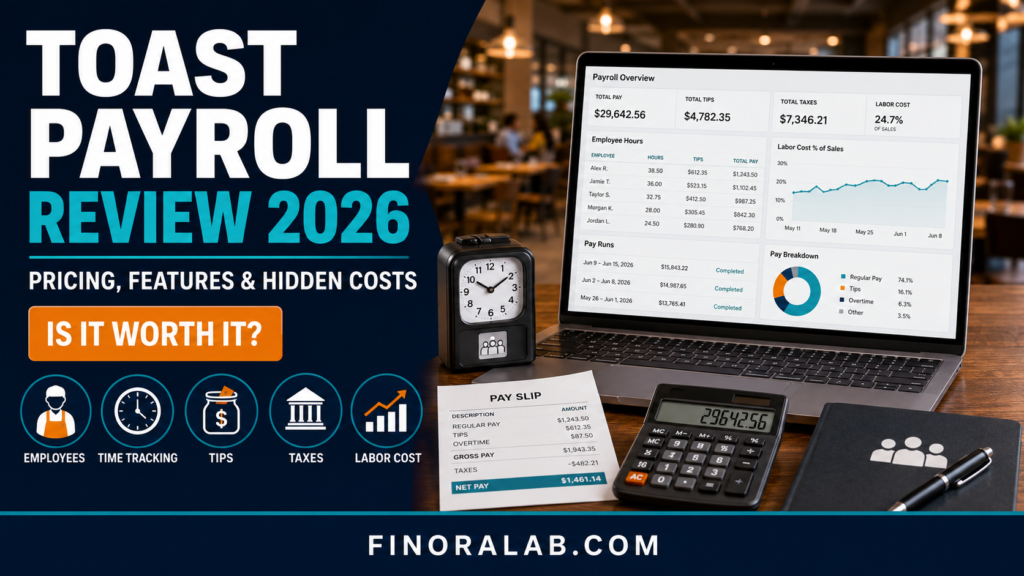
Toast Payroll Review 2026: Pricing, Features & Hidden Costs Revealed
Shanzay Arain·Jul 20, 2026
Running restaurant payroll can be much more complicated than paying employees a fixed salary every two weeks. Restaurants often employ hourly workers who perform different jobs, earn multiple pay rates, receive tips, work overtime, and move between locations.
Toast Payroll is designed to address these hospitality specific challenges by connecting payroll with the Toast restaurant point of sale system. Instead of transferring hours, tips, and employee information between separate platforms, restaurant operators can manage much of this data within the wider Toast ecosystem.
That convenience can reduce manual work, but it does not automatically make Toast Payroll the best option for every restaurant. Subscription costs, implementation requirements, POS dependency, tax responsibilities, support quality, and feature limitations must all be considered.
This independent Toast Payroll review explains how the service works, its major features, current pricing information, benefits, possible disadvantages, setup process, and important payroll tax considerations for 2026.
What Is Toast Payroll?
Toast Payroll and Team Management is a payroll and workforce administration system developed for US restaurants using Toasts technology platform. It combines employee information, hours, tips, pay rates, deductions, and payroll processing with data generated through Toast POS.
The platform is designed to handle restaurant specific situations such as tip payouts, employees working multiple roles, overtime across job types, and different hourly rates for the same worker. These situations can become difficult to manage when timekeeping, point of sale data, and payroll operate independently.
Toast Payroll also includes or connects with employee onboarding, pay stub access, payroll reporting, HR resources, time tracking, and selected benefits tools. Availability may depend on the restaurants subscription, location, agreement, and additional Toast products.
According to Toast, the system is intended primarily for US restaurants that want payroll linked with their point of sale, scheduling, labor, and tip management workflows. Toast Payroll product overview
Quick Summary Table
Category
Important details
Main purpose
Restaurant payroll and workforce management
Best suited for
US restaurants already using or planning to use Toast POS
Advertised starting price
$69 per month plus $9 per employee per month
Main advantage
Payroll data connects with Toast POS, hours, roles and tips
Payroll functions
Wage calculations, deductions, tax administration and payments
Restaurant features
Tip payments, multiple pay rates, overtime and multi location labor data
Employee tools
Mobile onboarding, pay stub access, benefits and tip information
HR support
Restaurant focused HR Toolkit and compliance resources
Customer support
Payroll support by chat and phone seven days a week
Main limitation
Most valuable when used inside the wider Toast ecosystem
Main financial risk
Costs can rise with headcount, locations and additional products
Pricing warning
Final pricing may depend on the restaurants personalized quote and contract
The pricing information above was reviewed on July 20, 2026. Promotions, eligibility requirements, contract terms, and product pricing can change. Request a written quote and review the latest official Toast pricing information before purchasing.
How Toast Payroll Works
Toast Payroll connects restaurant labor data with payroll processing. Employees clock in and out through the Toast environment, while the system records their working hours, jobs, locations, and eligible pay rates.
When the pay period ends, an authorized manager reviews timesheets, shift changes, breaks, tips, overtime, bonuses, deductions, and reimbursements. The manager should correct missing or inaccurate information before approving payroll.
After the information is reviewed, the payroll system calculates each employees gross earnings. It then applies eligible pre tax deductions, payroll tax withholding, post tax deductions, and other adjustments to determine net pay.
The system supports payroll tax administration and creates payroll records and pay stubs. Employees can review information about their compensation, benefits, and tips through Toasts employee tools.
The connection with Toast POS is the central attraction. Toast says timesheets can be embedded in payroll, while the system can flag issues such as missing Social Security numbers, automatic clock outs, and unapproved tips. These alerts may help managers identify incomplete data before wages are processed.
Automation does not transfer all legal responsibility to the software provider. Employers remain responsible for worker classification, accurate records, state registrations, wage and hour compliance, sufficient payroll funds, and reviewing tax filings.
Practical Toast Payroll Example
Consider a restaurant employee who works 25 hours as a server at $8 per hour and 15 hours as a bartender at $14 per hour during the same workweek. The employee also receives eligible tips recorded through the restaurants system.
A basic payroll process may require a manager to export the employees hours, divide them by job, confirm the relevant rates, calculate overtime correctly, record tips, and import everything into a different payroll platform.
With an integrated system, Toast Payroll can receive much of the employees time, role, and tip information from the restaurants Toast environment. The manager reviews the records, resolves exceptions, and then submits the approved data for payroll processing.
The restaurant still needs to verify whether overtime is calculated using the correct regular rate method. When an employee works at multiple rates, overtime can be more complicated than multiplying the highest or lowest hourly rate by 1.5.
State laws, tip credit rules, predictive scheduling laws, meal break requirements, and local wage ordinances may also affect the final calculation. Restaurants should obtain professional guidance when the applicable rules are unclear.
Toast Payroll Pricing and Possible Costs
Toasts pricing page advertised a payroll starting price of $69 per month plus $9 per employee per month when reviewed in July 2026. The page indicated that published pricing applied to new customers and single locations, meaning an established, multi location, or differently configured restaurant may receive another quote.
For a restaurant with 15 employees, the simple starting price calculation would be
Monthly base price $69
Employee charges 15 × $9 = $135
Estimated monthly payroll software cost $204
Estimated annual cost $2,448
This illustration does not include POS subscriptions, hardware, payment processing charges, implementation, additional locations, optional products, taxes, benefits, promotions, or contract specific expenses.
A restaurant with seasonal turnover should ask how Toast defines a billable employee. Confirm whether terminated, inactive, or temporarily unavailable workers continue generating per person charges.
The operator should also determine whether the quoted payroll price includes every required tax filing, year end forms, state unemployment filings, amended returns, garnishments, off cycle payroll, multiple state registrations, and migration assistance.
Do not rely solely on a verbal sales estimate. Ask for a written quote showing the full monthly and one time costs, contract length, renewal terms, cancellation requirements, implementation fees, and charges for additional locations.
Important Toast Payroll Features
Integration with Toast POS
Toast Payrolls primary differentiator is its direct connection with Toast POS. Labor records, timesheets, job information, and tips can move into payroll without the same level of manual exporting and re entry required by disconnected systems.
Integration can reduce data entry work, but managers must still review information. An incorrect clock in, missing break, wrong role, or unapproved tip can affect the employees paycheck if it is not corrected.
Multiple jobs and pay rates
Restaurant employees frequently perform more than one role. A team member might work as a server during lunch and a bartender during dinner, with different rates for each position.
Toast says its payroll platform can handle multiple pay rates for the same employee. This capability is valuable only when every role and wage rate is configured correctly.
Tips and tip pooling
Toast Payroll can send pooled tips to employee paychecks. This may reduce the need for manual cash distribution and provide a clearer record of tips paid through payroll.
Tip pooling is subject to federal and state rules. Employers should not assume that software configuration makes a tip pool legally compliant. Managers must confirm which employees may participate, how funds are allocated, and whether a service charge is legally treated as a tip.
Overtime tracking
The platform tracks and calculates overtime across supported locations and job types. This is especially relevant when employees work different positions or shifts during the same workweek.
Payroll administrators should verify the correct workweek, employee exemption status, total hours, and regular rate. Overtime rules may be affected by bonuses, multiple rates, and state law.
Mobile employee onboarding
New employees can complete selected onboarding paperwork through their phones. This may help restaurants process new hires without keeping workers in an office for lengthy administrative sessions.
Employers should still inspect submitted documents, complete required employment verification procedures, and ensure state new hire reporting is handled properly.
Employee self service
Employees can use the MyToast application to access information about pay stubs, benefits, and tips by shift. Self service may reduce routine questions directed to managers.
Restaurants should establish a secure process for employees who change addresses, tax elections, or bank information. Sensitive updates should be protected against fraud and unauthorized access.
Payroll alerts
Toast Payroll can flag issues such as missing Social Security numbers, unapproved tips, and automatic clock outs. These warnings may help prevent some incomplete records from entering payroll.
Alerts are useful safeguards, but they cannot identify every compliance or data problem. A manager should review exception reports and payroll registers before every submission.
HR resources
Toast offers an HR Toolkit powered by Mineral. It includes restaurant focused HR material, employee handbook templates, regulatory alerts, and answers to common questions.
Templates should be adapted to the restaurants state, city, workforce, and operating practices. They should not be treated as personalized legal advice.
Retirement integration
Toast Payroll integrates with Vestwell 401(k) services to automate selected retirement deductions. This may make it easier to connect employee contributions with payroll.
Retirement plans involve separate administrative, investment, fiduciary, and fee considerations. Restaurant owners should examine the provider agreement and obtain professional advice before offering a plan.
Benefits of Toast Payroll
The biggest potential benefit is reduced manual data transfer. When employee hours, pay rates, jobs, and tips are stored in connected systems, managers may spend less time copying information between platforms.
Restaurant specific design is another advantage. General payroll applications can process hourly workers, but they may require extra configuration or third party integrations to handle the operational details common in hospitality.
The ability to view labor and sales information within the wider Toast environment can support better business decisions. Restaurant operators may compare staffing costs with revenue and identify periods of unusually high labor expense.
Employee self service can improve transparency. Workers can review their pay stubs, tips, and selected benefits information without asking managers to locate every document.
Toast also states that its Payroll Care Team is available through phone and chat seven days a week. Weekend availability may be valuable because many restaurants operate outside traditional office hours.
Finally, using fewer vendors can simplify administration. One relationship for point of sale, labor data, and payroll may be easier to manage than several independent contracts and integrations.
Risks and Possible Disadvantages
Toast Payroll may create stronger dependence on the Toast ecosystem. Restaurants not using Toast POS may receive less value from its most important integration benefits.
Per employee pricing can become expensive as the workforce grows. Restaurants often have high turnover and seasonal hiring, so operators should clarify when employees become billable and how inactive profiles are treated.
Published starting prices may not represent the final expense. Multi location businesses, existing Toast customers, or restaurants needing additional services may receive different terms.
Data errors can also travel quickly through an integrated system. If an employee clocks into the wrong position or a manager approves an incorrect timesheet, the problem may flow directly into payroll.
Changing providers later may require substantial preparation. Restaurants should understand how to export employee records, payroll registers, tax forms, tip reports, and historical data before committing.
No payroll system removes compliance risk completely. Restaurants remain responsible for minimum wages, overtime, tip credits, tip pooling, breaks, predictive scheduling, final paychecks, tax registrations, and worker classification.
Step by Step Guide to Setting Up Toast Payroll
Review your restaurants requirements
Document the number of employees, locations, work states, pay schedules, positions, wage rates, tip policies, deductions, benefits, and accounting needs.
Identify any special requirements such as multiple rates, tipped employees, minors, seasonal workers, garnishments, retirement deductions, or employees working across locations.
Request a detailed quote
Ask Toast for a written proposal based on your actual headcount and number of locations. Confirm the payroll subscription, POS requirements, implementation fees, add ons, contract period, and renewal terms.
Prepare business and tax information
Gather the restaurants legal business name, Employer Identification Number, bank information, addresses, federal tax records, and state or local payroll account numbers.
A company hiring in a new state may need to register with the states tax and unemployment agencies before payroll begins.
Collect employee information securely
You may need each employees legal name, address, Social Security number, Form W 4, state withholding form, hiring date, work location, pay rate, direct deposit information, and benefit elections.
Do not collect or transmit sensitive information through unsecured messages.
Configure jobs and wage rates
Set up every position and rate carefully. Employees performing multiple roles should be assigned correctly so their hours are paid at the proper rates.
Establish tip policies
Document how tips are reported, pooled, allocated, and distributed. Confirm that the policy complies with federal, state, and local requirements.
Import prior payroll records
When changing providers during the year, accurate year to date wage, tax, deduction, and tip information is essential. Incorrect opening balances can affect later tax filings and Forms W 2.
Test time and payroll data
Run a test using representative employees, including someone with multiple roles, overtime, tips, deductions, and time off activity.
Review the first payroll carefully
Check gross wages, hours, tips, taxes, deductions, reimbursements, and net pay for every employee. Verify the total withdrawal and payment date before approval.
Reconcile the results
Compare the payroll register with bank activity, POS labor reports, general ledger accounts, and tax liabilities. Resolve differences immediately.
Common Mistakes to Avoid
Choosing the software without calculating its total annual cost
Assuming the advertised starting price applies to every restaurant
Failing to ask about additional location charges
Setting up incorrect job codes or wage rates
Approving unverified timesheets
Treating service charges and voluntary tips as identical
Misconfiguring tip pools
Calculating overtime from the wrong regular rate
Ignoring hours worked across positions or locations
Using the wrong work state for an employee
Importing inaccurate year to date payroll records
Assuming software replaces professional compliance advice
Failing to reconcile payroll with bank and accounting records
Canceling the old provider before confirming tax and data migration
Neglecting account security and administrator permissions
Latest Toast Payroll and Tax Updates
Toasts official payroll page, updated in July 2026, highlights support for multiple pay rates, payroll tip payouts, overtime across job types and locations, mobile onboarding, MyToast employee access, integrated timesheets, and seven day payroll support. Toast also advertises a median payroll processing time of 15 minutes or less among its Payroll Suite customers, although individual results can vary. Toast Payroll features
For 2026, the IRS states that the Social Security tax rate is 6.2% each for the employer and employee, with a wage base of $184,500. The Medicare rate is 1.45% each, and Medicare has no general wage base limit. IRS Publication 15 for 2026
The 2026 federal withholding rules also address deductions for certain qualified tips and qualified overtime compensation. Qualified cash tips remain generally subject to Social Security and Medicare taxes, even though eligible workers may claim a federal income tax deduction on their personal returns. Mandatory service charges are not treated as qualified tips for that deduction. IRS Publication 15 T for 2026
Restaurant employers should not interpret no tax on tips or no tax on overtime as meaning those earnings can simply be excluded from payroll. Reporting, withholding, eligibility, and employment tax requirements are more complicated than those phrases suggest.
Tax rules, withholding tables, employment laws, and Toasts features may change. Verify important information using Toasts current documents, IRS guidance, state labor and tax agencies, and qualified professionals.
Toast Payroll vs General Payroll Software
A general payroll platform may be more flexible for companies operating in several industries or using a different point of sale provider. It may also offer broader accounting integrations or pricing that better suits a small workforce.
Toast Payrolls main advantage is its restaurant focus and Toast POS connection. Restaurants already committed to Toast may prefer keeping hours, tips, employee roles, and payroll within the same environment.
When comparing providers, use the same criteria for each
Comparison factor
Questions to ask
Total price
What is the annual cost at your real headcount?
Tax filing
Which federal, state and local filings are included?
Restaurant tools
Can it handle tips, multiple rates and overtime?
POS integration
Is the connection native or third party?
Support
When is live payroll assistance available?
Migration
Who imports prior payroll data?
Data access
Can all records be exported easily?
Contract
What are the renewal and cancellation terms?
The right service is not necessarily the platform with the longest feature list. It is the one that handles the restaurants actual payroll requirements reliably at an acceptable total cost.
Expert Tips for Managing Restaurant Payroll
Create a written payroll checklist covering new hires, terminations, hours, breaks, overtime, tips, bonuses, reimbursements, deductions, and bank funding. Use it every pay period.
Require managers to approve timesheets before the payroll deadline. Employees should also have a clear process for reporting missed punches or incorrect roles.
Review labor reports by position and location. Unexpected changes may reveal scheduling problems, excessive overtime, or incorrect job assignments.
Keep enough cash available for net wages, employer taxes, benefits, service fees, and other payroll liabilities. Restaurant revenue can fluctuate, but payroll obligations remain time sensitive.
Restrict administrative access and use strong account security. Payroll systems contain Social Security numbers, bank information, compensation details, and sensitive business records.
Complete a formal payroll reconciliation after every run. Compare the payroll register, bank withdrawal, tax liabilities, and accounting entries rather than assuming an approved payroll is automatically correct.
Finally, involve a qualified payroll accountant or employment professional when introducing tip pools, hiring in a new state, operating multiple locations, or handling complex overtime.
Is Toast Payroll Worth It?
Toast Payroll may be worth considering for a restaurant that already uses Toast POS and wants a more connected way to manage time records, tips, multiple pay rates, onboarding, and payroll.
The value is less clear for businesses outside hospitality or restaurants that use another POS system. Those employers should compare independent payroll platforms that do not require investment in the wider Toast environment.
A restaurant should evaluate the platform using a full year cost estimate, a detailed product demonstration, and a written contract. The best decision will depend on employee count, turnover, locations, payroll complexity, existing technology, and support needs.
Conclusion
Toast Payroll offers a restaurant focused approach to employee payments by connecting payroll with POS labor data, tips, multiple job roles, overtime, and employee onboarding. That integration may save time and reduce repetitive data entry for restaurants already using Toast.However, operators should examine total costs, contract requirements, tax coverage, data portability, and compliance responsibilities before subscribing. Toast Payroll can be a practical solution for an appropriate restaurant, but it still requires accurate setup, careful payroll review, secure administration, and regular financial reconciliation.
Toast Payroll is a restaurant payroll and team management system that connects employee payments with Toast POS data, including hours, job roles, wage rates, overtime, and tips.
How much does Toast Payroll cost?
Toast advertised payroll starting at $69 per month plus $9 per employee per month in July 2026. Actual pricing may vary by customer, location, contract, products, and optional services. Request a current written quote.
Does Toast Payroll file payroll taxes?
Toast Payroll provides payroll tax administration as part of its payroll service. Restaurants should confirm exactly which federal, state, and local filings are included and monitor all filing confirmations.
Can Toast Payroll manage employee tips?
Yes. Toast Payroll can incorporate tip information and send eligible pooled tips through employee paychecks. Restaurant owners remain responsible for creating a legally compliant tip policy.
Can Toast Payroll handle multiple pay rates?
Toast states that its payroll platform can handle different rates when the same employee works multiple jobs. Accurate job assignments and overtime configuration remain essential.
Do I need Toast POS to use Toast Payroll?
Toast Payroll is primarily designed for restaurants using the Toast platform, and its main advantage is its native connection with Toast POS. Confirm current eligibility and technical requirements directly with Toast.
Is Toast Payroll good for small restaurants?
It may be suitable for a small restaurant that wants payroll, time records, tips, and POS data connected in one system. The owner should compare its full annual cost and features with at least two alternatives.
I am a professional finance content writer with expertise in personal finance investing, banking, loans, insurance, credit cards, budgeting, and market related topics. I create clear, SEO optimized, and reader friendly finance content that helps audiences understand complex financial concepts in simple words. My goal is to write trustworthy and engaging content that improves search visibility, builds credibility, and supports business growth.
I am a professional finance content writer with expertise in personal finance investing, banking, loans, insurance, credit cards, budgeting, and market related topics. I create clear, SEO optimized, and reader friendly finance content that helps audiences understand complex financial concepts in simple words. My goal is to write trustworthy and engaging content that improves search visibility, builds credibility, and supports business growth.