
Gross monthly income is one of the most frequently requested numbers on loan, credit card, mortgage, rental and financial assistance applications. Although the calculation may appear simple, many people are uncertain about which income sources to include and whether they should use their earnings before or after taxes.
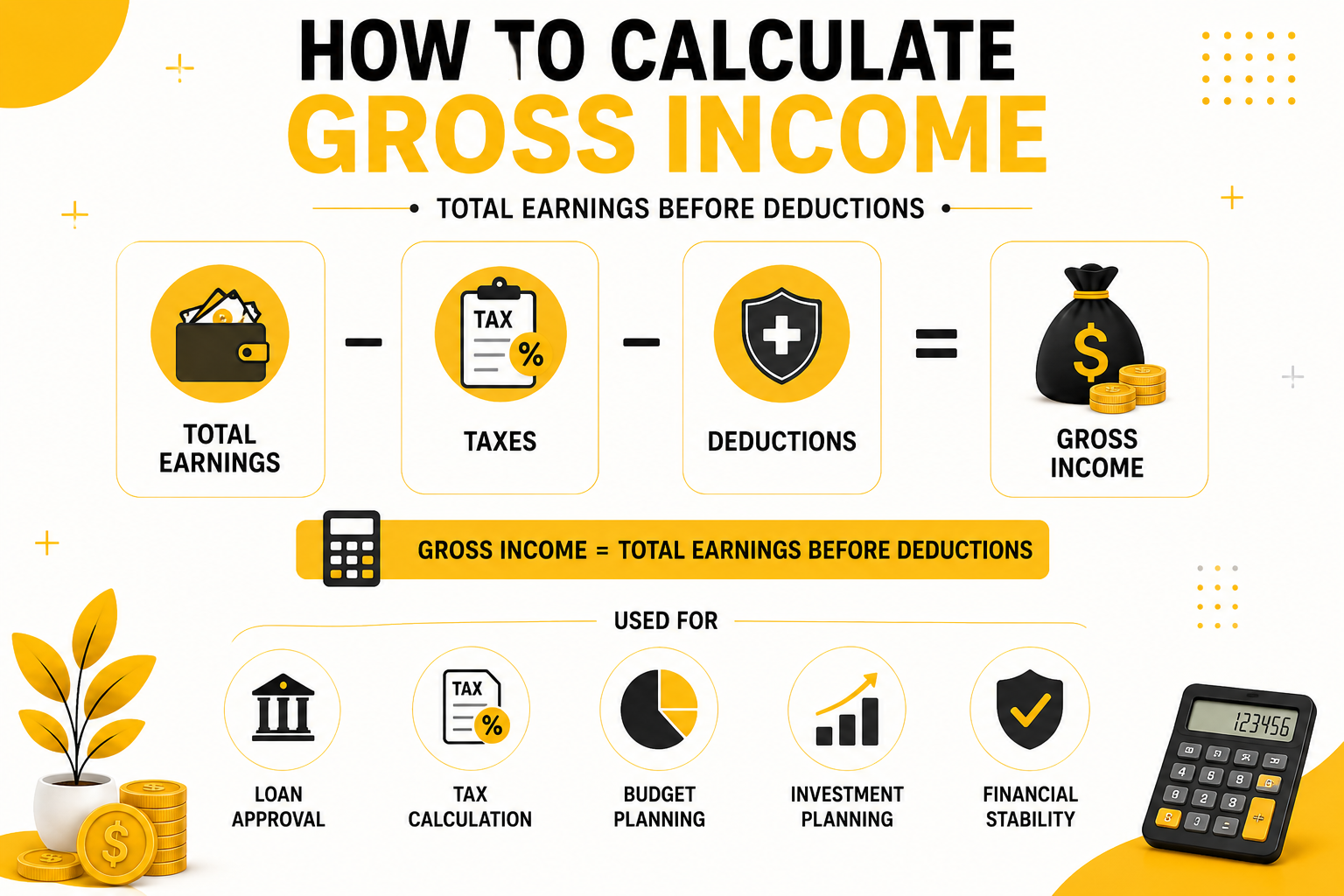
In straightforward terms, gross monthly income is the total amount you earn during a month before taxes, insurance premiums, retirement contributions and other deductions are removed. It may include wages, salaries, overtime, commissions, bonuses and certain additional sources of recurring income.
Understanding this figure can help you complete financial applications accurately, evaluate your borrowing capacity and create a more realistic household budget. It is also essential for calculating your debt to income ratio, which lenders commonly use when assessing whether you can manage additional monthly payments.
This guide explains the gross monthly income formula, provides practical examples and covers calculations for salaried, hourly, self employed and irregular income workers.
What Is Gross Monthly Income?
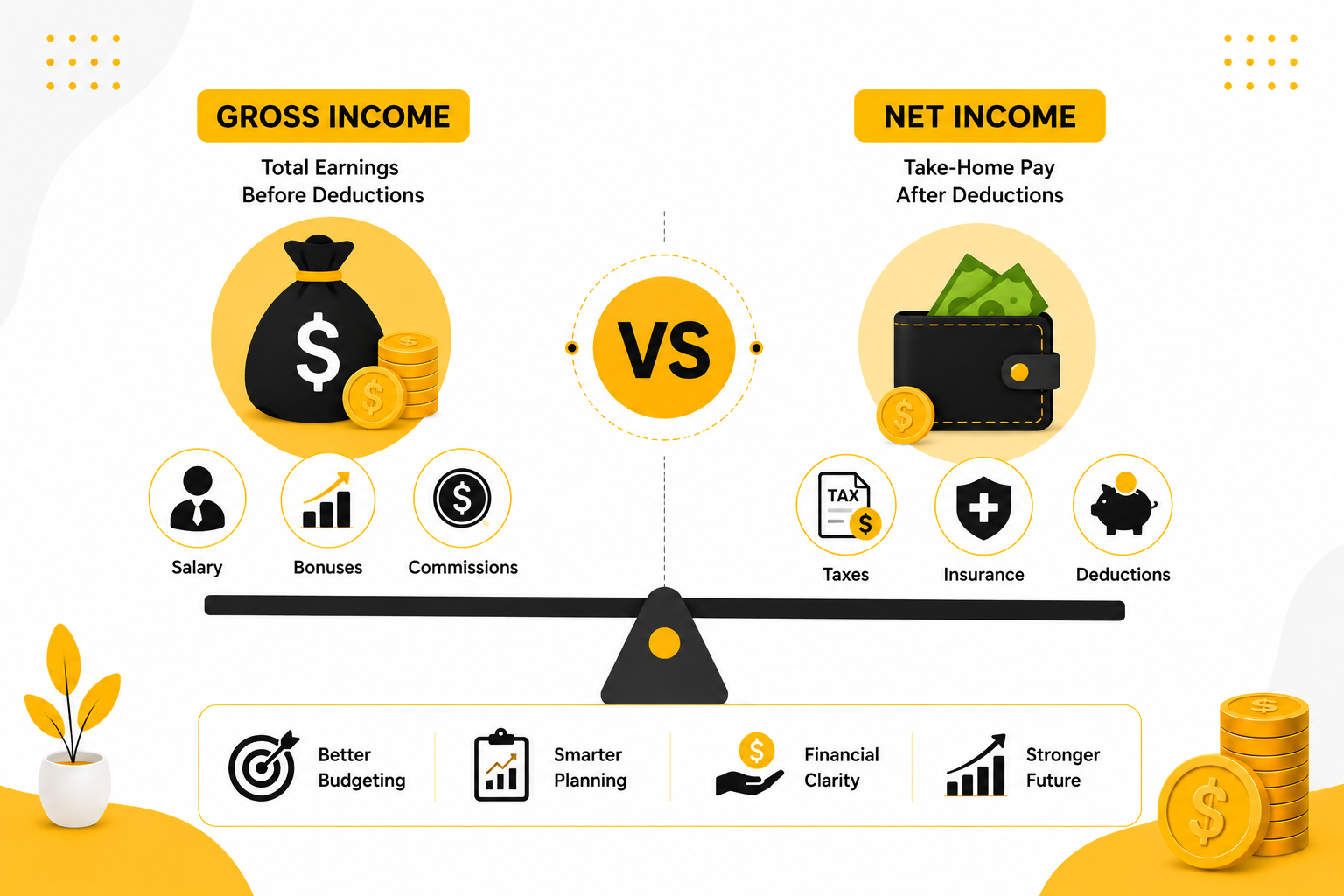
Gross monthly income is your total income for a month before payroll deductions and other expenses. It represents what you earn rather than the amount deposited into your bank account.
For example, suppose an employee earns $5,000 during a month. The employer deducts $700 in taxes, $250 for health insurance and $300 for a retirement plan. The employee receives $3,750 after those deductions.
In this situation
- Gross monthly income $5,000
- Total deductions $1,250
- Net monthly income $3,750
Gross income is generally the figure shown near the top of a pay stub. Net income, sometimes called take home pay, is the amount remaining after deductions.
The Consumer Financial Protection Bureau defines gross monthly income in the debt to income context as the amount earned before taxes and other deductions are taken out. The agency explains that lenders may compare monthly debt payments with this figure when evaluating a borrowers ability to manage a loan. Consumer Financial Protection Bureau
Quick Summary Table
| Topic | Explanation |
| Basic meaning | Total monthly earnings before taxes and deductions |
| Basic formula | Annual gross income ÷ 12 |
| Hourly worker formula | Hourly rate × weekly hours × 52 ÷ 12 |
| Gross versus net | Gross is before deductions net is after deductions |
| Common income sources | Salary, wages, overtime, commissions, bonuses and eligible recurring income |
| Common uses | Loans, mortgages, credit cards, rentals, budgeting and benefit applications |
| Main limitation | Gross income does not show how much money is actually available to spend |
| Important document | Pay stub, tax return, employment letter or income statement |
What Is Included in Gross Monthly Income?
What counts as income can depend on why the calculation is being performed. A household budget may include all reliable income, while a lender or government program may follow a more specific definition.
Common income sources may include
- Regular salary or wages
- Overtime pay
- Commissions
- Tips
- Recurring bonuses
- Freelance or contract earnings
- Net self employment income
- Rental income
- Pension payments
- Certain retirement distributions
- Alimony or child support when applicable and voluntarily disclosed
- Disability or Social Security benefits
- Investment income
- Other recurring and verifiable income
For some official housing programs, the full amount of wages, salaries, overtime, commissions, fees, tips and bonuses may be considered before payroll deductions. However, individual programs can apply exclusions and special rules. U.S. Department of Housing and Urban Development
Not every payment you receive should automatically be treated as recurring gross income. Loan proceeds, transfers between your accounts, reimbursements and money received from selling personal property are generally different from earned or recurring income.
Always use the definition provided on the particular application you are completing.
What May Not Be Included?
Depending on the purpose of the calculation, the following amounts may be excluded or treated differently
- One time gifts
- Money borrowed through a personal loan
- Credit card cash advances
- Transfers from savings
- Expense reimbursements
- Refunds
- Temporary or unverified cash payments
- Proceeds from selling personal possessions
- Certain government benefits
- Income that is unlikely to continue
A lender may allow bonuses, commissions or overtime only when there is sufficient evidence that the income is stable and likely to continue. Similarly, a landlord may ask for several months of records before accepting freelance or gig economy income.
The safest approach is to report income honestly and provide supporting documents. Do not include uncertain income merely to improve an application.
How to Calculate Gross Monthly Income
The correct calculation depends on how you are paid. Salaried employees, hourly workers and self employed individuals may need different methods.
Calculating Monthly Income From an Annual Salary
If you receive a fixed annual salary, divide the annual amount by 12
Gross monthly income = Annual gross salary ÷ 12
Suppose your annual salary is $72,000
$72,000 ÷ 12 = $6,000
Your gross monthly income is $6,000.
This remains your gross amount even if taxes, insurance and retirement contributions reduce the deposit you receive each month.
Calculating Income From a Monthly Salary
If your employment contract already states your monthly salary, the calculation is direct
Gross monthly income = Monthly salary before deductions
For example, if your monthly salary is $4,200 before deductions, your gross monthly income is $4,200.
Add other qualifying and recurring earnings separately if the application permits them.
Calculating Income From a Weekly Paycheck
Multiply weekly gross pay by 52 and divide the result by 12
Gross monthly income = Weekly gross pay × 52 ÷ 12
If you earn $1,000 per week
$1,000 × 52 ÷ 12 = $4,333.33
Your average gross monthly income is approximately $4,333.33.
Avoid simply multiplying weekly income by four. A year contains 52 weeks, while 12 four week periods account for only 48 weeks. Using the annual conversion produces a more accurate monthly average.
Calculating Income From a Biweekly Paycheck
Biweekly employees usually receive 26 paychecks per year
Gross monthly income = Biweekly gross pay × 26 ÷ 12
If your gross pay is $2,000 every two weeks
$2,000 × 26 ÷ 12 = $4,333.33
Your average gross monthly income is approximately $4,333.33.
Calculating Income From Semimonthly Pay
Semimonthly workers receive two paychecks each month, normally resulting in 24 payments per year
Gross monthly income = Semimonthly gross pay × 2
If each gross paycheck is $2,100
$2,100 × 2 = $4,200
Your gross monthly income is $4,200.
Biweekly and semimonthly pay schedules are not the same. Biweekly means every two weeks, while semimonthly generally means twice per calendar month.
Calculating Income for an Hourly Worker
Use your hourly rate and average weekly hours
Gross monthly income = Hourly rate × Weekly hours × 52 ÷ 12
Suppose you earn $25 per hour and work 40 hours per week
$25 × 40 × 52 ÷ 12 = $4,333.33
Your estimated gross monthly income is approximately $4,333.33.
If your working hours change, calculate an average using recent pay stubs rather than assuming that every week contains the maximum number of hours.
How Gross Monthly Income Works Practical Example
Imagine that Sarah receives the following monthly earnings
- Base salary $4,500
- Average commission $600
- Recurring freelance income $400
- One time birthday gift $200
Her relevant gross monthly income may be calculated as
$4,500 + $600 + $400 = $5,500
The birthday gift would not normally be treated as regular earned income because it is a one time personal payment.
Sarahs payroll deductions include $650 in taxes, $200 for health insurance and $250 for retirement contributions. These deductions affect her net pay but do not reduce her gross monthly salary calculation.
Her figures are therefore
- Gross monthly income $5,500
- Payroll deductions $1,100
- Estimated net monthly income $4,400
If a loan application asks for gross income, Sarah would normally report $5,500, subject to the lenders documentation and income eligibility rules.
Gross Monthly Income for Self Employed Workers
Calculating income is more complicated for business owners, freelancers and independent contractors. Business revenue and personal income are not necessarily the same.
Suppose a freelance designer receives $8,000 in monthly client payments but has $3,000 in legitimate business expenses. Treating the entire $8,000 as personal income could overstate the designers financial position.
A simplified calculation would be
Business revenue − Eligible business expenses = Self employment income
In this example
$8,000 − $3,000 = $5,000
The estimated monthly business income is $5,000.
However, lenders and tax authorities may use definitions that differ from a personal budgeting calculation. They may examine tax returns, profit and loss statements, bank statements and multi year income trends. Depreciation, noncash expenses and business debts can also affect underwriting calculations.
Self employed applicants should follow the requesting institutions instructions instead of assuming that gross business receipts equal qualifying personal income.
How to Calculate Irregular Monthly Income
People working in sales, seasonal employment, gig work or project based roles may not receive the same amount every month. In these situations, an average can provide a more useful estimate.
Use this formula
Average gross monthly income = Total qualifying income during the period ÷ Number of months
For example, suppose you earned the following amounts over six months
- Month one $3,800
- Month two $4,500
- Month three $3,200
- Month four $5,000
- Month five $4,100
- Month six $3,400
The total is $24,000
$24,000 ÷ 6 = $4,000
Your six month average gross monthly income is $4,000.
For formal applications, the lender or agency may require a longer calculation period. Some may also exclude income that is too recent, inconsistent or unlikely to continue.
Gross Monthly Income vs. Net Monthly Income
Gross and net income serve different purposes.
| Gross Monthly Income | Net Monthly Income |
| Calculated before deductions | Calculated after deductions |
| Often used by lenders | Better for personal budgeting |
| Usually higher | Usually lower |
| Includes taxes that you do not keep | Reflects take home pay |
| Useful for income comparisons | Useful for spending decisions |
Gross income shows earning capacity, but net income shows the money that may actually reach your account. A person earning $6,000 gross does not necessarily have $6,000 available for housing, debt payments and daily expenses.
When building a household budget, use net income as the starting point. When a lender or landlord specifically requests gross income, use the properly documented pre deduction figure.
Gross Monthly Income vs. Adjusted Gross Income
Gross monthly income should not be confused with adjusted gross income, commonly known as AGI in the United States.
Gross monthly income is a general monthly measure of earnings before common payroll deductions. Adjusted gross income is a tax specific figure calculated after certain permitted adjustments to income. It is generally reported on a tax return and should not be replaced with a casual monthly estimate.
Tax definitions, deductions and reporting requirements can change. Verify current instructions through the relevant tax authority or consult a qualified tax professional before using an income figure for tax reporting.
Why Lenders Use Gross Monthly Income
Lenders use gross income because it creates a relatively consistent starting point for comparing applicants. Payroll deductions can vary significantly based on health plans, retirement contributions, tax withholding choices and other personal circumstances.
One of the most common calculations is the debt to income ratio
Debt to income ratio = Total monthly debt payments ÷ Gross monthly income × 100
Suppose you have
- Gross monthly income $6,000
- Mortgage or rent related debt considered by the lender $1,500
- Auto loan $400
- Student loan $250
- Minimum credit card payments $150
Total monthly debt payments are $2,300
$2,300 ÷ $6,000 × 100 = 38.3%
Your debt to income ratio is approximately 38.3%.
The CFPB explains that lenders use DTI as one way to measure a consumers ability to manage monthly payments. It also notes that requirements differ among lenders and loan products, so there is no universal approval percentage for every application. Consumer Financial Protection Bureau
Where Gross Monthly Income Is Used
You may be asked to provide gross income when applying for
- A home mortgage
- A personal or auto loan
- A credit card
- An apartment or rental property
- Refinancing
- Student financial assistance
- Government benefits
- Affordable housing programs
- Insurance products
- Child support assessments
- Certain tax or legal processes
Housing programs may use their own definitions of annual and monthly income. HUD, for example, indicates that public housing eligibility considers annual gross income, among other factors. U.S. Department of Housing and Urban Development
Therefore, a number calculated for a personal loan application may not always be identical to the income figure required by a housing or benefits program.
Benefits and Limitations
Benefits of Knowing Your Gross Income
Calculating your gross income can help you
- Complete applications more accurately
- Estimate your debt to income ratio
- Compare job offers
- Review compensation changes
- Plan retirement contributions
- Organize financial records
- Understand your overall earning capacity
- Prepare for rental or mortgage applications
It also gives you a stable reference point when your take home pay changes because of taxes, insurance or voluntary payroll deductions.
Limitations and Financial Risks
Gross income can create an overly optimistic picture of affordability. It includes money that may never become available for ordinary spending.
If you choose a home, car or personal loan based only on gross income, you may underestimate the pressure created by taxes, insurance, childcare, transportation, food and other essential expenses.
Variable earnings introduce another risk. A commission heavy employee may have a strong annual average but experience several low income months. Borrowing based on the best month instead of a conservative average can make repayment difficult.
Use gross income for standardized calculations, but use net income and actual expenses when deciding what you can comfortably afford.
Step by Step Guide to Finding Your Gross Monthly Income
Review Your Documents
Gather recent pay stubs, employment contracts, bank records, tax returns and income statements. Self employed workers may also need invoices and profit and loss reports.
Identify Your Pay Frequency
Confirm whether you are paid weekly, biweekly, semimonthly, monthly or annually. Selecting the wrong pay frequency can cause a significant calculation error.
Use Pre Deduction Earnings
Locate the gross pay figure before taxes, retirement contributions, insurance and other deductions.
Convert the Amount to a Monthly Average
Use the appropriate formula
- Annual salary divide by 12
- Weekly income multiply by 52 and divide by 12
- Biweekly income multiply by 26 and divide by 12
- Semimonthly income multiply by two
- Hourly income multiply rate by hours and annualize it
- Variable income total the selected period and divide by its number of months
Add Eligible Recurring Income
Include qualifying commissions, bonuses, freelance income, investment income or other sources only when relevant and permitted.
Exclude Non Income Transactions
Do not count borrowed funds, account transfers or one time personal gifts as earned monthly income unless the applicable rules explicitly require different treatment.
Verify the Applications Definition
Read the instructions before submitting your number. A lender, housing agency and tax authority may each define qualifying income differently.
Common Mistakes to Avoid
Using Net Income Instead of Gross Income
A frequent mistake is entering the paycheck deposit instead of the pre deduction amount. Check your pay stub and use the line marked gross pay when gross income is requested.
Multiplying Weekly Pay by Four
A month does not contain exactly four weeks. Multiply weekly pay by 52 and divide by 12 for a more accurate average.
Confusing Biweekly With Semimonthly Pay
Biweekly employees generally receive 26 payments per year, while semimonthly employees receive 24. The distinction changes the monthly calculation.
Counting Business Revenue as Personal Income
Self employed workers should account for relevant business expenses and follow the institutions verification method.
Using the Highest Earning Month
One unusually strong commission or overtime month may not represent sustainable income. Use a reasonable documented average.
Including Unreliable Income
Do not count expected bonuses, potential client contracts or unconfirmed overtime as if the money has already been earned.
Ignoring Application Instructions
Different institutions can treat tips, bonuses, benefits and investment income differently. Use the definition provided by the organization requesting the information.
Latest Update and Current Guidance
As of July 2026, there is no single universal formula that determines which income sources every lender, landlord or government program must accept. The basic meaning—income before taxes and deductions—remains consistent, but verification and eligibility rules differ.
Current U.S. mortgage regulations require creditors to consider repayment ability, and the applicable framework may involve monthly debt to income or residual income analysis. The CFPBs Regulation Z materials also make clear that the rule does not impose one single DTI threshold across every covered lending decision. CFPB Regulation Z
Loan standards, tax rules, benefit requirements and housing program definitions may change. Readers should confirm current requirements directly with the lender, landlord, tax authority or government agency handling their application.
Expert Tips
- Keep several months of pay stubs and bank records.
- Use conservative averages for commissions and overtime.
- Track both gross and net income separately.
- Build your budget around take home pay, not gross earnings.
- Review your debt to income ratio before applying for credit.
- Maintain updated profit and loss records if self employed.
- Avoid changing figures merely to improve an application.
- Ask the institution which documents it accepts before applying.
- Leave room for emergencies instead of borrowing to the maximum offered.
- Recalculate income after a salary, schedule or employment change.
Conclusion
Gross monthly income is the total amount you earn in an average month before taxes and other deductions. You can calculate it by dividing annual salary by 12, converting weekly or biweekly earnings into a monthly average, or averaging irregular income over an appropriate period.Although gross monthly income is useful for loans, mortgages, rentals and financial comparisons, it does not equal spendable income. Use verified gross earnings on formal applications, but rely on net income and real household expenses when making affordability decisions.
You may also read more blogs
FAQs
What does gross monthly income mean?
Gross monthly income is your total income for one month before taxes, insurance, retirement contributions and other deductions are removed.
How do I calculate gross monthly income from annual salary?
Divide your annual gross salary by 12. For example, an annual salary of $60,000 equals $5,000 in gross monthly income.
Is gross monthly income before or after taxes?
It is calculated before taxes. Income remaining after taxes and deductions is known as net income or take home pay.
Does gross monthly income include overtime?
It may include overtime when it is earned consistently and the organization requesting the information accepts it. A lender may request employment history or pay stubs to verify that it is likely to continue.
Should I include bonuses in gross monthly income?
Regular, documented bonuses may be included in some calculations. One time or uncertain bonuses should not automatically be treated as reliable monthly income.
How do I calculate gross monthly income if I am paid hourly?
Multiply your hourly rate by average weekly hours, multiply that result by 52 and divide by 12. Use an average of recent hours if your schedule changes.
Why do lenders use gross income instead of net income?
Gross income provides a standardized starting point because taxes and voluntary payroll deductions differ between applicants. Lenders may use it to calculate DTI, while also reviewing credit, debts, assets, expenses and other underwriting factors.

I am a professional finance content writer with expertise in personal finance investing, banking, loans, insurance, credit cards, budgeting, and market related topics. I create clear, SEO optimized, and reader friendly finance content that helps audiences understand complex financial concepts in simple words. My goal is to write trustworthy and engaging content that improves search visibility, builds credibility, and supports business growth.