Understanding how to calculate gross income is one of the most important financial skills for employees freelancers business owners and even students entering the workforce. Whether you are applying for a loan filing taxes planning a budget or using online finance tools gross income plays a major role in your financial life.
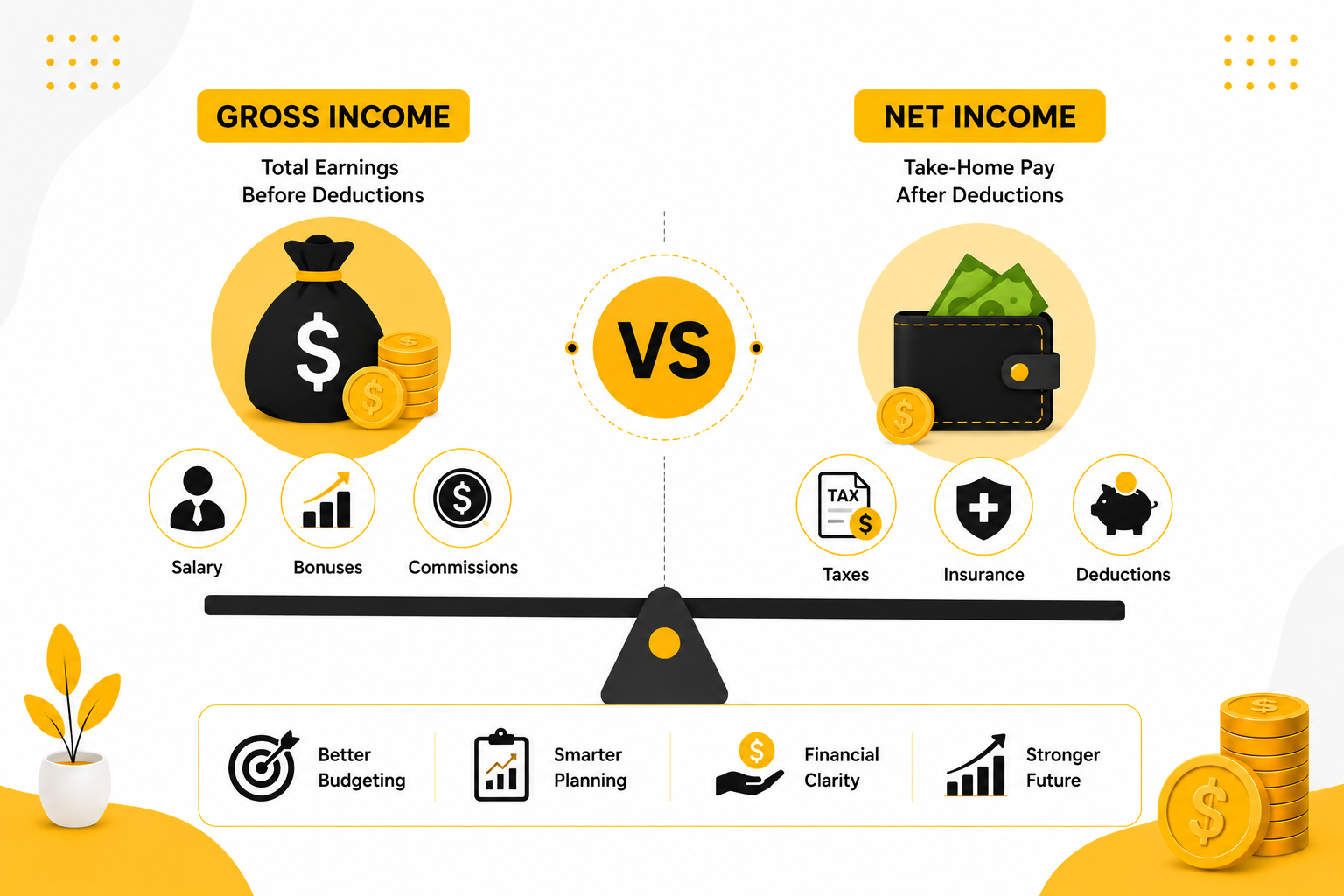
Many people confuse gross income with net income but the difference between the two can significantly affect budgeting decisions tax planning and financial goals. Gross income represents your total earnings before deductions such as taxes insurance retirement contributions or loan repayments are taken out.
In today’s modern financial environment banks lenders employers and investment platforms regularly evaluate gross income to determine financial eligibility. It is also one of the most commonly used figures in tools like loan calculators tax calculators and budgeting apps.
This guide from FinoraLab explains how to calculate gross income in a simple and practical way. You will learn the formulas examples real-world applications common mistakes and how financial calculators make the process easier.
Key Takeaways
- Gross income is the total amount earned before taxes and deductions.
- Employees and self-employed individuals calculate gross income differently.
- Gross income is used for taxes loans budgeting and investment planning.
- Understanding gross income helps improve financial decision-making.
- Finance calculators simplify income-related calculations and projections.
- Knowing your gross income helps compare job offers and manage expenses better.
What Is Gross Income?
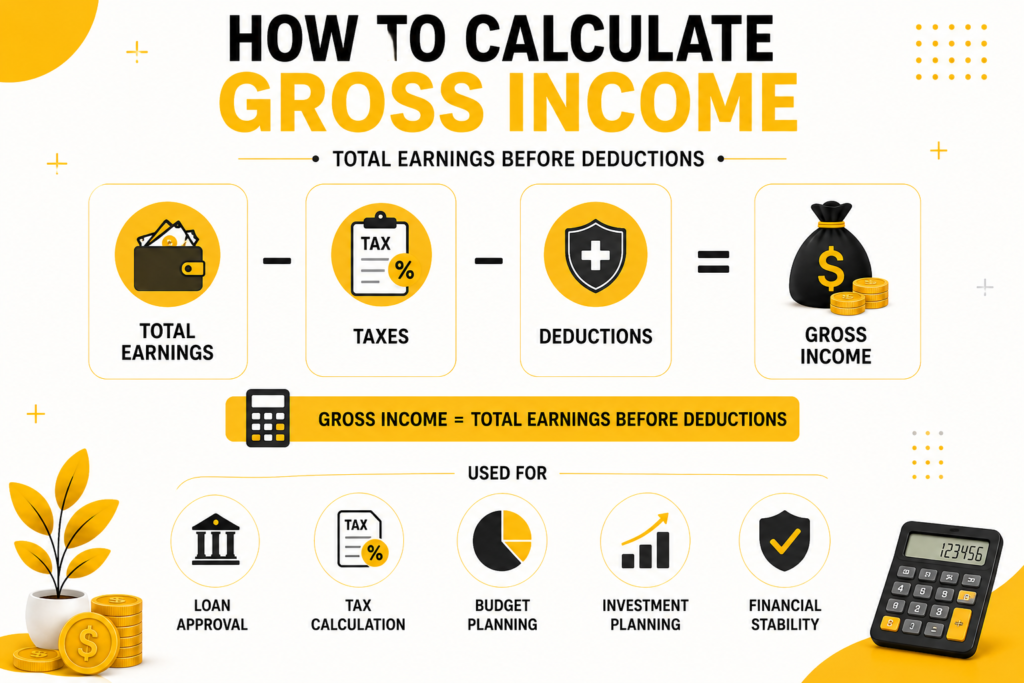
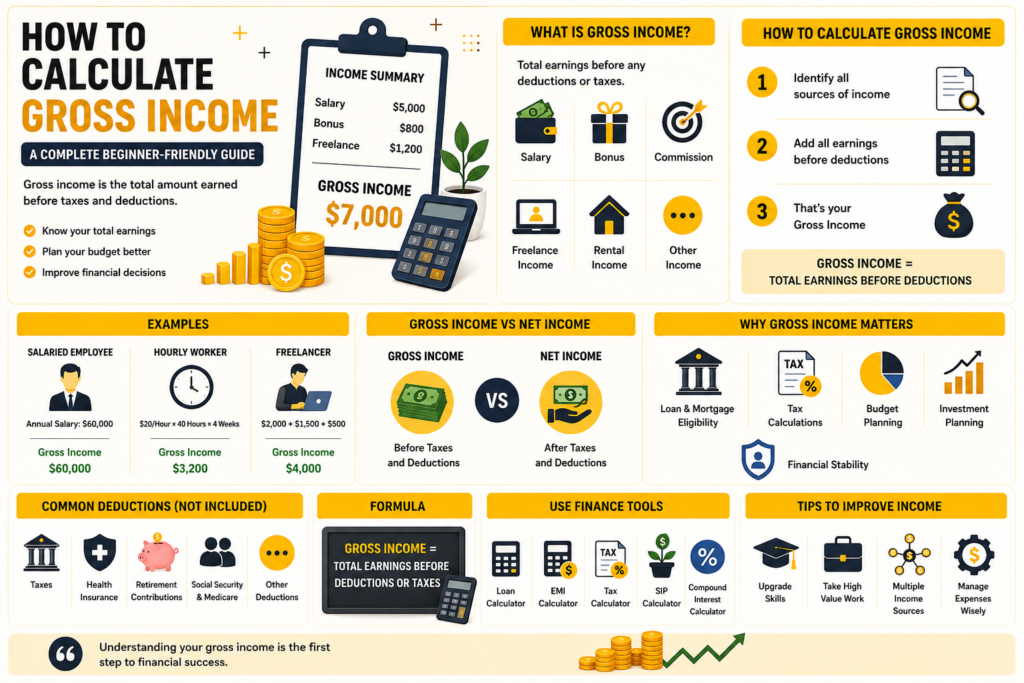
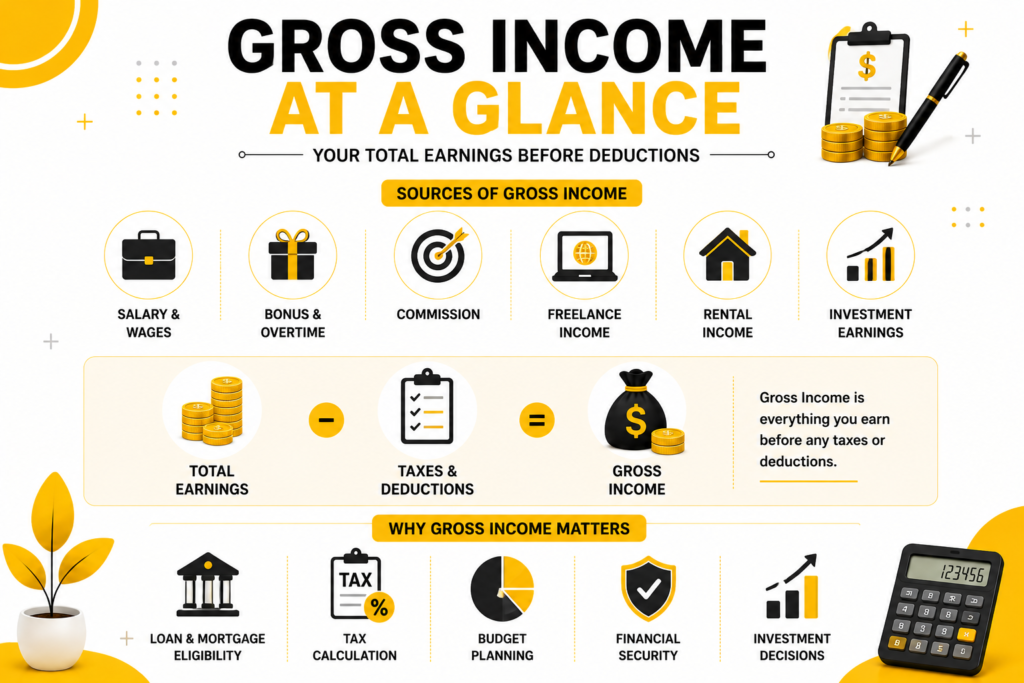
Gross income refers to the total amount of money earned before any deductions are taken out. It includes wages salaries bonuses commissions rental income freelance income investment earnings and other revenue sources.
For employees gross income is usually listed at the top of a paycheck before deductions appear. For business owners or freelancers gross income represents total revenue earned before expenses and taxes.
In simple terms:
- Gross income = Total earnings before deductions
- Net income = Income remaining after deductions
Understanding this distinction is essential because many financial institutions use gross income instead of net income when evaluating applications for mortgages credit cards car loans or personal loans.
Why Gross Income Matters in Personal Finance
Gross income is much more than a number on your paycheck. It directly affects several financial areas including:
Loan Eligibility
Banks use gross income to calculate debt-to-income ratios. A higher gross income may improve approval chances for mortgages and loans.
Tax Calculations
Tax authorities calculate taxable income based partly on gross income.
Budget Planning
Understanding gross income helps individuals estimate spending limits and savings goals.
Investment Planning
Investors often evaluate income levels before choosing investment strategies.
Retirement Contributions
Many retirement plans calculate contributions using gross earnings.
How to Calculate Gross Income for Employees
For salaried employees calculating gross income is usually straightforward.
Gross Income Formula for Salaried Employees
\text{Gross Income} = \text{Salary Before Deductions}
If you receive a fixed annual salary your gross income is your total yearly salary before taxes or deductions.
Example
Suppose your annual salary is $60000.
Your gross income is:
- Annual Gross Income = $60000
- Monthly Gross Income = $5000
- Weekly Gross Income = approximately $1154
This amount does not include deductions for taxes health insurance or retirement contributions.
How Hourly Workers Calculate Gross Income
Hourly employees calculate gross income differently because earnings depend on hours worked.
Gross Income Formula for Hourly Workers
\text{Gross Income} = \text{Hourly Rate} \times \text{Hours Worked}
Example
Imagine you earn $20 per hour and work 40 hours weekly.
Calculation:
- Weekly Gross Income = $20 × 40
- Weekly Gross Income = $800
If overtime exists additional calculations are needed.
Including Overtime
Suppose overtime pay is 1.5 times the regular rate.
- Regular Pay = $20 × 40 = $800
- Overtime Rate = $20 × 1.5 = $30
- Overtime Pay = $30 × 5 = $150
Total Gross Income:
- $800 + $150 = $950
How Self-Employed Individuals Calculate Gross Income
Freelancers contractors and business owners calculate gross income differently from employees.
Formula for Self-Employed Gross Income
\text{Gross Income} = \text{Total Revenue Earned Before Expenses}
Example
A freelance graphic designer earns:
- Client A = $2000
- Client B = $1500
- Client C = $500
Total Gross Income:
- $2000 + $1500 + $500 = $4000
Business expenses are not deducted when calculating gross income.
Gross Income vs Net Income
One of the biggest financial misunderstandings involves gross income and net income.
| Feature | Gross Income | Net Income |
| Definition | Earnings before deductions | Earnings after deductions |
| Includes Taxes | Yes | No |
| Used for Loans | Frequently | Sometimes |
| Appears on Paychecks | Top section | Final amount |
| Useful for Budgeting | Partially | More accurate |
Gross income shows total earning power while net income reflects actual take-home pay.
Common Sources of Gross Income
Gross income can come from multiple income streams.
Employment Income
- Salaries
- Wages
- Bonuses
- Overtime pay
- Commissions
Investment Income
- Dividends
- Interest income
- Rental income
- Capital gains
Business Income
- Freelance earnings
- Online business revenue
- Consulting income
- Service fees
Other Income Sources
- Royalties
- Pension income
- Side hustle earnings
Pre-Tax Deductions and Their Impact
Many people assume deductions reduce gross income but that is not always true.
Common deductions include:
- Health insurance
- Retirement contributions
- Federal taxes
- State taxes
- Social security contributions
Gross income remains the original amount earned before these deductions.
Monthly Gross Income vs Annual Gross Income
Gross income may be calculated monthly annually weekly or biweekly.
Annual Gross Income
Total earnings over one year.
Monthly Gross Income
Annual income divided by 12.
Example
If annual salary equals $72000:
\text{Monthly Gross Income} = \frac{72000}{12}
Monthly Gross Income = $6000
How Gross Income Is Used in Loan Applications
Lenders use gross income to evaluate financial stability.
Mortgage Loans
Mortgage providers compare monthly debt obligations with gross monthly income.
Car Loans
Auto lenders review gross income to determine repayment capacity.
Credit Cards
Credit card companies may request annual gross income during applications.
A stable and higher gross income often improves approval chances.
Debt-to-Income Ratio and Gross Income
Debt-to-income ratio measures how much debt exists compared to income.
Formula
\text{Debt-to-Income Ratio} = \frac{\text{Monthly Debt Payments}}{\text{Gross Monthly Income}} \times 100
Example
Suppose:
- Monthly Debt Payments = $1500
- Gross Monthly Income = $5000
Calculation:
- DTI = (1500 ÷ 5000) × 100
- DTI = 30%
Lower debt-to-income ratios generally improve borrowing opportunities.
Gross Income and Taxable Income
Gross income and taxable income are not always identical.
Taxable income may exclude:
- Certain retirement contributions
- Tax deductions
- Tax credits
- Business expenses
However gross income remains the starting point for most tax calculations.
Using a Tax Calculator can simplify these calculations significantly.
Real-World Example of Gross Income Calculation
Consider Sarah a marketing specialist.
She earns:
- Base Salary = $55000
- Annual Bonus = $5000
- Freelance Income = $4000
Total Gross Income:
55000 + 5000 + 4000 = 64000
Sarah’s gross annual income equals $64000 before deductions.
Gross Income for Businesses
Businesses also use gross income calculations though terminology may vary.
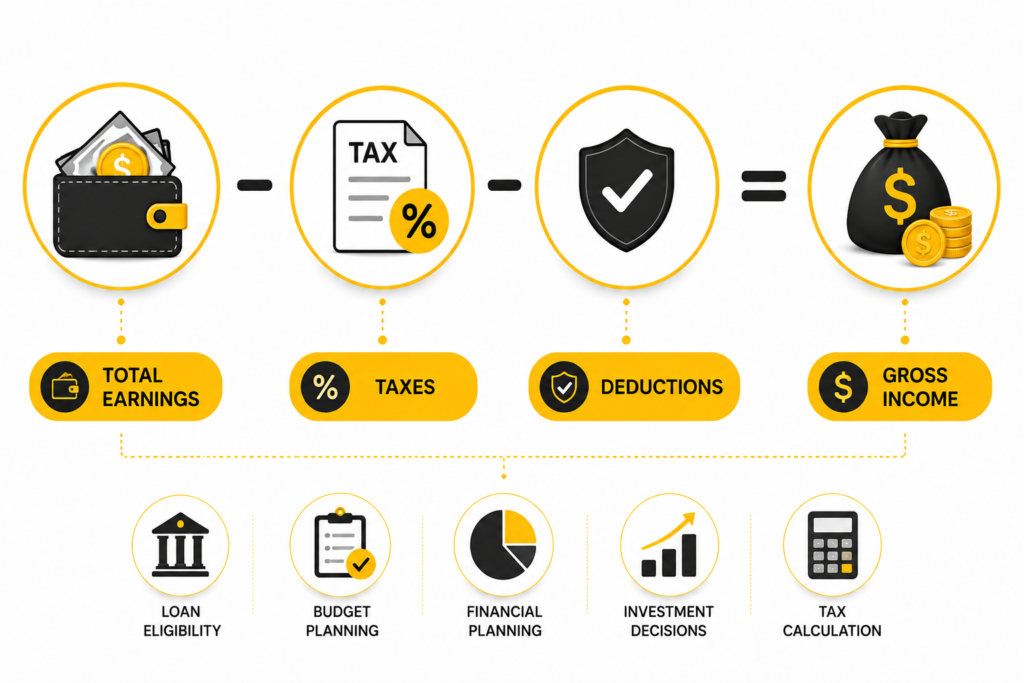
For companies gross income often refers to revenue remaining after subtracting production costs.
Business Gross Income Formula
\text{Gross Income} = \text{Revenue} – \text{Cost of Goods Sold}
Example
A store generates:
- Revenue = $100000
- Cost of Goods Sold = $40000
Gross Income = $60000
This figure helps businesses analyze profitability.
Common Mistakes When Calculating Gross Income
Even simple income calculations can become confusing.
Ignoring Bonuses or Overtime
Many employees forget additional earnings.
Confusing Gross and Net Income
Take-home pay is not gross income.
Forgetting Multiple Income Sources
Freelancers and side hustlers often overlook secondary income streams.
Deducting Taxes Too Early
Taxes should not be removed when calculating gross income.
How Finance Calculators Simplify Gross Income Calculations
Modern finance tools save time and reduce mistakes.
Tax Calculator
Helps estimate taxes based on gross income.
Loan Calculator
Uses gross income to estimate borrowing power.
EMI Calculator
Shows monthly loan payments relative to income.
ROI Calculator
Measures returns from investments.
SIP Calculator
Projects wealth growth from regular investments.
Compound Interest Calculator
Estimates long-term investment growth.
For example compound interest calculations use formulas such as:
genui{“math_block_widget_always_prefetch_v2”:{“content”:”A = P\left(1+\frac{r}{n}\right)^{nt}”}}
Where:
- A = Final investment amount
- P = Initial investment
- r = Annual interest rate
- n = Number of compounding periods
- t = Number of years
These tools help individuals understand how income connects to savings and future wealth.
Historical Importance of Gross Income in Finance
Gross income has long been a central concept in banking and taxation.
Governments historically used income measurements to determine tax responsibilities. Over time lenders adopted gross income analysis to assess repayment ability.
Today digital banking systems and finance apps automatically calculate gross income for millions of users worldwide.
The rise of gig economy jobs and freelance work has made understanding gross income even more important because income sources are now more diverse than ever.
Gross Income in Budget Planning
Budgeting starts with understanding income accurately.
A common budgeting approach involves:
- Calculating gross income
- Estimating taxes
- Determining net income
- Allocating spending categories
Without knowing gross income financial planning becomes unreliable.
People often use the 50/30/20 budgeting rule:
- 50% for necessities
- 30% for wants
- 20% for savings
Gross income provides the starting framework for these calculations.
How Investors Use Gross Income Information
Investment companies sometimes evaluate gross income before approving certain accounts or financial products.
Higher income levels may influence:
- Risk tolerance assessments
- Margin account eligibility
- Mortgage-backed investments
- Retirement contribution limits
Financial advisors also use income data to build personalized investment strategies.
Advantages of Understanding Gross Income
Learning how to calculate gross income provides several benefits.
Better Financial Awareness
People understand exactly how much they earn before deductions.
Improved Loan Readiness
Borrowers can estimate approval chances more accurately.
Smarter Budgeting
Income planning becomes more realistic.
Easier Tax Preparation
Tax filing becomes more organized and less stressful.
Stronger Salary Negotiation
Employees can compare compensation packages properly.
Limitations of Gross Income
Although useful gross income has limitations.
Does Not Reflect Actual Spending Power
Taxes and deductions reduce take-home pay significantly.
May Create Budgeting Errors
People who rely only on gross income may overspend.
Not Always Equal to Taxable Income
Tax laws may exclude certain earnings.
Because of this both gross income and net income should be considered together.
Things to Know Before Calculating Gross Income
Before calculating gross income keep these points in mind:
- Include all income sources
- Use pre-tax figures
- Count bonuses and commissions
- Separate business expenses from revenue
- Track irregular earnings carefully
Accurate calculations improve financial decision-making.
Real-World Applications of Gross Income
Gross income affects many daily financial activities.
Banking
Banks use income data to evaluate loan applications.
Real Estate
Landlords may require proof of gross monthly income.
Insurance
Insurance providers sometimes assess earnings when determining coverage options.
Investing
Income affects contribution limits for retirement accounts.
Government Programs
Eligibility for benefits may depend partly on income levels.
Understanding gross income helps individuals navigate these systems confidently.
Conclusion
Learning how to calculate gross income is a foundational financial skill that affects nearly every aspect of personal and business finance. Whether you are earning a salary working hourly freelancing or running a business knowing your gross income helps you understand your financial position clearly.
Gross income plays a major role in taxes budgeting loan approvals investments and long-term financial planning. While it does not reflect actual take-home pay it remains one of the most important figures used throughout the financial industry.
As financial tools and online calculators become more advanced calculating gross income has become easier than ever. Still understanding the logic behind the numbers gives you greater confidence and control over your money.
By mastering gross income calculations you can make smarter financial decisions prepare for major expenses and build a stronger financial future.
FAQs
What is gross income in simple words?
Gross income is the total amount of money earned before taxes and deductions are removed.
How do I calculate monthly gross income?
Divide your annual salary by 12 or add all monthly earnings before deductions.
Is gross income before taxes?
Yes gross income always refers to earnings before taxes and deductions.
What is the difference between gross income and net income?
Gross income is total earnings before deductions while net income is the amount left after deductions.
Does gross income include bonuses?
Yes bonuses commissions overtime pay and additional earnings are included in gross income.
Why do lenders use gross income?
Lenders use gross income to measure repayment ability and assess financial stability.
Can freelancers calculate gross income?
Yes freelancers calculate gross income by adding all earnings before expenses and taxes.
Is gross income the same as taxable income?
Not always. Taxable income may exclude deductions credits or specific exemptions.

I am a professional finance content writer with expertise in personal finance investing, banking, loans, insurance, credit cards, budgeting, and market related topics. I create clear, SEO optimized, and reader friendly finance content that helps audiences understand complex financial concepts in simple words. My goal is to write trustworthy and engaging content that improves search visibility, builds credibility, and supports business growth.