
A free CD calculator helps you estimate how much interest you could earn from a certificate of deposit (CD) and how much money you may receive when it matures. Enter your initial deposit, annual percentage yield (APY), and CD term to calculate your estimated interest and final balance.
A certificate of deposit is a savings product offered by banks and credit unions. You deposit money for an agreed period in exchange for interest. In return, you generally agree to leave the money in the account until maturity or pay an early withdrawal penalty.
Use the calculator to compare different deposit amounts, interest rates, and CD terms before choosing an account.
Key takeaways
- Calculate potential CD interest without paying for a calculator.
- Estimate your total balance at the end of a CD term.
- Compare different APYs and deposit amounts.
- Understand how compounding affects your earnings.
- Check early withdrawal penalties, taxes, and maturity rules before opening a CD.
Free CD calculator
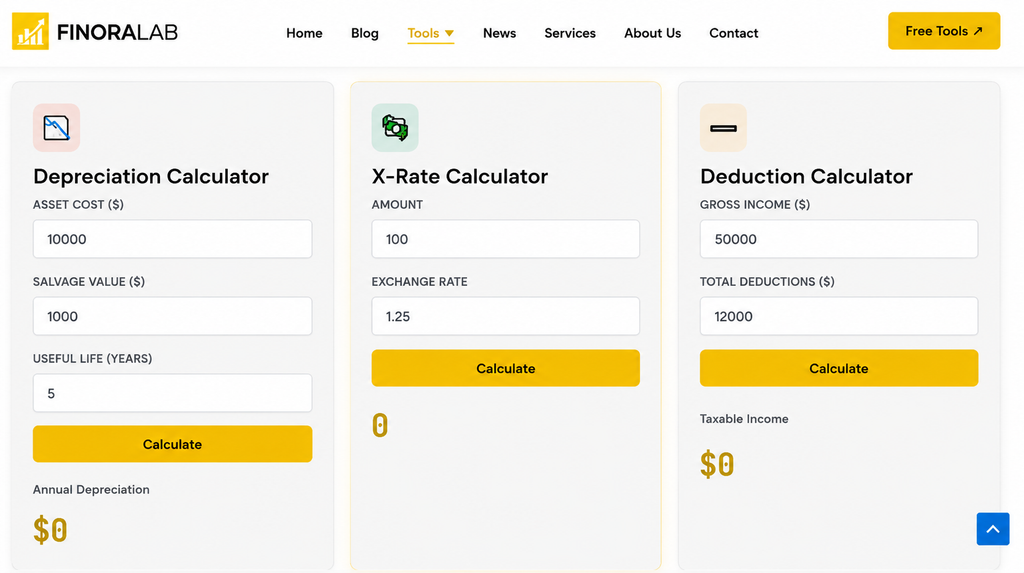
[INSERT WORKING CD CALCULATOR HERE]
Your calculator should include these inputs
| Calculator input | What to enter |
| Initial deposit | Amount you plan to invest |
| Annual percentage yield (APY) | APY offered by the financial institution |
| CD term | Number of months or years |
| Compounding method (optional) | Daily, monthly, quarterly, or the banks stated method |
The calculator should display
- Initial deposit
- Estimated interest earned
- Estimated maturity balance
- CD term
- APY used
Example If you deposit $5,000 into a CD with a hypothetical 4% APY for one year, your estimated interest is $200. Your estimated maturity balance is $5,200 before taxes, assuming the stated APY applies throughout the term.
This is an illustrative calculation, not a current bank offer or guaranteed return.
How does a free CD calculator work?
The calculator uses your deposit, APY, and investment period to estimate compound interest.
The result helps you understand the relationship between your savings amount, the interest rate, and the time your money remains in the CD.
CD compound interest formula
The standard compound interest formula is
A=P1+rnnt
Where
- A = Final account balance
- P = Initial deposit
- r = Annual nominal interest rate as a decimal
- n = Number of compounding periods per year
- t = Number of years
To calculate your interest
Interest=A P
If your bank advertises APY instead of a nominal interest rate, you can use this formula for a whole number of years
A=P(1+APY)t
Important APY already includes the effect of compounding. Do not apply another compounding adjustment to it.
For a partial year estimate, you can use the following approximation
AP(1+APY)d/365
Here, d represents the number of days. Your banks actual maturity calculation may differ because of its day count convention and account terms.
Example 1 Calculate interest on a $2,000 CD
Suppose you deposit $2,000 into a one year CD with a hypothetical 3% APY.
Calculation
A=2000(1+0.03)
\[ A=\$2,060 \]
Your estimated earnings are
\[ 2060 2000=\$60 \]
| Detail | Amount |
| Initial deposit | $2,000 |
| APY | 3% |
| Term | 1 year |
| Interest earned | $60 |
| Final balance | $2,060 |
Example 2 Calculate interest on a $10,000 CD
Suppose you deposit $10,000 into an 18 month CD with a hypothetical 4% APY.
Convert the term into years
1812=1.5
Calculate the estimated maturity balance
A10000(1.04)1.5
\[ A\approx\$10,604.04 \]
| Detail | Amount |
| Initial deposit | $10,000 |
| APY | 4% |
| Term | 18 months |
| Estimated interest | $604.04 |
| Estimated balance | $10,604.04 |
These are illustrative calculations, not current bank offers. The actual amount depends on the CD agreement and interest crediting method.
What information do you need to use a CD calculator?
You only need a few details to get a useful estimate.
Initial deposit Enter the amount you plan to deposit. A larger deposit generally earns more interest when the APY and term are unchanged.
Annual percentage yield Use the APY shown in the banks official CD offer. Do not substitute a different banks advertised rate.
CD term Enter the length of the deposit agreement. It may be expressed in months or years.
Compounding frequency If the calculator requests a nominal interest rate, you may also need the compounding frequency. If it uses APY, a separate compounding frequency is generally unnecessary for a whole year APY based estimate.
APY vs. interest rate what should you enter?
APY and interest rate are related, but they are not interchangeable.
| Term | Meaning |
| Interest rate | The stated annual rate used to calculate interest |
| APY | The annualized yield that reflects compounding |
| Compounding | The process of earning interest on previously credited interest |
For example, two banks could advertise the same nominal interest rate but offer different APYs because their compounding schedules differ.
When comparing CDs, APY is generally the more useful figure because it accounts for compounding.
You can review deposit account disclosure requirements through the Consumer Financial Protection Bureaus Regulation DD.
What affects your CD interest earnings?
Several factors influence the amount you may receive at maturity.
Deposit amount
Your starting balance affects how much interest you can earn.
For example, at a hypothetical 4% APY for one year
| Deposit | Estimated interest | Final balance |
| $1,000 | $40 | $1,040 |
| $5,000 | $200 | $5,200 |
| $10,000 | $400 | $10,400 |
| $20,000 | $800 | $20,800 |
CD interest rate
A higher APY generally produces higher earnings when the deposit amount and term are identical.
Compare offers from different financial institutions using the same deposit amount and maturity period.
CD length
CDs have different maturity periods. A longer term does not automatically mean a higher APY.
Compare the available terms and consider when you might need access to your money.
Compounding frequency
Interest may compound daily, monthly, quarterly, or according to another schedule.
If you use a nominal interest rate, the compounding frequency affects the calculation. If you use APY, the compounding effect is already reflected in that figure.
Early withdrawal penalty
Many traditional CDs charge a penalty if you withdraw money before maturity.
The amount depends on the financial institutions agreement. It may reduce some or all of your earned interest.
Check the banks official disclosure before opening an account.
CD vs. high yield savings account
A CD and a high yield savings account can both help you earn interest on your savings. However, they offer different levels of flexibility.
| Feature | CD | High yield savings |
| Interest rate | Often fixed for the term | Usually variable |
| Maturity date | Yes | No |
| Early withdrawal penalty | May apply | Generally no CD style penalty |
| Access to money | Restricted by account terms | Generally more flexible |
| Interest earnings | Based on the CD terms | Based on the changing APY |
Choose a CD if you have money you can leave deposited until maturity and prefer a stated rate for the term.
Consider a high yield savings account if you want easier access to your savings and can accept a variable interest rate.
Neither option is automatically better. Your decision should depend on your savings goal, access needs, and the actual account terms.
Are CDs FDIC insured?
CDs held at FDIC insured banks are generally covered by federal deposit insurance.
The standard FDIC coverage limit is $250,000 per depositor, per insured bank, per ownership category. The limit applies to eligible deposits combined within the same ownership category at the same bank.
For example, your checking account, savings account, and CDs may all count toward the same coverage limit if they share the same ownership category.
Credit union CDs may instead be insured by the National Credit Union Administration (NCUA), subject to its coverage requirements.
Before depositing money, check the institutions insurance status and your total eligible deposits.
Official resources
- FDIC deposit insurance information
- FDIC Electronic Deposit Insurance Estimator
- National Credit Union Administration
fdic.gov+3
Are CD earnings taxable?
Generally, interest earned on a CD is taxable for federal income tax purposes.
The timing of taxation depends on the CDs interest payment arrangement. Some deferred interest CDs have special tax rules.
Keep these points in mind
- Your calculator generally shows interest before taxes.
- Your actual after tax earnings depend on your tax circumstances.
- Early withdrawal penalties do not necessarily eliminate the requirement to report interest.
- Certain qualifying early withdrawal penalties may be deductible as an adjustment to income.
The IRS explains CD interest and deferred interest rules in Publication 550. Consider checking with a qualified tax professional if your CD has unusual interest or redemption terms.
Internal Revenue Service
Common CD calculator mistakes to avoid
A calculator is only useful when you enter the correct information.
- Using the wrong rate Enter APY if the calculator requests APY, not the nominal interest rate.
- Double counting compounding Do not compound APY again.
- Entering the wrong term Check whether the calculator expects months, years, or days.
- Ignoring withdrawal penalties Your early withdrawal balance may be lower than the projected maturity balance.
- Forgetting taxes Estimated interest is generally not the same as after tax earnings.
- Assuming automatic renewal is beneficial A renewed CD may have a different APY and term. Review the maturity notice and renewal conditions.
Who should use a free CD calculator?
A free CD calculator can be useful if you
- Want to estimate earnings before opening a CD.
- Have savings you do not expect to need immediately.
- Want to compare different APYs.
- Are deciding between different maturity periods.
- Need to estimate the balance available for a future expense.
A traditional CD may be less suitable if you regularly need access to your savings, have no separate emergency savings, or cannot accept an early withdrawal penalty.
Use the calculator as an educational comparison tool, not as a substitute for reviewing the financial institutions actual agreement.
Conclusion
A free CD calculator makes it easier to estimate interest earnings, compare APYs, and understand how your savings may grow over a specific term.Before opening a CD, enter your deposit amount, use the banks advertised APY, and compare different maturity periods. Then review the accounts early withdrawal penalty, renewal policy, and insurance coverage. Use the calculator above to compare at least two CD offers with the same deposit amount and term.
You may also read more blogs
FAQs
Is there a free CD calculator?
Yes. A free CD calculator lets you estimate certificate of deposit interest and maturity value without paying for a calculation tool. You typically enter your deposit, APY, and CD term.
How much interest will a $10,000 CD earn?
It depends on the APY and term. For example, a $10,000 CD with a hypothetical 4% APY for one year would earn approximately $400, giving you a total of $10,400 before taxes.
How do I calculate CD interest?
You can use the compound interest formula
A=P1+rnnt
Subtract your initial deposit from the final balance to calculate your interest earnings. If you use APY, apply an APY based formula without compounding it twice.
Does a CD calculator include taxes?
Most basic CD calculators show estimated interest before taxes. Your actual after tax earnings depend on your tax circumstances and applicable IRS rules.
Can I withdraw money from a CD early?
Many traditional CDs allow early withdrawals but charge a penalty. The penalty depends on the financial institutions account agreement and may reduce your interest earnings.
Is APY better than the interest rate when comparing CDs?
APY is generally more useful for comparing CD returns because it accounts for compounding. Compare APYs using the same deposit amount and term.
Are CDs safer than savings accounts?
Both can be covered by FDIC or NCUA deposit insurance when held at eligible insured institutions. Their main difference is access to your money and account terms, rather than deposit insurance protection.
What happens when my CD reaches maturity?
At maturity, the bank generally pays the principal and applicable interest or follows your renewal instructions. Some CDs automatically renew if you do not take action during the banks specified grace period.

Pingback: CD Calculator rate: See How Much Interest You Could Earn