Fidelity 500 Index Fund: Fees, Returns & What to Know
Shanzay Arain·Aug 08, 2026
Meta Description Fidelity 500 Index Fund explained learn how FXAIX works, its fees, S&P 500 exposure, risks, taxes, returns, and whether it fits your portfolio.
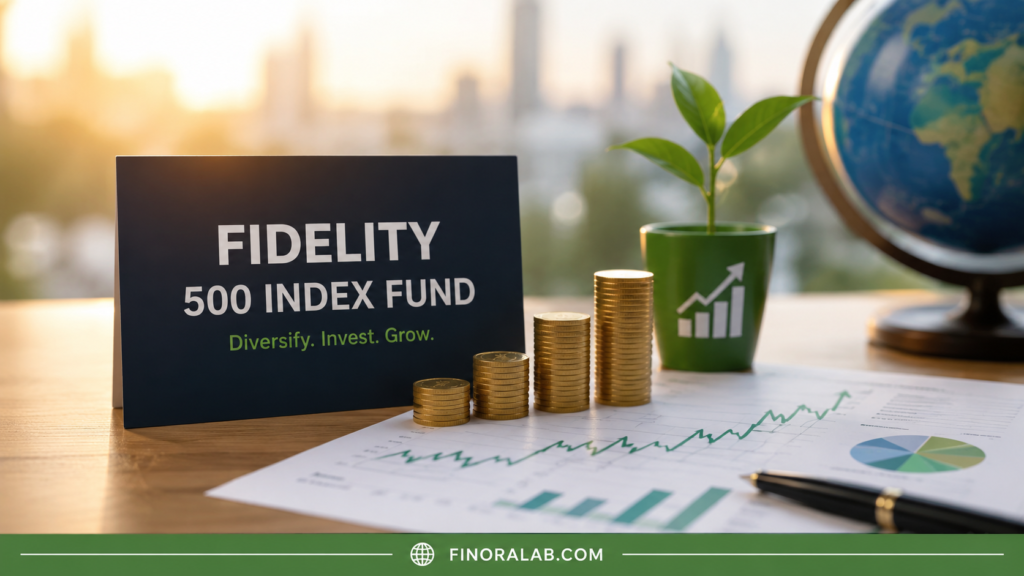
The Fidelity 500 Index Fund, commonly identified by the ticker FXAIX, is one of the most widely followed index mutual funds for investors seeking broad exposure to large U.S. companies. The fund is designed to track the performance of the S&P 500 Index, giving investors access to hundreds of major publicly traded businesses through a single investment. Its extremely low expense ratio and long operating history make it especially relevant for retirement savers and long term investors.
However, a popular fund is not automatically appropriate for every investor. FXAIX is still a stock investment, which means its value can decline substantially during market downturns. Understanding its strategy, costs, diversification, tax treatment, historical performance, and limitations is essential before deciding whether it belongs in a financial plan.
What Is the Fidelity 500 Index Fund?
The Fidelity 500 Index Fund is a mutual fund managed by Fidelity Investments that seeks to provide investment results corresponding to the total return of common stocks publicly traded in the United States. Its primary benchmark is the S&P 500 Index, a market capitalization weighted index designed to represent large U.S. companies across major industries. FXAIX was launched in 1988, giving it a substantial operating history through multiple market cycles.
Rather than having a portfolio manager constantly select individual stocks based on forecasts, the fund uses an index tracking approach. It normally invests at least 80% of its assets in common stocks included in the S&P 500. This makes the fund fundamentally different from an actively managed mutual fund, where managers attempt to outperform a benchmark through security selection, market positioning, or other strategies.
For a beginner, the simplest way to understand FXAIX is to think of it as a packaged ownership stake in a large collection of leading U.S. businesses. Instead of purchasing hundreds of individual stocks yourself, you can purchase shares of the mutual fund and gain indirect exposure to the companies held inside it.
That structure can simplify investing considerably. An investor does not have to research every company, decide how much money to put into each stock, or manually rebalance the portfolio every time the index changes. The fund handles the portfolio implementation while attempting to stay closely aligned with its benchmark.
How FXAIX Tracks the S&P 500
The S&P 500 is not simply a list of the 500 biggest American companies. Its constituents are selected using criteria involving factors such as market capitalization, liquidity, and industry representation. The index is also market cap weighted, meaning companies with larger market values generally have greater influence on the indexs performance than smaller constituents. FXAIX is designed to reflect that structure rather than assigning every company an equal allocation.
This market capitalization approach has an important consequence for investors. Owning FXAIX does provide diversification across many companies, but the fund is not equally diversified among all holdings. When a handful of enormous companies become very large relative to the rest of the market, they can have a meaningful impact on the overall index. Fidelitys own disclosures note that the fund may experience additional volatility because it can have significant exposure to a small number of individual issuers.
The funds objective is not to beat the S&P 500 by making aggressive predictions. Instead, its purpose is to track the index as efficiently as possible. Because investment expenses and portfolio implementation create small differences, the funds return may not exactly match the index in every period.
For example, Fidelity reported that as of June 30, 2026, FXAIX had a one year average annual total return of 22.31%, while the S&P 500 benchmark returned 22.32% over the same period. Over 10 years, the fund returned 15.49% annually compared with 15.51% for the benchmark. The relatively small difference illustrates how closely the fund has tracked its target index.
Fidelity 500 Index Fund Fees and Expense Ratio
One of FXAIXs most notable features is its very low expense ratio. Fidelity lists the funds gross and net expense ratio at 0.015% as of April 29, 2026. The expense ratio represents the annual operating expenses charged against fund assets. Investors do not normally receive a separate bill for this amount instead, the expenses are reflected in the funds returns.
To understand the practical effect, suppose an investor has $10,000 in FXAIX and the expense ratio remains 0.015%. The approximate annual operating expense attributable to that investment would be $1.50, although actual costs and balances fluctuate. On a $100,000 balance, the same percentage would correspond to approximately $15 per year. This illustrates why even tiny differences in fund expenses can matter over long periods, particularly as an investment portfolio compounds.
Low costs do not eliminate investment risk, but they can reduce the amount of a portfolios return consumed by fund expenses. Fidelitys fund research information classifies FXAIXs expense structure as low compared with other funds in its Morningstar category. Still, investors should not select an investment solely because it has a low expense ratio. Asset allocation, diversification, taxes, investment horizon, and risk tolerance remain important.
Investors should also distinguish between a funds expense ratio and other potential account level costs. The funds operating expense is one consideration, while brokerage account fees, advisory charges, transaction costs, taxes, and other expenses can depend on how and where the investment is held.
Fidelity 500 Index Fund Performance and Historical Returns
Historical performance is one of the most common reasons investors search for information about FXAIX. As of June 30, 2026, Fidelity reported average annual total returns of 22.31% for one year, 20.60% for three years, 13.39% for five years, and 15.49% for 10 years. Since the funds inception in February 1988, its average annual total return was listed at 11.34%.
These figures can help investors understand the funds historical behavior, but they should not be interpreted as expected future returns. Stock markets can experience long periods of gains, sharp corrections, recessions, and extended declines. A 10 year annualized return also does not mean the fund gained exactly that percentage every year. Annual returns can vary substantially around the average.
Fidelitys own data provides a useful comparison with the funds benchmark. Through June 30, 2026, the S&P 500s 10 year annualized return was 15.51%, compared with 15.49% for FXAIX. The difference was only 0.02 percentage points annually. This is consistent with the funds objective of closely following the index rather than attempting to outperform it.
Investors should therefore evaluate FXAIX using multiple time horizons instead of focusing on the latest 12 month number. A strong recent year can create the impression that an investment is guaranteed to continue rising, while a weak year can make a fundamentally sound long term strategy appear broken. Neither conclusion is reliable without considering valuation, economic conditions, diversification, and the investors time horizon.
Fidelity 500 Index Fund Diversification and Holdings
FXAIX offers substantial diversification compared with buying a single companys stock. The fund invests primarily in the companies represented in the S&P 500, giving investors exposure to businesses across sectors of the U.S. economy. That can reduce the company specific risk associated with holding only a handful of individual stocks.
However, diversification does not mean the fund is risk free. The S&P 500 represents large cap U.S. equities, so FXAIX is concentrated within one broad segment of the global investment market. It does not provide the same direct exposure to international stocks, smaller U.S. companies, bonds, Treasury securities, or other asset classes.
Another important consideration is sector concentration. Fidelitys data showed information technology represented approximately 38% of the portfolio as of June 30, 2026. That means technology related companies can have a substantial influence on results. The exact composition can change as stock prices, index membership, and market capitalization change.
This matters when constructing a complete investment portfolio. An investor who owns FXAIX alongside another large cap U.S. fund may unintentionally duplicate many of the same companies. Someone who wants a broader allocation may instead combine a large cap U.S. index fund with investments covering smaller companies, international equities, and fixed income.
Is FXAIX a Good Investment for Beginners?
For many long term investors, a low cost S&P 500 index fund can be a relatively straightforward way to gain diversified exposure to large U.S. businesses. The strategy is easy to understand, the operating expenses are extremely low, and investors do not need to research individual companies to maintain the core position.
FXAIX can therefore be useful for investors who want a simple approach and are comfortable with stock market volatility. It may be particularly relevant for someone investing regularly over many years through a retirement account, where short term price movements may be less important than long term growth and disciplined contributions.
Still, good investment depends on the investor. A person saving for a house down payment within two years has a very different risk profile from someone saving for retirement several decades away. If a 30% market decline would force an investor to sell because the money is needed soon, a portfolio consisting entirely of FXAIX may be too aggressive.
Beginners should also avoid confusing diversification within stocks with diversification across asset classes. FXAIX spreads money across many companies, but it remains an equity fund. A balanced financial plan may require cash reserves, bonds, international stocks, and other assets depending on the investors goals and risk capacity.
FXAIX vs. Other S&P 500 Investments
Investors comparing FXAIX may encounter other mutual funds and exchange traded funds that track the S&P 500. These products can have very similar underlying exposure because they are designed to follow the same index. Therefore, the decision is often less about which product will dramatically outperform and more about expenses, account availability, tax considerations, trading preferences, and personal circumstances.
One major distinction is between mutual funds and ETFs. FXAIX is a mutual fund, while many competing S&P 500 products are ETFs. Mutual funds are generally purchased and redeemed at the funds next calculated net asset value, while ETFs trade throughout the market day like stocks. Neither structure is universally superior the better choice depends on how an investor uses the account and what features matter.
Investors should also compare the actual expense ratio rather than relying on a funds reputation. FXAIXs 0.015% expense ratio is already extremely low. A difference of 0.01 or 0.02 percentage points may be financially insignificant for a small portfolio, while differences can become more meaningful as balances grow over decades.
Another practical consideration is tax efficiency. Mutual funds and ETFs can have different distribution characteristics, although tax outcomes depend on the particular fund and account. Investors should examine the funds prospectus, distribution history, account type, and individual tax situation rather than assuming that every S&P 500 investment produces identical tax results.
FXAIX in a 401(k), IRA, or Taxable Brokerage Account
The account where you hold FXAIX can be just as important as the fund itself. In an employer sponsored 401(k), an S&P 500 index fund can potentially serve as a core U.S. stock allocation if it is available among the plans investment choices. Retirement accounts can offer tax advantages, although the specific rules depend on whether the account is traditional or Roth.
In a traditional retirement account, contributions may receive tax treatment that differs from a Roth account, while withdrawals are generally governed by separate rules. The funds investment performance is only one component of the overall financial result. Contribution rates, employer matching, taxes, fees, and withdrawal strategy can substantially influence retirement outcomes.
A taxable brokerage account requires additional attention to investment taxes. Mutual funds can distribute dividends and capital gains. The IRS explains that mutual fund capital gain distributions are generally treated as long term capital gains, even when an investor did not personally sell fund shares. These distributions can therefore create taxable income in a taxable account.
This is one reason investors should consider asset location as part of financial planning. Asset location means choosing which types of investments belong in taxable accounts versus tax advantaged accounts. It is not about avoiding taxes completely rather, it is about understanding how account rules interact with investment income, distributions, withdrawals, and long term goals.
Taxes and the Fidelity 500 Index Fund
Taxes are an important part of the real return an investor keeps. In a taxable brokerage account, distributions from FXAIX may generate tax obligations even when the investor chooses to reinvest them. The IRS notes that mutual funds can pass capital gains from securities they sell through to shareholders, and those distributions are generally reported using Form 1099 DIV.
Consider a simplified example. Suppose an investor receives $500 of taxable distributions during a year and automatically reinvests the entire amount. The investor has not received the money as cash, but the distribution can still represent taxable income in a taxable account. The exact tax treatment depends on the character of the distribution and the investors circumstances.
Tax treatment differs significantly in retirement accounts. For that reason, investors should not compare taxable and tax advantaged investments solely by looking at their quoted historical returns. The accounts tax structure can influence the amount available for spending after taxes.
Investors should also maintain accurate records of cost basis when buying and selling mutual fund shares. The cost basis generally represents the amount used to determine taxable gain or loss. Because tax laws can be complicated, individuals with substantial investments, multiple accounts, or unusual tax circumstances may benefit from consulting a qualified tax professional.
Risks of Investing in FXAIX
The biggest risk associated with FXAIX is equity market risk. Because the fund invests primarily in stocks, its value can fall sharply when economic conditions deteriorate, corporate earnings decline, interest rates change, investor sentiment weakens, or other market shocks occur. Fidelity explicitly warns that stock markets can decline significantly in response to adverse economic, political, regulatory, or issuer specific developments.
There is also concentration risk. Although FXAIX owns many companies, the fund is heavily tied to large U.S. businesses and is weighted according to market capitalization. If a relatively small group of very large companies experiences substantial declines, the overall fund can be affected disproportionately.
Another risk is behavioral rather than structural. Investors may buy after a strong market run and sell during a downturn because they become uncomfortable with losses. That can undermine a long term strategy. An index fund does not prevent poor investment decisions if the investor continually changes course based on short term market movements.
Investors should therefore determine their risk tolerance before investing. A suitable portfolio should be one that an investor can realistically hold through periods of significant volatility. Historical returns cannot guarantee that future returns will be positive, and the principal value of the investment can fluctuate.
How Much Should You Invest in FXAIX?
There is no universal percentage that every investor should place into FXAIX. The appropriate allocation depends on age, income stability, emergency savings, debt, investment horizon, retirement goals, risk tolerance, and other assets. Someone with a 30 year retirement horizon may tolerate substantially more stock exposure than someone who expects to spend the money within a few years.
A useful starting point is to think about the role FXAIX plays rather than choosing a percentage randomly. If it is intended to be the core U.S. large cap stock allocation, the investor can then consider what other exposures are needed. International stocks, small cap stocks, bonds, cash, and other assets may provide additional diversification depending on the overall strategy.
Suppose an investor has $100,000 available for long term investing and chooses to allocate 70% to U.S. large cap stocks. That would represent $70,000 in an S&P 500 oriented investment if FXAIX is being used for that entire allocation. The remaining $30,000 could potentially be allocated across other asset classes according to the investors financial plan.
This is only an illustration, not a recommended allocation. Investors should also consider their emergency fund and high interest debt before directing all available cash toward long term investments. Paying down expensive debt can sometimes provide a more predictable financial benefit than taking additional market risk.
How to Buy the Fidelity 500 Index Fund
Investors who have access to FXAIX through a brokerage or retirement account can generally search for the fund using its ticker symbol, FXAIX. Before placing an order, an investor should verify that the selected fund is the intended share class and review its current prospectus, fees, investment objective, and risks.
Fidelity currently lists a $0 minimum investment for FXAIX, although account level requirements or other circumstances can vary. Fidelitys fund data also lists a net asset value that changes over time as the value of the underlying portfolio changes. Investors should check current information before making a transaction because prices and fund details can change.
For long term investors, the purchase decision is only the beginning. A disciplined contribution strategy may be more important than trying to identify the perfect day to invest. Some investors contribute regularly from each paycheck, which can reduce the temptation to make decisions based on short term market headlines.
Before buying, investors should determine whether the fund fits their broader asset allocation. Purchasing FXAIX simply because its recent return was strong can create concentration or timing risks. A written investment plan can help establish contribution amounts, target allocations, rebalancing rules, and circumstances under which changes should actually be made.
FXAIX and Long Term Retirement Planning
An S&P 500 index fund can play an important role in retirement planning because retirement investors often have long time horizons. When the investment horizon is measured in decades, investors may have greater capacity to tolerate short term volatility in exchange for potential long term growth. However, the closer someone gets to retirement, the more important sequence of returns risk and withdrawal planning can become.
Sequence of returns risk refers to the possibility that poor market returns occur early in retirement while an investor is withdrawing money. Two retirees could experience the same average long term return but have very different outcomes depending on the order of yearly gains and losses. This is one reason a retirement portfolio should be evaluated based on both accumulation and withdrawal needs.
Investors should also consider inflation. Holding only cash for decades can expose purchasing power to inflation, while holding only stocks exposes the investor to substantial market volatility. A diversified retirement plan seeks to balance growth needs with liquidity and stability requirements.
FXAIX can therefore be a useful component of retirement planning without necessarily being the entire retirement portfolio. The right structure depends on the investors retirement income sources, Social Security benefits, pension availability, spending requirements, tax situation, and tolerance for market declines.
Common Mistakes Investors Make With FXAIX
One common mistake is assuming that because FXAIX tracks a broad index, it is completely diversified. It is diversified across many large U.S. companies, but it does not represent every asset class or every geographic market. Investors who hold several similar large cap funds may also own substantially overlapping positions without realizing it.
Another mistake is judging the fund solely by recent performance. If FXAIX has experienced strong returns, an investor may become overly confident and invest money needed for short term goals. Conversely, a major decline may cause an investor to sell at an unfavorable time. Investment decisions should be based on goals, time horizon, and risk capacity rather than emotions.
A third mistake is ignoring taxes in taxable accounts. Investors should understand that mutual fund distributions can create taxable income even when distributions are automatically reinvested. The IRS specifically notes that mutual fund capital gain distributions can be taxable to shareholders.
Finally, investors sometimes focus so heavily on the fund that they overlook personal finance fundamentals. An appropriate emergency fund, manageable debt, adequate insurance, retirement contributions, and a realistic budget can have a larger impact on financial security than selecting between two nearly identical index funds.
Who Should Consider the Fidelity 500 Index Fund?
FXAIX may be worth considering for investors who want low cost exposure to large U.S. companies and are comfortable accepting stock market volatility. Its index tracking strategy can be attractive to people who prefer a straightforward approach rather than researching and selecting individual stocks.
It may also suit investors who want to make regular contributions over a long time horizon. Someone building retirement savings over several decades may value the combination of broad large cap exposure, low operating costs, and a strategy that does not require frequent security selection.
However, FXAIX may not be appropriate as a complete portfolio for every investor. Someone seeking international diversification, significant bond exposure, or lower short term volatility may need other investments. Likewise, an investor saving for a near term purchase should consider whether the potential for substantial stock market losses is compatible with the deadline.
The key question is therefore not simply whether FXAIX is good. The better question is whether an S&P 500 index strategy fits the investors objectives, time horizon, risk tolerance, tax situation, and existing portfolio. That approach leads to more useful financial decisions than choosing an investment based solely on popularity.
Conclusion
The Fidelity 500 Index Fund, or FXAIX, is a low cost mutual fund designed to track the S&P 500 Index and provide exposure to large U.S. companies. Its 0.015% expense ratio, long history, broad stock exposure, and close historical tracking of its benchmark make it an important option for investors researching low cost index investing. Fidelity reported a 15.49% annualized 10 year return through June 30, 2026, compared with 15.51% for the S&P 500.Nevertheless, past performance is not a guarantee of future results. FXAIX remains an equity investment and can experience substantial losses during market declines. It also concentrates exposure in large U.S. companies and can have significant exposure to the largest businesses and sectors in the index. Investors should evaluate the fund as part of a complete financial plan rather than as a standalone solution.For a long term investor, the most important considerations may be maintaining an appropriate asset allocation, contributing consistently, controlling unnecessary costs, understanding taxes, and avoiding emotionally driven decisions. FXAIX can be an effective tool within that framework, but the right investment decision ultimately depends on the investors individual circumstances.
The Fidelity 500 Index Fund is a mutual fund with the ticker symbol FXAIX. Its objective is to provide investment results that correspond to the total return of common stocks publicly traded in the United States, primarily by investing in stocks included in the S&P 500 Index. Fidelity states that the fund normally invests at least 80% of its assets in common stocks included in the index.
Is FXAIX the same as the S&P 500?
FXAIX is not the S&P 500 itself. The S&P 500 is an index, while FXAIX is a mutual fund designed to track that index. Because the fund has operating expenses and must implement the index strategy, its performance can differ slightly from the benchmark. Through June 30, 2026, Fidelity reported a 10 year annualized return of 15.49% for FXAIX versus 15.51% for the S&P 500.
What is the expense ratio for FXAIX?
Fidelity lists FXAIXs gross and net expense ratio at 0.015% as of April 29, 2026. This is an extremely low operating expense ratio. At that rate, a hypothetical $10,000 investment would correspond to approximately $1.50 in annual fund expenses, although actual costs vary with the investment balance and fund operations.
Is FXAIX a good investment for retirement?
FXAIX can be useful for retirement investing because it provides broad exposure to large U.S. companies and has a low expense ratio. However, whether it is appropriate depends on the investors retirement timeline, risk tolerance, existing investments, and need for diversification. A retirement portfolio may also require bonds, international stocks, cash reserves, or other investments depending on the individuals circumstances.
Does FXAIX pay dividends?
FXAIX can make distributions to shareholders from income generated by the securities held by the fund. The exact distribution amount and schedule can change. Investors in taxable accounts should understand that distributions may have tax consequences even if they choose to automatically reinvest the money rather than receive it as cash.
Is FXAIX safe?
FXAIX is not a risk free investment. It invests primarily in stocks, and stock prices can decline significantly. Fidelity warns that equity markets can experience substantial declines due to economic, political, regulatory, or issuer specific developments. The fund can also have meaningful exposure to a relatively small number of large companies.
Can you lose money in FXAIX?
Yes. The value of FXAIX can fall below the amount you invested. For example, if you invested $10,000 and the fund declined 25%, the investment would temporarily be worth approximately $7,500 before considering distributions or other factors. A loss becomes permanent when an investor sells at a lower price, although market declines can last for extended periods and recovery is never guaranteed.
Is FXAIX better than an S&P 500 ETF?
Neither structure is automatically better. FXAIX is a mutual fund, while many competing S&P 500 products are ETFs. Investors should compare expense ratios, taxes, trading flexibility, account availability, bid ask spreads for ETFs, and personal preferences. Because many products track the same index, the differences in implementation and costs can be more important than the basic investment objective.
Is FXAIX good for beginners?
FXAIX can be relatively easy for beginners to understand because its core strategy is straightforward obtain exposure to the S&P 500 through a low cost mutual fund. However, beginners should understand that simplicity does not mean low risk. The fund remains heavily exposed to the stock market, so investors should have an appropriate time horizon and be financially prepared for periods of substantial volatility.
Should you invest all your money in FXAIX?
Putting all of your investable assets into one S&P 500 fund may not be appropriate for everyone. Although FXAIX provides diversification across many large U.S. companies, it does not provide broad exposure to bonds, international markets, smaller companies, or cash. A complete portfolio should reflect the investors goals, time horizon, risk tolerance, liquidity needs, and overall financial situation.
I am a professional finance content writer with expertise in personal finance investing, banking, loans, insurance, credit cards, budgeting, and market related topics. I create clear, SEO optimized, and reader friendly finance content that helps audiences understand complex financial concepts in simple words. My goal is to write trustworthy and engaging content that improves search visibility, builds credibility, and supports business growth.
I am a professional finance content writer with expertise in personal finance investing, banking, loans, insurance, credit cards, budgeting, and market related topics. I create clear, SEO optimized, and reader friendly finance content that helps audiences understand complex financial concepts in simple words. My goal is to write trustworthy and engaging content that improves search visibility, builds credibility, and supports business growth.