SCHD Dividend Yield Explained: Complete Guide to Schwab Dividend ETF Income
Shanzay Arain·Jun 14, 2026
The SCHD dividend yield is one of the most searched topics among income-focused investors who want to build long-term passive income. It represents the annual dividend income an investor receives from the Schwab U.S. Dividend Equity ETF (SCHD) relative to its share price.
In simple terms SCHD dividend yield tells you how much cash flow you can expect from your investment. It is especially popular among investors seeking stability consistent payouts and long-term wealth building through dividends.
What Is SCHD and How It Works
The Schwab U.S. Dividend Equity ETF (SCHD) is a fund designed to track high-quality U.S. companies with strong dividend histories. It is managed by Charles Schwab one of the largest financial institutions in the United States.
SCHD invests in companies with strong fundamentals such as cash flow return on equity and consistent dividend payments. The ETF selects stocks based on financial strength rather than speculation or hype making it a favorite among conservative and long-term investors.
The ETF distributes income quarterly meaning investors receive dividend payments four times a year. These payouts come from the dividends collected from the underlying companies held in the fund.
Understanding Dividend Yield in ETFs
Dividend yield is a financial ratio that shows how much income an investor earns from an investment relative to its price. It is expressed as a percentage and is widely used in income investing strategies.
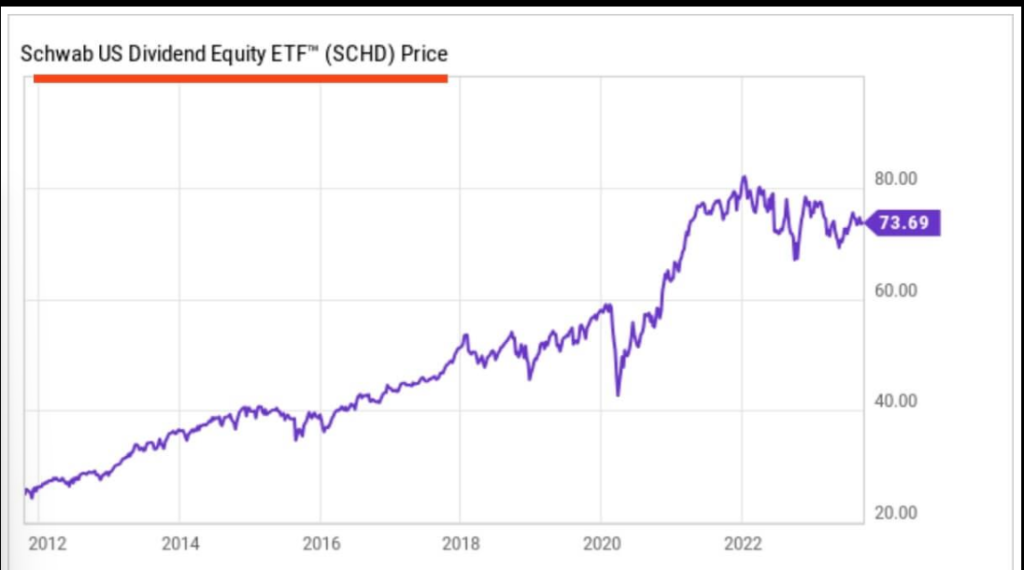
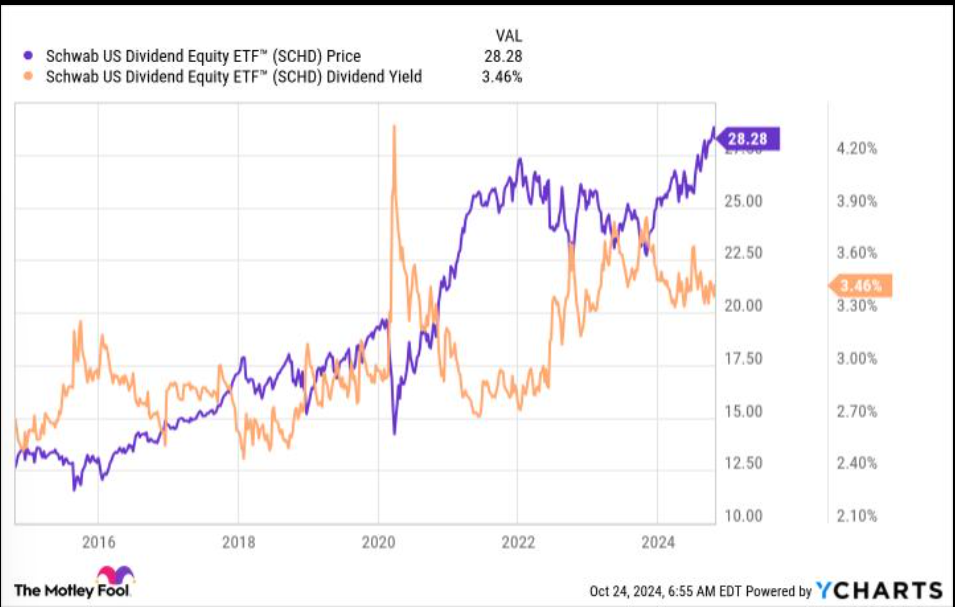
For SCHD the dividend yield changes over time because it depends on both dividend payouts and market price fluctuations. When SCHD’s price goes up the yield may decrease and when the price falls the yield may increase.
This makes dividend yield a dynamic metric not a fixed return guarantee. Investors must understand that SCHD yield reflects both company performance and broader market conditions.
SCHD Dividend Yield Historical Performance
Historically SCHD has delivered a moderate to high dividend yield compared to the S&P 500 average. While exact yield varies SCHD typically stays in a competitive range that appeals to income investors.
Over the past several years SCHD has shown consistent dividend growth due to its focus on financially strong companies. Instead of chasing high-yield risky stocks SCHD emphasizes dividend sustainability and growth.
This long-term strategy has helped SCHD become one of the most trusted dividend ETFs for investors who prioritize steady income rather than short-term speculation.
How SCHD Generates Dividends
SCHD generates dividends through the companies it holds in its portfolio. These companies pay dividends from their profits and SCHD collects and redistributes them to shareholders.
The ETF uses a fundamental selection process focusing on companies with strong balance sheets and consistent dividend policies. This ensures that dividend income is not only stable but also capable of growing over time.
Because SCHD is passively managed it does not rely on active stock picking for short-term gains. Instead it follows a structured index that prioritizes quality dividend-paying companies.
Latest Update on SCHD Dividend Trends
In recent years SCHD has maintained strong investor interest due to rising demand for passive income strategies. Many investors have shifted toward dividend ETFs as interest rate environments and market volatility fluctuate.
SCHD’s dividend payouts have shown a gradual upward trend reflecting the growth of its underlying companies. Even during uncertain market periods SCHD has continued to distribute dividends consistently.
This reliability has strengthened its reputation as a core income ETF in many long-term portfolios especially among retirement-focused investors.
Why SCHD Is Popular Among Income Investors
SCHD is widely popular because it balances yield stability and growth potential. Unlike high-yield stocks that may carry risk SCHD focuses on companies with sustainable earnings.
Another reason for its popularity is its low expense ratio which allows investors to keep more of their returns. This efficiency makes it attractive for both beginners and experienced investors.
Additionally SCHD is often used in retirement portfolios because it provides predictable quarterly income combined with long-term capital appreciation potential.
SCHD Dividend Yield vs Other ETFs
When compared to other dividend ETFs SCHD often stands out for its balance between yield and quality. Some ETFs may offer higher yields but they often come with higher risk or unstable payouts.
SCHD on the other hand focuses on dividend growth rather than maximum yield. This means investors may not always get the highest immediate income but they benefit from increasing dividends over time.
This strategy makes SCHD particularly appealing for long-term investors who want both income and stability.
Factors Affecting SCHD Dividend Yield
Several factors influence SCHD dividend yield including interest rates stock market performance and corporate earnings.
When interest rates rise dividend ETFs can become less attractive compared to fixed-income securities which may impact demand and pricing. Similarly strong corporate earnings generally lead to higher dividend payouts.
Market volatility can also affect SCHD yield indirectly by changing its share price which is part of the yield calculation.
Risks and Limitations of Investing in SCHD
Although SCHD is considered a stable investment it is not risk-free. One key risk is market exposure as the ETF still depends on stock market performance.
Another limitation is sector concentration. SCHD may overweight certain sectors like financials or industrials which can impact diversification.
Investors should also understand that dividend income is not guaranteed and can change based on company performance and economic conditions.
Who Should Invest in SCHD
SCHD is ideal for long-term investors who want steady income and moderate growth. It is particularly suitable for retirement planning passive income strategies and dividend reinvestment plans.
It may not be ideal for short-term traders or those seeking rapid capital gains. Instead it works best as a core holding in a diversified portfolio.
Investors who prefer stability over speculation often find SCHD a strong long-term choice.
SCHD Dividend Reinvestment Strategy
One of the most powerful strategies with SCHD is dividend reinvestment (DRIP). This allows investors to automatically reinvest dividends into additional shares of SCHD.
Over time reinvesting dividends can significantly increase compounding returns. This strategy is especially effective for long-term wealth building.
Many investors use SCHD in tax-advantaged accounts to maximize compounding without immediate tax impact.
Tax Considerations for SCHD Dividends
SCHD dividends are generally subject to taxation depending on the investor’s location and account type. In taxable accounts dividends may be taxed as qualified dividend income.
Holding SCHD in retirement accounts such as IRAs can help defer or reduce tax obligations depending on local regulations.
Understanding tax implications is important for maximizing net returns from dividend investing strategies.
Future Outlook of SCHD Dividend Yield
The future of SCHD dividend yield depends on corporate earnings growth and overall economic conditions. If the companies in the ETF continue to perform well dividend growth is likely to continue.
SCHD’s strategy of focusing on quality dividend stocks positions it well for long-term stability. However market cycles will always influence short-term yield fluctuations.
Overall SCHD is expected to remain a strong choice for income-focused investors seeking consistent performance.
Conclusion
The SCHD dividend yield remains one of the most important metrics for investors seeking reliable passive income. With its focus on high-quality dividend-paying companies SCHD offers a balanced approach between yield stability and long-term growth.
While it is not the highest-yielding ETF available its consistency and dividend growth potential make it a powerful long-term investment choice. For income-focused investors SCHD continues to be a cornerstone of modern dividend investing strategies.
FAQs
What is SCHD dividend yield?
SCHD dividend yield is the annual income percentage an investor earns from the Schwab U.S. Dividend Equity ETF relative to its price.
How often does SCHD pay dividends?
SCHD pays dividends quarterly distributing income four times per year.
Is SCHD good for passive income?
Yes SCHD is widely considered a strong option for passive income due to its consistent dividend payouts and quality holdings.
Does SCHD dividend increase over time?
Historically SCHD dividends have shown growth over time due to its focus on dividend-growing companies.
Is SCHD safe during market downturns?
While SCHD is relatively stable it is still exposed to market risk like all equity-based ETFs.
What affects SCHD dividend yield?
Market price changes company earnings and interest rates all influence SCHD dividend yield.
Can SCHD replace a pension?
For some investors SCHD can be part of a retirement income strategy but it should not be the only source of retirement funds.
I am a professional finance content writer with expertise in personal finance investing, banking, loans, insurance, credit cards, budgeting, and market related topics. I create clear, SEO optimized, and reader friendly finance content that helps audiences understand complex financial concepts in simple words. My goal is to write trustworthy and engaging content that improves search visibility, builds credibility, and supports business growth.
I am a professional finance content writer with expertise in personal finance investing, banking, loans, insurance, credit cards, budgeting, and market related topics. I create clear, SEO optimized, and reader friendly finance content that helps audiences understand complex financial concepts in simple words. My goal is to write trustworthy and engaging content that improves search visibility, builds credibility, and supports business growth.