
Working additional hours can increase your paycheck, but estimating the correct amount is not always as simple as multiplying hours by your standard wage. The calculation may depend on your regular rate, total hours, bonuses, shift differentials, overtime multiplier and local employment rules.
An overtime calculator helps estimate how much extra pay you may receive after working beyond the applicable regular hours threshold. For many covered, nonexempt employees in the United States, federal law generally requires overtime pay at no less than one and a half times the regular rate for hours worked beyond 40 in a workweek.
However, some states provide broader protections, including daily overtime or double time requirements. Certain workers may also be exempt based on their job duties, compensation method and applicable law.
This guide explains how to calculate time and a half, double time, total weekly earnings and estimated after tax overtime pay. It also covers salaried employees, bonuses, multiple hourly rates and common calculation errors.
Overtime Calculator Quick Summary
| Calculation | Basic formula |
| Regular pay | Regular hours × Hourly rate |
| Overtime hours | Total hours − Regular hour threshold |
| Time and a half rate | Hourly rate × 1.5 |
| Double time rate | Hourly rate × 2 |
| Overtime earnings | Overtime hours × Overtime rate |
| Total gross pay | Regular pay + Overtime earnings |
| Weekly hourly rate from salary | Weekly salary ÷ Normal weekly hours |
| Annual hourly rate estimate | Annual salary ÷ Annual working hours |
| Federal overtime threshold | Generally over 40 hours in a workweek |
| Main limitation | Legal eligibility varies by job and jurisdiction |
What Is Overtime Pay?
Overtime pay is additional compensation provided when an eligible employee works beyond a legally defined or contractually agreed threshold.
Under the federal Fair Labor Standards Act, covered nonexempt employees generally must receive at least one and a half times their regular rate for hours worked beyond 40 in a workweek.
The U.S. Department of Labor defines a workweek as a fixed and regularly recurring period of 168 hours—seven consecutive 24 hour periods. It does not necessarily have to begin on Monday or match the calendar week. U.S. Department of Labor
Federal law does not generally require extra pay merely because work occurs on a Saturday, Sunday or holiday. Extra pay may be required if those hours push the employee beyond 40 hours in the workweek or if state law, an employment contract or employer policy provides a separate premium.
How an Overtime Calculator Works
A standard overtime calculator requires several inputs
- Regular hourly rate
- Regular hours worked
- Overtime hours
- Overtime multiplier
- Double time hours, if applicable
- Bonuses or shift differentials
- Additional deductions for an estimated net pay result
The calculator first determines the applicable overtime rate
Overtime rate = Regular rate × Overtime multiplier
It then calculates overtime earnings
Overtime pay = Overtime hours × Overtime rate
Finally, it combines regular and overtime earnings
Total gross pay = Regular pay + Overtime pay
This produces gross earnings before payroll taxes, insurance, retirement contributions and other deductions.
How to Calculate Time and a Half
Time and a half means 1.5 times the employees regular hourly rate.
Use this formula
Time and a half rate = Regular hourly rate × 1.5
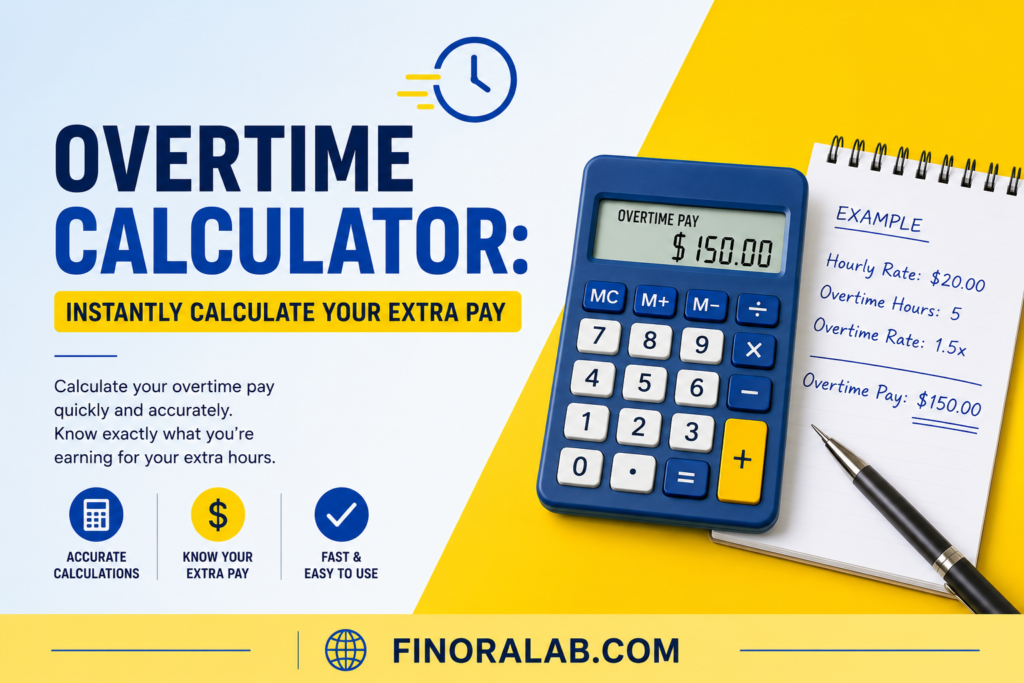
If your regular rate is $20 per hour
$20 × 1.5 = $30
Your time and a half overtime rate is $30 per hour.
If you work five qualifying overtime hours
5 × $30 = $150
Your gross overtime earnings would be $150.
Practical Overtime Pay Example
Suppose an employee earns $24 per hour and works 48 hours during a workweek. Assume that the worker is covered, nonexempt and eligible for overtime after 40 hours.
Calculate Regular Hours
The first 40 hours are regular hours
40 × $24 = $960
Calculate Overtime Hours
48 total hours − 40 regular hours = 8 overtime hours
Calculate the Overtime Rate
$24 × 1.5 = $36
Calculate Overtime Earnings
8 × $36 = $288
Calculate Total Weekly Gross Pay
$960 + $288 = $1,248
The employees total gross weekly pay would be $1,248 before taxes and other deductions.
Overtime Pay Formula
The complete basic formula is
Total pay = (Regular hours × Regular rate) + (Overtime hours × Regular rate × Overtime multiplier)
If
- Regular hours = 40
- Overtime hours = 10
- Hourly rate = $18
- Multiplier = 1.5
Then
Regular pay = 40 × $18 = $720
Overtime pay = 10 × $18 × 1.5 = $270
Total gross pay = $720 + $270 = $990
This formula works when the employee has one hourly rate and no additional compensation affecting the regular rate.
How to Calculate Overtime Hours
Use the following formula when overtime begins after 40 hours
Overtime hours = Total weekly hours − 40
If an employee works 46 hours
46 − 40 = 6 overtime hours
If an employee works 38 hours, the result should not be treated as negative overtime. Instead, overtime hours are zero.
A calculator can express this as
Overtime hours = Maximum of zero or total hours minus threshold
State law, union agreements and employer policies may provide a different threshold. For example, certain employees may receive overtime after eight hours in a day rather than only after 40 hours in a week.
How to Calculate Double Time Pay
Double time means two times the employees regular hourly rate.
Use this formula
Double time rate = Regular hourly rate × 2
If your regular rate is $22
$22 × 2 = $44
For three qualifying double time hours
3 × $44 = $132
Double time is not generally required by the federal FLSA simply because an employee works a very long shift. It may be required by state law, an employment agreement, a union contract or company policy.
California, for example, has daily overtime and double time rules for many nonexempt employees. Its rules can require double time after certain daily hour or consecutive day thresholds. California Department of Industrial Relations
Always use the rules that apply to the employees work location and classification.
Time and a Half vs. Double Time
| Pay type | Multiplier | $20 hourly example |
| Regular time | 1.0 | $20 per hour |
| Time and a half | 1.5 | $30 per hour |
| Double time | 2.0 | $40 per hour |
| Double time and a half | 2.5 | $50 per hour |
Double time and a half is uncommon and usually results from a specific contract, holiday policy or collective bargaining agreement rather than a general federal rule.
Understanding the Regular Rate of Pay
The regular rate is not always identical to the employees base hourly wage. Under federal rules, it can include certain compensation paid for employment.
The Department of Labor explains that the regular rate is generally calculated by dividing total includable pay for the workweek by the total hours actually worked. DOL Regular Rate Guidance
The regular rate may include
- Hourly wages
- Certain nondiscretionary bonuses
- Shift differentials
- Certain commissions
- Production incentives
- Premiums that do not qualify for exclusion
Certain payments may be excluded under specific legal rules, such as some discretionary bonuses, gifts, vacation pay and qualifying benefit plan contributions.
Because bonus and commission treatment can be complicated, employees should not assume overtime is always calculated using base hourly pay alone.
Overtime With a Nondiscretionary Bonus
Suppose an employee earns $20 per hour, works 45 hours and receives a $100 production bonus tied to predetermined performance targets.
First, calculate straight time earnings for all hours
45 × $20 = $900
Add the includable bonus
$900 + $100 = $1,000
Calculate the regular rate
$1,000 ÷ 45 = $22.22
Because straight time compensation has already been included for all 45 hours, the additional overtime premium may be calculated at one half of the regular rate for the five overtime hours
$22.22 × 0.5 × 5 = $55.55
Total weekly earnings would be approximately
$1,000 + $55.55 = $1,055.55
This is a simplified educational example. The correct method depends on how the compensation is structured and which amounts must be included in the regular rate.
The Department of Labor provides specific guidance for calculating overtime when bonuses are involved. DOL Bonus Guidance
Why Some Calculations Use an Extra Half Time Rate
Employees are sometimes confused when an overtime calculation uses 0.5 rather than 1.5.
If an hourly employee has already received straight time compensation for every hour worked—including overtime hours—only the additional half time premium may remain due.
For example
- Employee worked 45 hours
- Straight time pay has already covered all 45 hours
- Five hours qualify for overtime
- The employee is owed an additional 0.5 times the regular rate for those hours
By contrast, when regular pay covers only the first 40 hours, overtime hours are usually calculated directly at 1.5 times the regular rate.
A calculator must know whether straight time earnings for overtime hours are already included to avoid paying or displaying the same portion twice.
Calculating Overtime With Multiple Pay Rates
An employee may perform different jobs at different hourly rates during one workweek.
Suppose an employee works
- 30 hours at $18 per hour
- 15 hours at $24 per hour
Calculate straight time earnings
30 × $18 = $540
15 × $24 = $360
Total straight time earnings
$540 + $360 = $900
Total hours
30 + 15 = 45
Weighted regular rate
$900 ÷ 45 = $20
The employee worked five overtime hours. If straight time has already been paid for all hours, the additional half time premium would be
5 × $20 × 0.5 = $50
Total estimated gross pay
$900 + $50 = $950
Other legally permitted arrangements may apply in some circumstances. Employees and employers should confirm the proper method for the relevant jurisdiction.
How to Calculate Overtime for Salaried Employees
Receiving a salary does not automatically mean an employee is exempt from overtime. Exemption generally depends on applicable salary basis, salary level and job duties tests.
For a nonexempt salaried employee whose salary covers 40 hours, a simplified hourly rate may be
Regular hourly rate = Weekly salary ÷ 40
Suppose the employee receives $1,000 per week for a 40 hour schedule
$1,000 ÷ 40 = $25
Time and a half rate
$25 × 1.5 = $37.50
If the employee works six qualifying overtime hours
6 × $37.50 = $225
Estimated weekly gross pay
$1,000 + $225 = $1,225
This simplified method may not apply when a salary covers a different number of hours, when another permitted pay arrangement is used or when bonuses affect the regular rate.
Current Salary Threshold for Certain Federal Exemptions
As of 2026, the U.S. Department of Labor states that the operative standard salary level for many executive, administrative and professional exemptions is $684 per week, equivalent to $35,568 annually.
A May 2026 technical amendment restored the regulations established by the Departments 2019 rule after the 2024 rule was judicially vacated. U.S. Department of Labor 2026 Update
Salary alone does not determine exemption. The employee must generally satisfy the relevant salary basis and job duties tests. Some professions and occupations have separate rules.
State law may use a higher salary threshold or provide stronger employee protections.
Who May Qualify for Overtime?
Employees covered by the FLSA who are not exempt generally qualify for federal overtime after working more than 40 hours in a workweek.
Eligibility does not depend solely on whether someone is
- Paid hourly
- Paid a salary
- Given a managerial title
- Classified as an independent contractor
- Working remotely
- Working part time
The actual duties, employment relationship, compensation structure and governing laws matter.
Common federal exemptions may involve qualifying
- Executive employees
- Administrative employees
- Learned or creative professionals
- Outside sales employees
- Certain computer employees
- Highly compensated employees
- Specific transportation or agricultural workers
Exemptions can be fact specific. A job title such as manager does not automatically remove overtime rights.
Is Overtime Calculated Daily or Weekly?
Under the federal FLSA, overtime for most covered nonexempt workers is calculated after 40 hours in a workweek rather than after eight hours in one day.
For example
- Monday 10 hours
- Tuesday 10 hours
- Wednesday 10 hours
- Thursday 10 hours
- Friday 0 hours
- Total 40 hours
Federal law alone generally would not create overtime merely because four days exceeded eight hours, assuming no other rule applies.
However, certain states require daily overtime. Employment contracts and union agreements can also provide additional rights.
A good calculator should allow users to choose
- Weekly overtime
- Daily overtime
- Double time
- Custom threshold
- Custom overtime multiplier
Can Employers Average Hours Across Two Weeks?
For most federal overtime calculations, employers generally cannot average two separate workweeks to avoid overtime.
Suppose an employee works
- Week one 50 hours
- Week two 30 hours
The average is 40 hours, but the employee may still be entitled to 10 overtime hours for week one. The second week does not erase overtime earned in the first.
Special arrangements can apply to certain healthcare, public safety and other employees, but they should not be assumed for ordinary workers.
Does Weekend or Holiday Work Automatically Count as Overtime?
Federal law does not normally require overtime simply because work is performed on
- Saturday
- Sunday
- A public holiday
- A regular day off
- A night shift
Those hours may qualify for overtime when they cause the employees total to exceed 40 hours in the workweek.
An employer, union contract or state law may separately provide holiday pay, weekend premiums or shift differentials. These arrangements can be more generous than the federal minimum.
Overtime Calculator for Different Pay Periods
Overtime is generally calculated by workweek even when an employee is paid biweekly or semimonthly.
Weekly Payroll
The payroll period and overtime workweek may align, making the calculation relatively direct.
Biweekly Payroll
A biweekly check contains two workweeks. Each week should normally be reviewed separately.
An employee who works 45 hours in week one and 35 hours in week two may have five overtime hours, even though the biweekly total is 80.
Semimonthly Payroll
Semimonthly periods do not divide evenly into workweeks. Payroll must allocate hours to the appropriate workweek rather than calculating overtime solely from the total semimonthly hours.
Monthly Payroll
Monthly payroll can include several complete and partial workweeks. Overtime still needs to be associated with the correct workweek unless a specific lawful exception applies.
Overtime Pay Before and After Taxes
An overtime calculator usually shows gross pay. Your actual deposit will be lower after deductions.
Common deductions include
- Federal income tax withholding
- State or local income tax
- Social Security
- Medicare
- Health insurance
- Retirement contributions
- Wage garnishments
- Other authorized deductions
Overtime is not necessarily subject to a unique final federal income tax rate just because it is overtime. It increases taxable wages, and payroll withholding on a larger paycheck may be higher.
Withholding is a prepayment toward annual tax liability. The amount withheld from one check does not necessarily equal the final tax attributable to those overtime earnings.
Tax laws and withholding tables may change. Verify current information with the relevant tax authority or a qualified tax professional.
Step by Step Guide to Using an Overtime Calculator
Enter the Regular Hourly Rate
Use the regular rate when known. If compensation includes bonuses or multiple rates, a more advanced calculation may be required.
Enter Regular Hours
Enter the number of hours paid at the standard rate.
Enter Overtime Hours
Enter only hours that qualify under applicable law or employer policy.
Select the Overtime Multiplier
Common options include
- 1.5 for time and a half
- 2.0 for double time
- A custom multiplier under an employment agreement
Add Bonus or Shift Pay
Include compensation that must be part of the regular rate.
Calculate Gross Earnings
The calculator should display regular pay, overtime pay and total gross earnings separately.
Add Tax and Deduction Information
For estimated net pay, enter withholding and benefit information. Treat the result as an estimate rather than an exact payroll statement.
Compare the Result With Your Pay Stub
Review hours, pay rates and deductions. Report discrepancies promptly to the employer or payroll department.
Benefits and Limitations
Benefits of an Overtime Calculator
A calculator can help workers
- Estimate upcoming pay
- Check time and a half rates
- Compare extra shifts
- Identify possible payroll errors
- Budget using expected earnings
- Understand gross versus net pay
- Review bonus calculations
- Compare compensation structures
Employers may also use calculators for preliminary payroll planning, although official payroll records and compliant systems remain essential.
Risks and Limitations
A basic calculator may produce the wrong result when
- State daily overtime applies
- The employee has multiple rates
- Bonuses affect the regular rate
- The employee is paid by piece rate
- A salary covers variable hours
- A special exemption applies
- Tips or commissions are involved
- Straight time pay already covers overtime hours
- A union contract provides different terms
- Compensable working time is recorded incorrectly
The calculation does not determine legal eligibility by itself.
Common Mistakes to Avoid
Multiplying Every Worked Hour by 1.5
Usually, only qualifying overtime hours receive the overtime premium. Regular hours remain at the standard rate.
Using Base Pay Instead of the Regular Rate
Certain bonuses, commissions and shift differentials may need to be included.
Combining Two Workweeks
A low hour second week generally does not cancel overtime earned during a high hour first week.
Assuming Salaried Means Exempt
Salary is only one part of certain exemption tests.
Counting Paid Leave as Hours Worked
Under federal rules, paid vacation, holidays or sick leave may not count as hours actually worked for the 40 hour overtime threshold, although contracts or state rules may be more generous.
Ignoring Daily Overtime Laws
Some states provide daily overtime or double time rights.
Forgetting Straight Time Already Paid
If all hours have already received straight time pay, the remaining overtime premium may be an additional half time amount.
Ignoring Off the Clock Work
Compensable tasks completed before clocking in, after clocking out or during interrupted breaks may affect total hours worked.
Treating Withholding as the Final Tax Rate
A larger paycheck may have more withholding, but withholding does not automatically equal final annual tax.
Latest Overtime Update for 2026
The U.S. Department of Labor confirmed in May 2026 that the operative federal regulations generally use a salary level of $684 per week for certain executive, administrative and professional exemptions.
For covered nonexempt employees, the core federal overtime rule remains at least one and a half times the regular rate for hours beyond 40 in a workweek. DOL Overtime Requirements
State laws can establish higher salary thresholds, daily overtime, double time or broader coverage. Workers and employers should verify current federal, state and local requirements rather than relying on older payroll articles.
Expert Tips
- Keep a personal record of start, stop and break times.
- Confirm when the employers workweek begins and ends.
- Calculate each workweek separately.
- Review shift differentials and bonuses.
- Do not assume job title determines exemption.
- Compare gross earnings before estimating taxes.
- Check whether paid leave counts under employer policy.
- Enter daily overtime separately when applicable.
- Review every pay stub for rate and hour errors.
- Save schedules, time records and payroll statements.
- Ask payroll how nondiscretionary bonuses are handled.
- Verify state rules when working remotely across state lines.
- Consult a qualified professional for unusual compensation arrangements.
Conclusion
An overtime calculator estimates additional earnings by applying the correct premium to qualifying overtime hours. For a basic time and a half calculation, multiply the regular rate by 1.5 and then multiply the result by overtime hours.The calculation becomes more complex when bonuses, multiple rates, daily overtime, salaries, commissions or special employment rules apply. Use current federal and state guidance, review each workweek separately and treat an online result as an estimate rather than a legal determination.
You may also read more blogs
FAQs
How do I calculate overtime pay?
Multiply the regular hourly rate by the overtime multiplier, typically 1.5. Multiply that overtime rate by the number of qualifying overtime hours.
What is time and a half for $20 an hour?
Multiply $20 by 1.5. The time and a half rate is $30 per hour.
What is time and a half for $25 an hour?
The overtime rate is $37.50 per hour because $25 multiplied by 1.5 equals $37.50.
Is overtime calculated after eight or 40 hours?
Federal law generally uses more than 40 hours in a workweek for covered nonexempt employees. Some states require daily overtime after a specified number of hours.
Do salaried employees receive overtime?
Some salaried employees qualify for overtime. Exemption depends on compensation and job duties, not salary or job title alone.
Is overtime taxed more than regular pay?
Overtime increases taxable wages and may result in greater withholding on a larger paycheck. It is not necessarily subject to a separate final income tax rate merely because it is overtime.
Do bonuses affect overtime calculations?
Certain nondiscretionary bonuses may need to be included in the employees regular rate. Truly discretionary bonuses and certain other payments may be excluded under applicable rules.

I am a professional finance content writer with expertise in personal finance investing, banking, loans, insurance, credit cards, budgeting, and market related topics. I create clear, SEO optimized, and reader friendly finance content that helps audiences understand complex financial concepts in simple words. My goal is to write trustworthy and engaging content that improves search visibility, builds credibility, and supports business growth.