S Corp vs LLC: The Truth About Taxes, Costs & Which One Saves More
Shanzay Arain·Jul 21, 2026
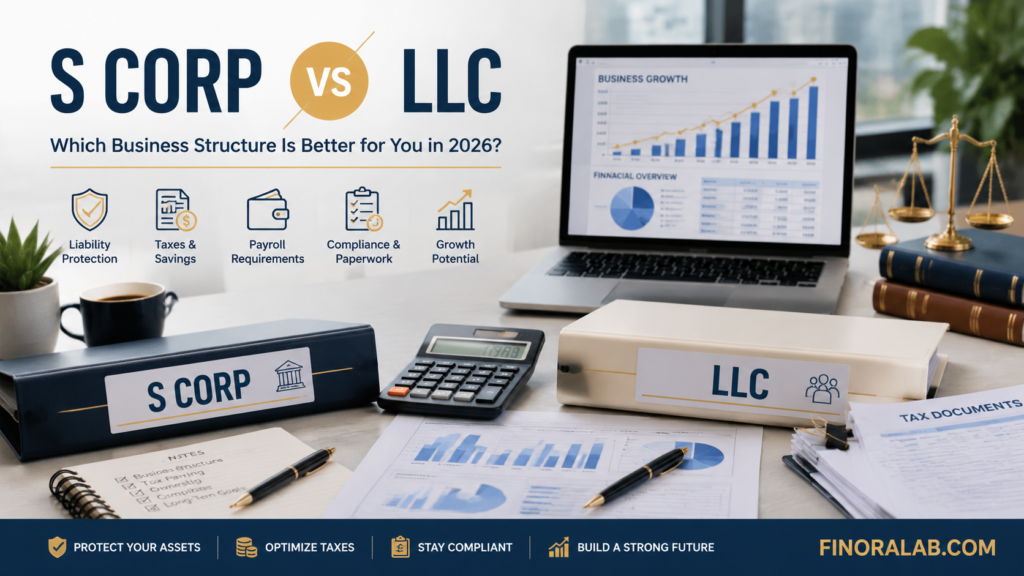
Choosing between an S corp vs LLC can feel confusing because the two terms do not describe exactly the same thing.
A limited liability company, or LLC, is a legal business structure created under state law. An S corporation is primarily a federal tax classification. A business may therefore be legally organized as an LLC while electing to be taxed as an S corporation.
That distinction is important. In many cases, the actual decision is not whether to form an LLC or an S corporation. It is whether to form an LLC and keep its default tax treatment or form an LLC and elect S corporation taxation.
Both options may offer liability protection and pass through taxation. However, they differ significantly in payroll requirements, ownership restrictions, administrative work, tax reporting, and the way an owner pays themselves.
This guide explains the differences in simple terms so you can have a more productive conversation with a certified public accountant, enrolled agent, or business attorney.
What Does S Corp vs LLC Really Mean?
An LLC is formed by filing business formation documents—usually called articles of organization—with a state. The LLC exists as a separate legal entity from its owner or owners.
For federal income tax purposes, however, LLC is not a single tax category. The IRS may treat an LLC as a disregarded entity, partnership, C corporation, or S corporation depending on its number of members and the elections it makes. poration is a qualifying corporation or other eligible entity that elects to pass income, losses, deductions, and credits through to its shareholders. Those items are generally reported on the shareholders individual income tax returns instead of being taxed under the normal C corporation system. l Business Administration specifically notes that S corporation status is not strictly a separate business structure. An LLC may elect to be taxed as an S corporation while continuing to operate legally as an LLC under state law. Summary Table
Feature
Default LLC Taxation
LLC Taxed as an S Corp
Legal structure
Limited liability company
Limited liability company
Federal tax status
Sole proprietorship or partnership by default
S corporation
Liability protection
Generally available
Generally available
Pass through taxation
Yes
Yes
Owner payroll required
Usually no
Yes, when an owner performs services
Owner compensation
Draws or distributions
Reasonable salary plus possible distributions
Self employment or payroll tax
Generally applies to active business earnings
Payroll taxes apply to reasonable salary qualifying distributions generally are not subject to employment taxes
Federal business return
Schedule C for many single member LLCs or Form 1065 for partnerships
Form 1120 S
Ownership flexibility
Usually broad, subject to state law
Restricted by federal S corporation rules
Administrative burden
Lower
Higher
Best suited for
New or lower profit businesses seeking simplicity
Profitable eligible businesses that can support payroll and compliance costs
Actual liability, filing requirements, taxes, and fees vary by state and business circumstances. The SBA recommends confirming the appropriate structure with a business or tax professional. Is an LLC?
A limited liability company is a state law business entity that combines liability protection with relatively flexible ownership and management rules.
An LLC can have one owner, known as a member, or multiple members. Its internal rules are generally documented in an operating agreement covering ownership percentages, management responsibilities, voting rights, distributions, and procedures for adding or removing members.
How a Single Member LLC Is Taxed
By default, a domestic LLC with one member is generally treated as a disregarded entity for federal income tax purposes. This means the LLCs business activity is normally reported on the owners personal tax return.
For an individual operating an active trade or business, income and expenses are frequently reported on Schedule C. The LLC remains a separate entity for certain employment and excise tax purposes even when it is disregarded for income tax purposes. a Multi Member LLC Is Taxed
A domestic LLC with at least two members is generally classified as a partnership unless it elects corporate taxation.
A partnership files an annual information return, usually Form 1065, and provides each partner with a Schedule K 1 showing their share of income, deductions, credits, and other tax items. The partnership generally does not pay federal income tax itself profits and losses pass through to the partners. Self Employment Taxes
Owners of a default single member LLC operating an active business commonly pay self employment tax on net business earnings. Active members of an LLC taxed as a partnership may also owe self employment tax on their share of partnership earnings, subject to applicable exceptions and individual circumstances. dard self employment tax components are 12.4% for Social Security and 2.9% for Medicare. The calculation generally applies to 92.35% of net self employment earnings. Social Security wage limits, Additional Medicare Tax, deductions, and other rules can affect the final amount. Is an S Corporation?
An S corporation is a federal tax election available to qualifying domestic corporations and certain eligible entities, including many LLCs.
The business generally does not pay federal income tax under the normal C corporation system. Instead, taxable income, deductions, gains, losses, and credits flow through to shareholders, who report the relevant amounts on their individual tax returns.
Certain built in gains, passive income, state taxes, and special situations can still result in entity level tax. S corporation status should not therefore be interpreted as meaning the company will never owe any tax directly. rporation Eligibility Requirements
To qualify for S corporation taxation, a business generally must
Be a domestic corporation or eligible domestic entity.
Have no more than 100 shareholders.
Have only allowable shareholders.
Avoid partnerships, corporations, and nonresident aliens as shareholders.
Have only one class of stock.
Avoid classification as an ineligible corporation.
Certain trusts and estates may qualify as shareholders. Financial institutions, insurance companies, and other restricted organizations may be ineligible. strictions can make an S corporation unsuitable for businesses seeking foreign investors, corporate shareholders, multiple economic classes of ownership, or certain institutional investments.
The Main Differences Between an S Corp and LLC
Legal Structure Versus Tax Classification
An LLC is formed under state law. S corporation status is elected for federal tax purposes.
A business does not normally visit the IRS to form an S corporation as its first legal step. It creates an eligible entity under state law—often an LLC or corporation—and then submits an S corporation election to the IRS.
An eligible LLC that files a timely Form 2553 and meets the S corporation requirements generally does not need to submit a separate Form 8832 first. ility Protection
Both an LLC and a corporation may generally protect owners from personal responsibility for ordinary business debts and obligations.
However, limited liability is not unlimited. Owners may still face personal exposure when they personally guarantee debt, mix personal and business funds, commit fraud, fail to follow applicable legal requirements, or become personally responsible for negligent or wrongful conduct.
Maintaining separate bank accounts, accurate records, contracts, adequate insurance, and proper state filings is important regardless of the chosen tax classification.
Owner Compensation
A default LLC owner commonly takes money out of the business through owner draws or distributions. These withdrawals do not determine taxable profit. The owner is generally taxed on the businesss taxable income whether the cash remains in the business or is transferred to a personal account.
An S corporation shareholder who works in the business is generally treated as an employee. The company must pay the shareholder employee reasonable compensation before making non wage distributions related to the persons work. ns an active S corporation owner normally needs payroll, wage withholding, employment tax deposits, payroll returns, and a Form W 2.
Employment Tax Treatment
A major reason profitable business owners consider S corporation taxation is that qualifying non wage distributions are generally not subject to Social Security and Medicare employment taxes.
However, an owner cannot simply classify all business profit as a distribution. The IRS can reclassify distributions as wages when the payments actually represent compensation for services. Reclassified amounts may become subject to employment taxes, interest, and penalties. ry must be commercially reasonable based on factors such as the owners duties, working hours, training, experience, management responsibilities, industry compensation, and the source of the companys revenue.
Tax Return Requirements
A single member LLC with default taxation often reports business activity on the owners individual return. A multi member LLC taxed as a partnership normally files Form 1065.
An S corporation files Form 1120 S and issues Schedule K 1 forms showing each shareholders share of the businesss tax items. ness may also need quarterly and annual payroll returns, W 2 forms, state unemployment filings, annual reports, franchise tax filings, and state level S corporation returns.
Ownership and Profit Allocation
LLCs generally offer more flexibility in ownership and economic arrangements. Subject to tax law and the operating agreement, an LLC taxed as a partnership may sometimes allocate profits and losses differently from ownership percentages when the allocations have substantial economic effect.
An S corporation must generally maintain one class of stock. Income, losses, deductions, and distributions are generally allocated according to ownership percentages.
This makes an LLC taxed as a partnership potentially more suitable for ventures where investors contribute different combinations of money, labor, property, or expertise.
How S Corp vs LLC Works A Practical Example
Suppose a consulting business is legally formed as a single member LLC and generates $120,000 of profit before owner compensation.
Under default LLC taxation, the owner generally reports the business profit on their individual tax return. The active business earnings may be subject to income tax and self employment tax, subject to deductions, limitations, wage base rules, and the owners overall tax situation.
Now suppose the LLC makes a valid S corporation election. After reviewing the owners responsibilities, hours, experience, and comparable market compensation, a qualified professional determines that a $70,000 salary is reasonable.
The company pays the owner a $70,000 salary through payroll. The remaining $50,000 may potentially be paid or retained as S corporation profit and distributed according to the applicable tax and basis rules.
Payroll taxes would generally apply to the salary. A qualifying non wage distribution generally would not be subject to employment taxes, although both the salary and pass through business income can affect the owners federal and state income tax calculations.
This is only an illustration. A $70,000 salary is not automatically reasonable for every owner earning $120,000 of business profit. The correct amount depends on the work performed, industry, location, revenue source, employees, assets, and comparable compensation.
Benefits and Risks of an LLC
Benefits of an LLC
An LLC is usually easier to form and maintain than an S corporation tax setup. A single member LLC with default taxation may have relatively straightforward federal reporting, particularly when the activity is reported on Schedule C.
LLCs also provide management flexibility. There is generally no federal S corporation limit on the number or type of members, although state laws and other tax classifications can impose their own rules.
An LLC can also change its federal tax classification as the business develops. A new owner may begin with default LLC taxation and consider an S corporation election once the company reaches stable profitability.
Risks and Disadvantages of an LLC
Active LLC earnings may be subject to self employment tax under the default classification. This can become expensive as profit rises.
A multi member LLC can also involve complex partnership tax rules, especially when members contribute different assets, receive guaranteed payments, change ownership percentages, or allocate profits differently.
State formation fees, annual reports, franchise taxes, publication requirements, and registered agent costs may apply even when the federal return is simple.
Benefits and Risks of an S Corporation
Benefits of an S Corporation
The main potential benefit is employment tax efficiency. After paying reasonable compensation, remaining qualifying business profit may be distributed without employment taxes.
S corporations also provide pass through taxation, helping eligible businesses avoid the standard federal C corporation system in which corporate profit may be taxed at the company level and dividends may be taxed again when distributed.
The salary structure can also make an owners compensation easier to document for mortgage applications, retirement contributions, and other financial purposes.
Risks and Disadvantages of an S Corporation
An S corporation requires more administration. Payroll must be processed correctly, employment taxes must be deposited, payroll returns must be filed, and the business must complete Form 1120 S and Schedule K 1 reporting.
Tax preparation, payroll software, bookkeeping, and professional advisory costs can reduce or eliminate the expected tax benefit.
An owner who sets an unreasonably low salary may face an IRS adjustment. S corporation status can also be terminated if the company violates ownership or stock requirements.
Distributions require careful basis tracking. A distribution may become taxable when it exceeds the shareholders stock basis, and losses may be limited when the shareholder lacks sufficient stock or debt basis. p vs LLC Costs
LLC formation fees vary by state. Depending on the jurisdiction, a business may face an initial filing fee, annual or biennial report fee, franchise tax, registered agent charge, local license fee, or publication expense.
An LLC taxed as an S corporation normally has the same state entity costs as the underlying LLC, plus possible expenses for
Payroll processing.
Bookkeeping and financial statements.
Federal and state payroll filings.
Form 1120 S preparation.
Schedule K 1 preparation.
Salary research and documentation.
State S corporation or franchise tax returns.
Tax planning and compliance advice.
S corporation taxation usually makes more financial sense when the projected tax benefit comfortably exceeds the additional payroll, accounting, and administrative costs.
Step by Step Guide to Choosing an LLC or S Corp
Form the Legal Entity
Review your states rules and form an LLC or corporation. Prepare an operating agreement or corporate governance documents even when your state does not require them.
Obtain an EIN
Obtain an employer identification number when required. An EIN is generally needed for payroll, federal tax returns, business banking, and many licensing activities.
Estimate Sustainable Business Profit
Do not base the decision on revenue alone. Estimate profit after ordinary and necessary business expenses.
A company generating high revenue but little profit may receive minimal benefit from S corporation taxation.
Estimate Reasonable Owner Compensation
Research market compensation for the work the owner performs. Consider job duties, working hours, qualifications, location, industry, management responsibilities, and the amount of revenue generated by the owners services.
Compare Potential Savings With Compliance Costs
Estimate payroll taxes under both options and compare any potential savings with payroll, bookkeeping, tax preparation, state taxes, and professional fees.
Review S Corporation Eligibility
Confirm that the companys owners, stock rights, residency status, and ownership structure meet S corporation requirements.
File Form 2553
A qualifying business uses Form 2553 to elect S corporation status. The form generally must be filed no later than two months and 15 days after the beginning of the tax year in which the election is intended to take effect, or during the preceding tax year.
For a calendar year business seeking S corporation status effective January 1, the usual deadline is March 15. Late election relief may be available when the required conditions are satisfied, but it should not be assumed automatically. Up Payroll and Accounting
Establish payroll before paying an active shareholder employee. Keep wages, reimbursements, shareholder distributions, loans, and business expenses properly categorized.
Confirm IRS Acceptance
The IRS may issue a CP261 notice confirming acceptance of the S corporation election. Keep the notice and submitted Form 2553 with the companys permanent tax records. hould Consider a Default LLC?
Default LLC taxation may be suitable when
The business is new or has unpredictable profit.
The owner wants simple tax reporting.
Profit is too low to justify payroll and accounting costs.
The business expects to reinvest most available cash.
The owners need flexible partnership allocations.
The company may add foreign, corporate, or institutional investors.
The owner does not yet have reliable bookkeeping.
Starting with default LLC taxation does not necessarily prevent a later S corporation election.
Who Should Consider an S Corporation Election?
S corporation taxation may be worth evaluating when
The business produces stable profit beyond reasonable owner compensation.
The potential employment tax savings exceed compliance costs.
The owners qualify as S corporation shareholders.
The company can maintain accurate bookkeeping and payroll.
The ownership structure is simple.
The owner understands that salary cannot be reduced artificially.
The company does not need multiple economic classes of ownership.
There is no universal profit level at which an S corporation automatically becomes the better choice. State taxes, salary requirements, payroll costs, retirement goals, health insurance, and personal income all affect the calculation.
Common Mistakes to Avoid
Assuming an S Corp Is Always Better
S corporation taxation may increase expenses without producing meaningful savings when business profit is low or inconsistent.
Comparing Revenue Instead of Profit
A company with $300,000 of revenue and $280,000 of expenses does not have $300,000 available for salary and distributions.
Paying No Salary
An active shareholder employee generally cannot avoid payroll taxes by taking only distributions. Reasonable compensation must be paid before non wage distributions related to the owners services. sing an Arbitrarily Low Salary
Salary should be supported by evidence rather than selected solely to maximize distributions.
Missing the Form 2553 Deadline
Missing the election deadline can delay S corporation status or require a late election relief request.
Forgetting State Taxes
Some states do not fully recognize the federal S corporation election. Others impose franchise taxes, minimum taxes, gross receipts taxes, or separate S corporation fees.
Mixing Personal and Business Funds
Using one bank account for personal and business activity can damage bookkeeping accuracy and may weaken the separation between the business and its owner.
Ignoring Shareholder Basis
S corporation income, losses, contributions, loans, and distributions affect shareholder basis. Poor basis records can cause incorrect deductions or unexpected taxable distributions.
Latest S Corp and LLC Tax Update for 2026
One of the most important recent developments for pass through business owners concerns the Section 199A qualified business income deduction.
Under the Working Families Tax Cuts legislation, the qualified business income deduction was made permanent. The deduction can generally equal up to 20% of eligible qualified business income, although income limits, business type restrictions, wage tests, property tests, and other rules may apply.
Beginning in 2026, the law also widened the applicable phase in ranges and added an inflation adjusted minimum deduction of $400 for qualifying taxpayers with at least $1,000 of net qualified business income from active businesses in which they materially participate. ers of eligible default taxed LLCs and S corporation shareholders may qualify for the deduction. S corporation wages paid to an owner are not treated as qualified business income, however, so salary and distribution planning can affect the calculation.
Tax legislation, IRS forms, thresholds, state conformity rules, and administrative guidance can change. Business owners should verify current requirements directly through the IRS, their state revenue department, and a qualified tax professional before filing an election or return.
Expert Tips for Making the Right Choice
First, separate the legal and tax questions. Decide whether an LLC offers the state law ownership and liability structure you need. Then evaluate whether the LLC should keep its default taxation or elect S corporation status.
Second, model the decision using realistic profit rather than an unusually strong month. S corporation payroll obligations continue even when cash flow becomes tight.
Third, calculate the entire cost. Include payroll software, professional tax preparation, bookkeeping, state fees, unemployment taxes, and the time required to maintain compliance.
Fourth, document reasonable compensation. Save salary surveys, job descriptions, working hour estimates, industry data, and notes explaining how compensation was determined.
Finally, review the structure annually. A default LLC may become a good S corporation candidate as profit grows. An S corporation may also become restrictive when a business wants foreign investors, corporate shareholders, preferred economic rights, or more complex fundraising.
Conclusion
The s corp vs LLC decision depends on much more than finding the structure with the lowest advertised tax bill.A default LLC generally offers flexibility, simpler reporting, and lower administrative costs. An LLC taxed as an S corporation may offer employment tax advantages when the business earns enough profit to pay the owner reasonable compensation and still make distributions.The best option depends on profitability, ownership, state law, payroll costs, investor plans, retirement goals, and the owners ability to maintain accurate records. Before making an election, compare both structures with a tax professional using your actual business numbers.
An S corporation is not automatically better. It may provide employment tax savings for a consistently profitable eligible business, but it also requires payroll, additional tax filings, reasonable compensation, and more administrative work.
Can an LLC Be Taxed as an S Corp?
Yes. An eligible LLC can file Form 2553 to elect S corporation taxation while remaining an LLC under state law. A timely Form 2553 generally also establishes the required corporate tax classification without a separate Form 8832.
Do LLC Owners Need to Run Payroll?
Owners of default taxed single member LLCs generally do not pay themselves as W 2 employees. Active S corporation shareholder employees generally must receive reasonable wages through payroll.
When Should an LLC Elect S Corp Status?
An election may be worth considering when the company produces stable profit beyond reasonable owner compensation and the expected tax savings exceed payroll, accounting, state tax, and compliance costs.
Can a Non U.S. Resident Own an S Corp?
A nonresident alien generally cannot be an S corporation shareholder. Businesses expecting foreign ownership should review alternative structures with qualified legal and tax professionals. an S Corp Owner Take Only Distributions?
I am a professional finance content writer with expertise in personal finance investing, banking, loans, insurance, credit cards, budgeting, and market related topics. I create clear, SEO optimized, and reader friendly finance content that helps audiences understand complex financial concepts in simple words. My goal is to write trustworthy and engaging content that improves search visibility, builds credibility, and supports business growth.
I am a professional finance content writer with expertise in personal finance investing, banking, loans, insurance, credit cards, budgeting, and market related topics. I create clear, SEO optimized, and reader friendly finance content that helps audiences understand complex financial concepts in simple words. My goal is to write trustworthy and engaging content that improves search visibility, builds credibility, and supports business growth.