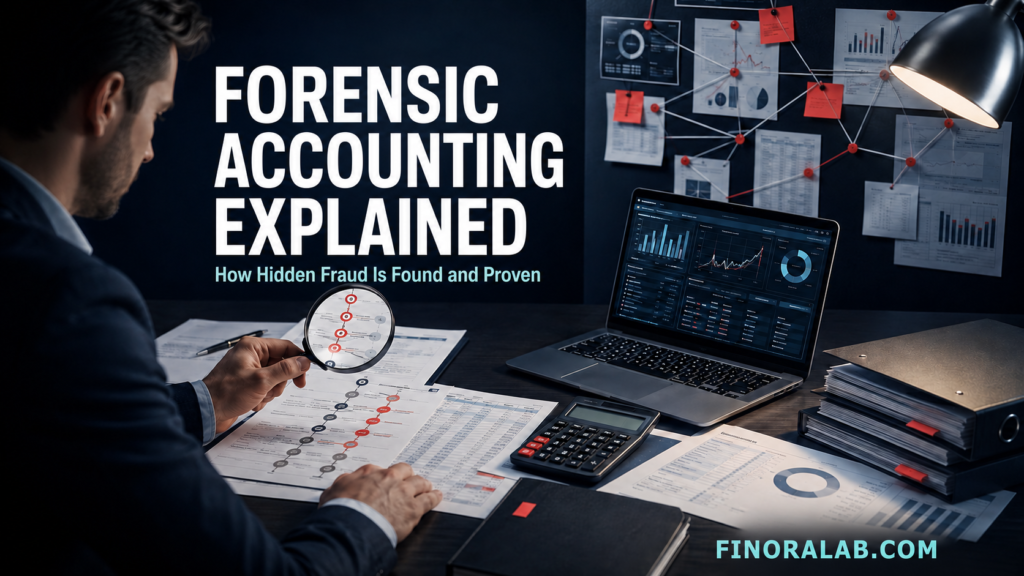
Forensic Accounting Explained: How Hidden Fraud Is Found and Proven
Shanzay Arain·Jul 20, 2026
Financial wrongdoing is rarely recorded as fraud in a companys accounting system. Suspicious transactions may appear as ordinary invoices, employee reimbursements, vendor payments, journal entries, loans, or asset transfers. Identifying what actually happened requires more than reviewing totals on a financial statement.
Forensic accounting combines accounting knowledge, financial analysis, investigative methods, and an understanding of legal evidence. Its purpose is to reconstruct financial events, identify irregularities, quantify losses, and explain the findings clearly enough to assist decision makers, attorneys, regulators, insurers, or courts.
A forensic accountant may trace missing business funds, investigate an employee theft allegation, analyze hidden assets during a divorce, calculate damages in a lawsuit, or determine whether financial statements were manipulated.
This guide explains forensic accounting in simple language, including how an investigation works, common warning signs, potential benefits and risks, professional requirements, expected costs, and recent fraud trends.
What Is Forensic Accounting?
Forensic accounting is the detailed examination of financial records for an investigative or legal purpose. The word forensic indicates that the work may need to withstand legal, regulatory, or formal dispute scrutiny.
The process involves collecting records, testing transactions, tracing funds, interviewing relevant individuals, reviewing electronic data, and documenting conclusions. The accountant must distinguish verified facts from assumptions and explain any limitations in the available evidence.
Forensic accounting is broader than fraud investigation alone. It may be used when no criminal activity is alleged, such as calculating lost profits, valuing economic damages, analyzing partnership disputes, reviewing insurance claims, or tracing marital assets.
A forensic accountant does not normally decide whether a person is legally guilty. That decision belongs to a court or other authorized body. The accountants role is to examine the financial evidence objectively and provide supportable findings.
Quick Summary Table
Category
Key details
Primary purpose
Investigate, reconstruct and explain financial activity
Common users
Businesses, attorneys, insurers, regulators and individuals
Common cases
Fraud, embezzlement, hidden assets, damages and financial disputes
Main evidence
Bank records, ledgers, invoices, emails, contracts and digital files
Common methods
Transaction testing, fund tracing, data analytics and interviews
Typical output
Written report, schedules, visual exhibits or expert testimony
Difference from an audit
Focuses on a specific suspicion, event or dispute
Possible credentials
CPA, CFE and CFF, depending on the professional and jurisdiction
Main benefit
Converts complex financial information into defensible findings
Main limitation
Results depend on evidence quality, access and investigation scope
Cost structure
Hourly, fixed fee, phased or retainer based
Important caution
No investigation can guarantee recovery or a favorable court result
When Is Forensic Accounting Used?
Employee theft and embezzlement
An employee with access to banking, vendor records, payroll, or cash may misuse business funds. Examples include writing unauthorized checks, creating a fictitious supplier, changing vendor bank details, or submitting personal expenses as business costs.
A forensic accountant can compare payments with supporting documents, trace money to recipients, examine approval controls, and calculate the suspected loss.
Financial statement fraud
Financial statement fraud may involve overstated revenue, hidden liabilities, delayed expenses, inflated assets, or unsupported journal entries. The purpose may be to meet performance targets, attract investors, maintain financing, or increase executive compensation.
These cases can require a detailed review of contracts, bank activity, accounting entries, management estimates, and the timing of reported transactions.
Vendor and procurement fraud
A dishonest employee may direct contracts to a related company, approve false invoices, receive kickbacks, or divide purchases to avoid approval limits.
Investigators may compare vendor addresses, ownership details, bank accounts, prices, invoice numbers, approval patterns, and employee relationships.
Divorce and hidden assets
In a divorce or family financial dispute, one party may suspect that income, accounts, investments, real estate, or business assets have not been disclosed.
A forensic accountant may analyze tax returns, bank records, company books, lifestyle spending, related party transactions, and transfers made before or during the dispute.
Business partnership disputes
Partners may disagree over distributions, company expenses, owner compensation, loans, asset transfers, or the accuracy of financial records.
Forensic accounting can reconstruct partner accounts, identify unsupported withdrawals, and calculate the financial effects of disputed activity.
Insurance claims
Insurers and policyholders may use forensic accountants to evaluate business interruption, inventory loss, employee dishonesty, property claims, or lost income.
The accountant assesses whether the claimed amount is supported by historical results, contracts, operating records, and applicable policy terms.
Litigation and economic damages
Courts and attorneys may need help measuring lost profits, unpaid royalties, contract damages, business losses, or the financial consequences of disputed conduct.
The accountant develops a calculation based on appropriate assumptions and available evidence. The opposing party may challenge both the assumptions and methodology.
Bankruptcy and insolvency
In distressed companies, forensic accountants may trace assets, analyze transactions with related parties, examine payments made before bankruptcy, and investigate whether company property was transferred improperly.
Money laundering and financial crime
Complex cases may involve funds passing through multiple accounts, businesses, countries, cryptocurrencies, or intermediaries.
Forensic accountants may create a flow of funds analysis showing where money originated, how it moved, and where it ultimately went.
How Forensic Accounting Works
A forensic investigation begins with a clearly defined question. Find all fraud is generally too broad. A more useful objective might be Determine whether unauthorized payments were made to Vendor X between January 2024 and June 2026.
The accountant then identifies the records required to answer that question. These may include bank statements, general ledger data, invoices, purchase orders, payroll files, tax returns, expense reports, contracts, emails, access logs, and mobile device records.
Data is preserved and organized before detailed testing begins. If litigation is expected, attorneys and technical specialists may help establish procedures for collecting electronic evidence and maintaining its integrity.
The investigator looks for patterns, exceptions, and relationships. Unusual transactions are compared with original documentation, approvals, business purpose, recipient information, and bank activity.
Interviews may be conducted with owners, employees, bookkeepers, vendors, or other knowledgeable individuals. Good investigators usually gather documents before interviewing the primary subject so they can test the persons explanation against the records.
The findings are then evaluated and documented. A professional report should explain the scope, records reviewed, procedures performed, calculations, conclusions, and limitations.
Practical Forensic Accounting Example
Imagine a construction company that notices its material expenses have increased even though project activity has remained stable.
A review identifies a supplier that received $240,000 over two years. The suppliers invoices contain vague descriptions, repeated round amounts, and invoice numbers that do not follow a normal sequence.
A forensic accountant compares those invoices with purchase orders, receiving reports, inventory records, project budgets, and bank payments. Several invoices have no receiving documents, and the listed materials cannot be found in project records.
Public business information shows that the vendors address matches a property connected with an accounts payable employees relative. Payment records then show that part of the money moved from the vendor to an account linked with that employee.
The accountant does not simply state that the expense looks wrong. The final analysis organizes the dates, documents, amounts, approvals, relationships, and flow of funds so that management and legal counsel can decide what action is appropriate.
Forensic Accounting vs Auditing
Traditional auditing and forensic accounting both involve financial records, but their objectives are different.
Traditional financial audit
Forensic accounting investigation
Examines financial statements as a whole
Focuses on a defined allegation, event or dispute
Provides an audit opinion
Develops investigative findings
Uses materiality and sampling
May examine individual transactions in depth
Follows a recurring reporting period
Often begins after a warning sign or legal claim
Not designed to guarantee fraud detection
Specifically investigates suspicious activity
Usually follows established audit procedures
Procedures are tailored to the case
Report has a standardized purpose
Report may support litigation or internal action
Public company auditors are required to consider fraud risks and respond to identified risks, including managements potential override of internal controls. However, an audit does not guarantee that every fraud will be detected.
Forensic accounting typically goes deeper into a specific concern. It may review communications, examine relationships, trace payments, reconstruct deleted records, or test a much larger portion of suspicious transactions.
Methods Used by Forensic Accountants
Financial statement analysis
Investigators compare financial results across periods, departments, locations, and industry expectations. Unexpected changes may indicate an area requiring further examination.
A change is not proof of fraud. Revenue, margins, and expenses may shift for legitimate reasons, so the accountant must seek supporting evidence.
Transaction testing
Transactions may be filtered by amount, date, employee, vendor, approval level, description, payment method, or account classification.
Testing might identify duplicate invoices, payments just below approval limits, weekend journal entries, or transactions involving inactive vendors.
Bank account tracing
A flow of funds analysis follows money through bank accounts and other financial instruments. This can help identify recipients, related accounts, asset purchases, and attempts to conceal ownership.
Data analytics
Specialized software can analyze large accounting datasets more efficiently than manual review. Investigators may search for duplicates, missing sequences, unusual timing, round dollar payments, or relationships between employees and vendors.
Analytics highlights anomalies it does not automatically prove misconduct. Every significant exception needs context and verification.
Document examination
Accountants compare invoices, contracts, purchase orders, checks, tax records, receipts, and supporting schedules. They may identify altered information, inconsistent formatting, missing approvals, or contradictions between documents.
Interviews
Interviews help establish how a process normally works, who had access, what controls existed, and why a transaction occurred. Responses may reveal new records or inconsistencies requiring further testing.
Digital evidence review
Modern investigations frequently involve emails, cloud files, accounting system logs, messaging platforms, mobile devices, and metadata.
Digital forensic specialists may be required to preserve and extract this information properly. A financial investigator should not alter the original electronic evidence.
Warning Signs That May Require Investigation
A single warning sign does not establish that fraud occurred. However, multiple unexplained indicators may justify a closer review.
Common organizational warning signs include
Unexplained cash shortages
Increasing expenses without matching business growth
Missing invoices or supporting documents
Duplicate or sequentially unusual vendor invoices
Payments just below approval thresholds
Frequent manual journal entries
Sudden changes to vendor bank information
Transactions with unknown related parties
Employees refusing to take leave
One person controlling authorization, payment and reconciliation
Unusual payroll employees or overtime
Customer refunds sent to unrelated accounts
Inventory losses that cannot be explained
Management overriding established controls
Financial results that consistently meet targets by very small margins
Behavioral signs should be handled carefully. Personal debt, close vendor relationships, defensiveness, or lifestyle changes are not proof of wrongdoing and should never replace financial evidence.
Step by Step Guide When Fraud Is Suspected
Protect the evidence
Preserve accounting records, bank statements, emails, access logs, devices, contracts, and other relevant information. Do not edit original files.
Limit unnecessary disclosure
Discuss the concern only with people who need to know. Premature accusations can compromise the investigation, cause evidence destruction, damage reputations, and create legal exposure.
Contact legal counsel
An attorney can help define the investigation, address employment issues, preserve legal privileges where applicable, and coordinate reporting obligations.
Define the objective
Identify the allegation, people, accounts, locations, and time period involved. A controlled scope makes the work more efficient and defensible.
Select an independent professional
Choose someone with relevant accounting, investigation, industry, technology, and litigation experience. Confirm that the professional has no disqualifying conflict of interest.
Secure financial accounts
If funds remain at risk, management may need to revise access rights, payment approvals, passwords, or bank instructions. Changes should be coordinated carefully so evidence is preserved.
Conduct the investigation
The forensic team collects records, analyzes transactions, interviews witnesses, traces money, and documents findings.
Review the results
Management and legal counsel should assess the report and decide whether to pursue recovery, insurance claims, disciplinary action, litigation, or regulatory reporting.
Improve controls
After addressing the immediate case, repair the weaknesses that allowed the problem to occur or remain undetected.
Benefits of Forensic Accounting
Forensic accounting provides a structured way to move from suspicion to evidence. This protects organizations from making major decisions based only on rumor or incomplete information.
A well designed investigation can quantify losses, identify responsible transactions, locate assets, explain control failures, and support recovery efforts.
The work can also assist attorneys by translating complex financial data into understandable reports, schedules, charts, and testimony.
Even when fraud is not proven, the investigation may reveal accounting errors, weak documentation, poor supervision, conflicts of interest, or control deficiencies that need attention.
Risks and Limitations
A forensic investigation can be expensive, particularly when records cover several years, data is incomplete, or multiple businesses and jurisdictions are involved.
There is also no guarantee that missing money will be recovered. Funds may have been spent, moved abroad, converted into other assets, or transferred to parties beyond the organizations immediate reach.
Incomplete evidence may prevent a definite conclusion. Skilled professionals should state when the records support only a limited finding rather than overstating certainty.
Investigations can also disrupt employees and normal operations. Confidentiality, communication, and evidence access procedures should be planned carefully.
Incorrectly accusing someone can create serious legal and reputational consequences. Forensic accounting should be objective and evidence led, not designed to confirm managements preferred theory.
Forensic Accounting Fees and Costs
There is no universal forensic accounting price. Fees depend on the professionals experience, location, case complexity, data volume, deadline, and likelihood of litigation.
Common billing arrangements include
Hourly professional rates
A fixed fee for a clearly defined preliminary review
A phased budget for investigation stages
An upfront retainer billed against future work
Separate fees for reports, depositions or expert testimony
A focused review of a limited number of transactions may cost much less than a multi year investigation involving several entities, digital evidence, foreign accounts, and court testimony.
Before engagement, request a written scope describing the objectives, deliverables, billing rates, estimated hours, assumptions, exclusions, and circumstances that could increase fees.
The cheapest investigator may not be the lowest cost choice if the analysis must later be repeated because it was poorly documented or unsuitable for litigation.
Qualifications and Career Requirements
Many forensic accountants begin with a bachelors degree in accounting, finance, or a related discipline. Employers may prefer candidates with auditing, internal control, tax, data analysis, or investigative experience.
A Certified Public Accountant license can demonstrate a strong accounting foundation, although licensing requirements vary by state. Other professionals may hold the Certified Fraud Examiner credential or the Certified in Financial Forensics credential.
Credentials do not replace relevant experience. A professional investigating cryptocurrency theft requires different technical knowledge from someone calculating lost profits in a contract dispute.
Important skills include
Financial accounting and auditing
Data analysis
Interviewing
Critical thinking
Report writing
Evidence documentation
Legal process awareness
Professional skepticism
Clear communication
Independence and ethical judgment
The US Bureau of Labor Statistics does not publish a separate employment projection exclusively for forensic accountants. It projects employment for the broader accountants and auditors category to grow 5% from 2024 through 2034, with approximately 124,200 openings annually on average.
How to Choose a Forensic Accountant
Begin by matching the professionals experience with the problem. Ask whether the accountant has handled similar fraud schemes, industries, data systems, and legal disputes.
Review credentials and licenses independently. Ask for information about prior expert testimony, report writing experience, data analytics capabilities, and professional liability coverage where relevant.
Discuss conflicts of interest before sharing confidential information. The professional should explain how evidence will be collected, stored, protected, and returned.
Ask who will perform the daily work. A senior expert may lead the engagement while associates conduct much of the analysis. Understand the entire teams rates and responsibilities.
Finally, request a clear engagement letter. It should identify the client, purpose, scope, fees, confidentiality provisions, document responsibilities, and anticipated deliverables.
Common Mistakes to Avoid
Confronting the suspected person before preserving evidence
Allowing original electronic files to be changed
Hiring an investigator with a conflict of interest
Defining the investigation too broadly
Assuming every unusual transaction is fraudulent
Ignoring alternative explanations
Focusing only on accounting records while overlooking emails and access logs
Failing to involve legal counsel when litigation is likely
Using normal financial audit procedures for a targeted fraud investigation
Expecting software to prove fraud automatically
Publishing accusations before the evidence is evaluated
Failing to document the chain of custody
Continuing weak payment controls during an investigation
Assuming a successful investigation guarantees financial recovery
Choosing an expert based solely on hourly price
Latest Forensic Accounting and Fraud Update
The Association of Certified Fraud Examiners 2026 global study analyzed 2,402 occupational fraud cases. Its published findings emphasize the relationship between detection speed and financial damage schemes detected within six months produced a median loss of $40,000, while those continuing for more than five years had median losses exceeding $1.1 million. The overall median scheme duration was 12 months. ACFE 2026 findings
These figures do not predict what any particular business will lose. They illustrate why early reporting, transaction monitoring, independent reconciliations, and well designed internal controls matter.
Technology is also changing the profession. Forensic accountants increasingly work with digital forensics specialists and use data analytics to examine entire transaction populations. At the same time, artificial intelligence, synthetic documents, cyber enabled payment fraud, and complex digital assets create new evidence and verification challenges.
Organizations should verify current legal, accounting, regulatory, and professional requirements through authoritative sources. Standards and enforcement expectations can change after an article is published.
Expert Tips for Preventing Financial Fraud
Separate payment responsibilities so the same person cannot create a vendor, approve an invoice, release payment, and reconcile the bank account.
Require independent confirmation whenever a supplier requests new banking information. Use a known telephone number rather than contact details included in the change request.
Review vendor master files for duplicate addresses, accounts, tax numbers, and employee connections.
Establish a confidential reporting channel. Occupational fraud research consistently demonstrates the importance of tips as a detection method.
Require senior employees in financial positions to take leave, and assign another trained person to perform their duties temporarily.
Monitor unusual journal entries, refunds, payroll changes, round dollar payments, and transactions just below approval limits.
Most importantly, respond consistently to warning signs. Controls lose credibility when managers override them without documentation.
Conclusion
Forensic accounting combines financial expertise with investigative methods to reconstruct transactions, trace money, quantify losses, and present findings that can withstand legal or regulatory scrutiny.It can help businesses, attorneys, insurers, government agencies, and individuals address fraud allegations, hidden assets, economic damages, partnership conflicts, and other complex disputes. However, a successful engagement requires a clear scope, preserved evidence, an independent professional, and realistic expectations.
FAQs
What does a forensic accountant do?
A forensic accountant investigates financial records, traces transactions, reviews supporting documents, calculates losses, and prepares findings for management, attorneys, insurers, regulators, or courts.
Is forensic accounting the same as auditing?
No. A financial audit evaluates whether financial statements are fairly presented in all material respects. Forensic accounting usually investigates a specific allegation, transaction, loss, or legal dispute in greater depth.
Can forensic accountants find hidden money?
They may trace money through bank accounts, businesses, assets, and related parties when sufficient records are available. However, they cannot guarantee that every asset will be located or recovered.
How long does a forensic accounting investigation take?
A limited review may take several weeks, while a complex multi year investigation can take months or longer. Timing depends on scope, record availability, cooperation, data volume, and litigation requirements.
How much does forensic accounting cost?
Costs vary widely. Professionals may charge hourly rates, fixed fees, phased budgets, or retainers. A written scope and estimate should be obtained before work begins.
Do forensic accountants testify in court?
Some forensic accountants serve as expert witnesses, explain financial calculations, prepare exhibits, give depositions, and testify in court. Not every forensic engagement results in testimony.
What qualifications should a forensic accountant have?
Relevant qualifications may include accounting education, a CPA license, CFE or CFF credentials, investigative experience, data analysis skills, and knowledge of the industry and legal issue involved.
I am a professional finance content writer with expertise in personal finance investing, banking, loans, insurance, credit cards, budgeting, and market related topics. I create clear, SEO optimized, and reader friendly finance content that helps audiences understand complex financial concepts in simple words. My goal is to write trustworthy and engaging content that improves search visibility, builds credibility, and supports business growth.
I am a professional finance content writer with expertise in personal finance investing, banking, loans, insurance, credit cards, budgeting, and market related topics. I create clear, SEO optimized, and reader friendly finance content that helps audiences understand complex financial concepts in simple words. My goal is to write trustworthy and engaging content that improves search visibility, builds credibility, and supports business growth.