
The stock market can feel intimidating when you first enter the world of investing. New investors often hear words like “bull market” “market capitalization” “dividends” “P/E ratio” or “blue-chip stocks” and immediately feel overwhelmed. Financial media moves quickly investment influencers throw around technical phrases and social media creators often assume everyone already understands the language of Wall Street. That confusion is exactly why learning stock market terminology is one of the most important first steps in building long-term financial confidence.
Understanding investing language is not just about memorizing definitions. It changes how people think about money risk wealth creation and financial decision-making. Investors who understand stock market terminology can interpret financial news more effectively avoid emotional mistakes evaluate opportunities intelligently and communicate confidently about investing strategies. In many ways financial vocabulary becomes a gateway to broader financial literacy.
The modern investment world also looks very different from previous decades. Today millions of everyday people invest through apps retirement accounts ETFs creator-led finance communities and online brokerages. Social media YouTube finance channels digital newsletters and investing podcasts have made market participation more accessible than ever. However easier access has also created misinformation hype-driven trading and emotional investing behavior. Learning proper stock market terminology helps investors separate genuine financial knowledge from internet noise.
This guide explores the most important stock market terms every investor should know while also explaining how those concepts apply to real-world investing wealth-building entrepreneurship financial psychology and long-term asset growth. Instead of simply listing definitions this article explains why these terms matter and how they shape investor behavior in modern financial markets.
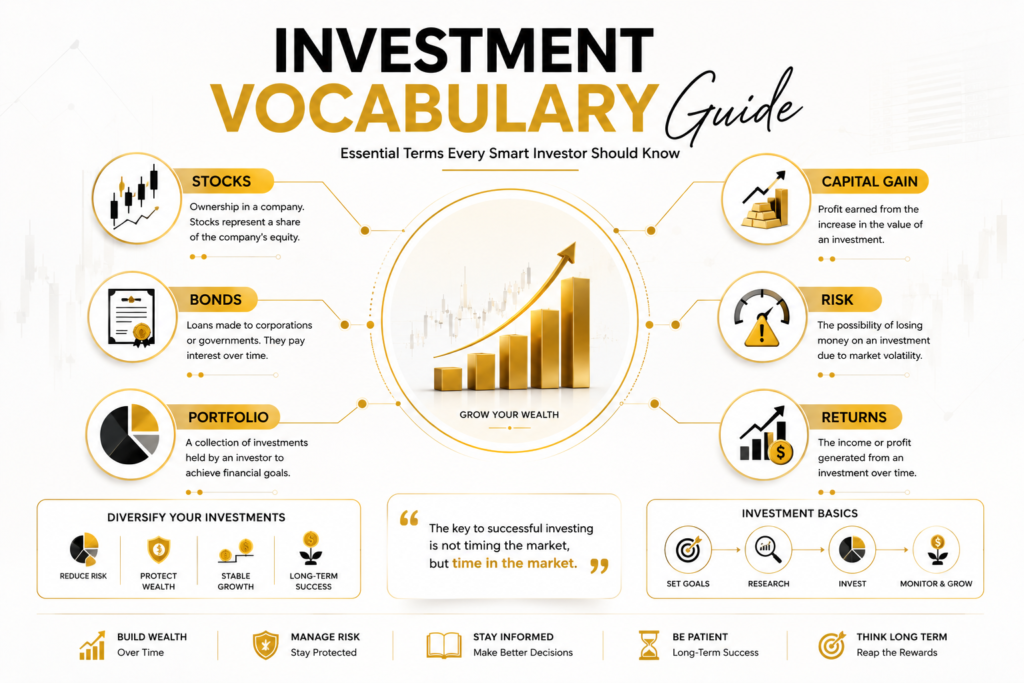
Why Stock Market Terminology Matters in Modern Investing
Financial language acts like a map. Without understanding basic investing terms even intelligent people struggle to navigate the stock market confidently. Many beginner investors lose money not because they lack ambition but because they misunderstand how markets actually function.
For example someone who does not understand volatility may panic during temporary market declines and sell investments at the worst possible moment. Another investor may misunderstand valuation metrics and buy overhyped companies trading at unrealistic prices. These mistakes often happen because financial terminology represents deeper investing concepts rather than isolated vocabulary words.
Stock market terminology also matters because investing has become deeply connected to modern culture. Celebrities influencers entrepreneurs athletes and content creators frequently discuss stocks crypto startups passive income and wealth-building online. Financial conversations are now part of mainstream internet culture. People who understand investing language participate more confidently in these discussions and make better financial decisions over time.
The rise of retail investing during the past decade also increased the importance of financial education. Commission-free trading apps made investing accessible to millions of first-time investors. While this democratized market participation it also created environments where hype spreads faster than informed analysis. Investors who understand terms like liquidity earnings growth diversification and risk management are less likely to fall into emotional speculation cycles.
Another reason terminology matters is because investing increasingly influences long-term financial security. Retirement planning wealth accumulation inflation protection and passive income generation often depend on stock market participation. Understanding the language of investing allows individuals to build stronger financial habits and make smarter long-term decisions.
Basic Stock Market Terminology Every Investor Should Know
One of the most important stock market terms is “share.” A share represents partial ownership in a company. When investors buy shares of a business they own a small piece of that company and potentially benefit from future growth profits and market appreciation.
Another foundational term is “stock exchange.” This refers to marketplaces where investors buy and sell securities. Major exchanges include New York Stock Exchange and NASDAQ. These exchanges facilitate trading and provide transparency for buyers and sellers.
“Market capitalization” often called market cap refers to the total value of a company’s outstanding shares. Large-cap companies like Apple or Microsoft are generally considered more stable than small-cap companies because they have larger business operations and financial resources.
“Bull market” and “bear market” are also essential investing terms. A bull market describes periods when stock prices rise consistently and investor confidence remains strong. A bear market occurs when prices decline significantly often accompanied by fear and economic uncertainty. Understanding these cycles helps investors manage emotions more effectively.
Another important term is “portfolio.” A portfolio represents the collection of investments owned by an individual or institution. Strong portfolios are typically diversified across sectors industries or asset classes to reduce risk exposure.
“Dividend” refers to a portion of company profits distributed to shareholders. Dividend-paying companies are popular among investors seeking passive income because they generate recurring cash flow even during slower market periods.
Learning these basic concepts creates the foundation for understanding more advanced investing strategies and financial discussions.

Understanding Bull Markets Bear Markets and Market Cycles
One of the most emotionally important aspects of investing involves understanding market cycles. Financial markets do not move upward continuously. They operate through recurring cycles influenced by economic conditions investor psychology interest rates technological innovation geopolitical events and corporate earnings performance.
A bull market typically reflects optimism economic growth strong consumer spending and rising corporate profits. During these periods investors often become more confident and willing to take risks. Technology stocks growth companies startups and speculative investments usually attract increased attention in bullish environments.
However prolonged bull markets can also create irrational behavior. Investors sometimes assume prices will continue rising indefinitely leading to overvaluation and speculative bubbles. Financial history repeatedly shows that excessive optimism often precedes corrections or downturns.
Bear markets create the opposite psychological environment. Falling stock prices increase fear and uncertainty. News headlines become negative investors panic and market volatility rises sharply. Many inexperienced investors sell assets during bear markets because they fear further losses.
Ironically some of the greatest long-term investing opportunities emerge during market downturns. Wealthy investors often view bear markets as periods when quality assets become temporarily undervalued. Long-term investors who remain disciplined during market declines frequently benefit significantly when markets recover.
Understanding stock market terminology related to market cycles helps investors avoid emotional decision-making. Successful investing requires recognizing that volatility is normal rather than treating every downturn as a financial catastrophe.
Key Financial Metrics and Valuation Terms
Modern investing relies heavily on financial metrics that help investors evaluate whether companies appear overvalued undervalued profitable or financially stable. One of the most common metrics is the “price-to-earnings ratio” commonly known as the P/E ratio. This compares a company’s stock price to its earnings per share.
A high P/E ratio may suggest investors expect strong future growth while a low P/E ratio could indicate slower growth expectations or undervaluation. However context matters greatly. Technology companies often trade at higher valuations because investors anticipate rapid future expansion.
“Earnings per share” or EPS measures how much profit a company generates for each outstanding share. Rising EPS often signals improving business performance and operational strength. Investors closely monitor earnings reports because they reveal whether companies are meeting growth expectations.
“Revenue” refers to total company income before expenses. “Net income” represents profit after costs taxes and operational expenses are deducted. Strong revenue growth combined with healthy profit margins usually attracts investor interest.
Another important term is “book value” which reflects the theoretical value of a company’s assets minus liabilities. Value investors often compare stock prices to book value when searching for potentially undervalued companies.
“Return on equity” or ROE measures how effectively management uses shareholder capital to generate profits. High ROE often indicates efficient business operations and strong financial management.
These financial metrics matter because stock prices ultimately reflect expectations about future earnings growth and profitability. Investors who understand valuation terminology make more informed decisions rather than blindly following hype-driven market trends.
Growth Stocks Value Stocks and Blue-Chip Companies
Different types of stocks attract different investor personalities and financial goals. “Growth stocks” refer to companies expected to increase revenue and earnings rapidly over time. These businesses often reinvest profits into expansion instead of paying dividends. Technology companies frequently fall into this category because innovation-driven industries can scale quickly.

Growth investing became especially popular during the digital economy boom. Companies connected to artificial intelligence cloud computing electric vehicles and e-commerce attracted enormous investor attention because markets anticipated future dominance. However growth stocks can also be volatile because valuations depend heavily on future expectations.
“Value stocks” represent companies considered undervalued relative to their financial fundamentals. Value investors search for businesses trading below their intrinsic worth due to temporary market pessimism or economic uncertainty. This investing philosophy became famous through legendary investors like Warren Buffett.
“Blue-chip stocks” describe large financially stable companies with long operating histories and reliable performance. These businesses often dominate their industries and maintain strong reputations among investors. Companies like Coca-Cola and Johnson & Johnson are frequently considered blue-chip investments.
Understanding these categories helps investors align strategies with personal goals and risk tolerance. Younger investors may prioritize growth opportunities while retirees often prefer dividend-paying blue-chip companies that provide stability and passive income.
The rise of social media investing also influenced how investors view these categories. Meme stocks influencer-driven trends and viral investing narratives sometimes blur traditional valuation logic making financial education even more important.
Dividends Passive Income and Long-Term Wealth Building
One reason stock market terminology matters so much is because investing directly connects to long-term wealth creation. Dividends are particularly important for investors interested in passive income strategies and financial independence.
A dividend is a payment distributed by companies to shareholders usually from profits. Dividend-paying companies are often mature businesses with stable cash flows. Utilities healthcare companies banks and consumer goods corporations frequently pay regular dividends because their businesses generate consistent revenue.
Dividend investing became increasingly popular as people searched for alternative income streams beyond traditional employment. Many investors use dividends to supplement retirement income reinvest for compound growth or create recurring cash flow without actively trading stocks.
“Dividend yield” refers to the annual dividend payment relative to the stock price. Higher yields may appear attractive but extremely high yields can sometimes indicate financial distress or unsustainable payout ratios. Smart investors analyze dividend sustainability rather than chasing the largest percentages.
“Compound growth” is another essential investing concept. Reinvested dividends purchase additional shares which then generate more dividends over time. This compounding effect can dramatically increase wealth during long investment horizons.
Passive income investing also reflects broader economic changes. Rising living costs inflation concerns and uncertain job markets pushed more individuals toward investing as part of long-term financial planning. Stock market terminology related to dividends yields and compounding therefore became increasingly relevant to everyday financial life.
Trading Terminology and Modern Market Behavior
The rise of online brokerages and social media transformed trading culture dramatically. Millions of new investors entered markets through mobile apps YouTube tutorials TikTok finance creators and investing communities. As a result trading terminology became mainstream internet language.
A “broker” refers to a platform or institution facilitating investment transactions. Popular brokerages now allow commission-free trading making stock market participation accessible to smaller investors.
“Day trading” involves buying and selling securities within the same trading day. Day traders attempt to profit from short-term price movements rather than long-term company growth. While social media often glamorizes day trading lifestyles the reality is extremely risky and emotionally demanding.
“Volatility” describes how dramatically asset prices fluctuate. Highly volatile stocks can rise or fall rapidly within short periods. Growth companies meme stocks and speculative assets often experience elevated volatility levels.

“Liquidity” refers to how easily assets can be bought or sold without significantly affecting market prices. Highly liquid investments generally have active trading volume and tighter bid-ask spreads.
Another common term is “short selling” where traders bet against a stock by borrowing shares and selling them in anticipation of price declines. Short squeezes became widely discussed during meme stock events involving companies like GameStop.
Modern market behavior increasingly reflects the influence of online communities influencer narratives algorithmic trading systems and real-time information sharing. Understanding trading terminology helps investors navigate these fast-moving environments more responsibly.
ETFs Index Funds and Diversification Strategies
One of the most important developments in modern investing is the rise of low-cost diversified investing through ETFs and index funds. These investment vehicles simplified market participation for millions of people worldwide.
An “ETF” or exchange-traded fund is a collection of assets traded like a stock on public exchanges. ETFs may track indexes industries commodities or specific investing themes such as artificial intelligence or renewable energy.
“Index funds” aim to replicate the performance of market indexes like the S&P 500. Instead of trying to outperform markets through active stock selection index investing focuses on broad market exposure with lower fees.
Diversification is a key principle behind these strategies. Diversified portfolios spread investments across multiple companies industries and sectors to reduce the impact of individual investment failures.
The popularity of ETFs reflects changing investor behavior. Many younger investors prefer simple long-term investing systems over constant trading. Passive investing strategies also gained popularity because research consistently showed many actively managed funds underperform market indexes over long periods.
Financial advisors frequently recommend diversified investing because it balances growth potential with risk management. Investors who understand diversification terminology are generally less vulnerable to emotionally chasing speculative trends.
The ETF industry also demonstrates how financial innovation evolves with consumer demand. Today investors can access thematic ETFs focused on AI creator economy businesses digital infrastructure fintech cybersecurity or sustainable energy trends.
Risk Management and Emotional Investing Psychology
One of the biggest reasons investors fail is not lack of intelligence but poor emotional control. Understanding stock market terminology related to risk management helps investors avoid destructive financial behavior during volatile periods.
“Risk tolerance” refers to an investor’s ability to handle market fluctuations emotionally and financially. Younger investors with long time horizons often accept higher volatility because they have more time to recover from downturns.
“Asset allocation” describes how investments are distributed across categories such as stocks bonds real estate or cash. Strategic asset allocation reduces dependence on any single market segment.
“Stop-loss orders” automatically sell investments if prices fall below predetermined levels. Traders use these tools to limit losses during volatile market conditions.
Fear and greed dominate market psychology repeatedly throughout history. During bull markets greed encourages excessive speculation and risky behavior. During bear markets fear causes panic selling and emotional decision-making.
Social media intensified emotional investing because online narratives spread rapidly. Influencers celebrity investors and viral finance content can create unrealistic expectations about overnight wealth. Many inexperienced investors chase momentum without understanding valuation or risk principles.
Financial literacy acts as emotional protection. Investors who understand stock market terminology are more likely to remain disciplined during uncertainty because they recognize market volatility as normal rather than catastrophic.
How Stock Market Terminology Connects to Wealth and Entrepreneurship
Investing terminology is no longer limited to Wall Street professionals. Entrepreneurs creators influencers athletes and digital business owners increasingly discuss stocks equity startup funding and asset building publicly.
Many celebrities and creators now invest in startups private equity fintech companies and public markets as part of long-term wealth strategies. Instead of relying solely on sponsorships or entertainment income they diversify into ownership-based assets.
This shift reflects a broader financial trend: modern wealth increasingly comes from ownership rather than labor alone. Entrepreneurs who understand investing language make smarter decisions about capital allocation fundraising partnerships and long-term growth.
Terms like “equity” “valuation” “IPO” and “capital gains” became mainstream because startup culture and creator economy businesses now dominate financial conversations online. Even social media influencers discuss stock portfolios real estate investments and passive income systems with their audiences.

The rise of digital business models also changed how younger generations approach wealth creation. Many individuals view investing as an essential complement to entrepreneurship rather than a separate activity. Understanding stock market terminology therefore supports broader financial literacy across multiple industries and income streams.
Ultimately investing language represents more than technical finance vocabulary. It reflects how modern economies function and how individuals participate in long-term wealth creation.
Conclusion
Learning stock market terminology is one of the most valuable financial investments a person can make. Understanding investing language transforms confusing market headlines into meaningful information and helps individuals make smarter decisions about wealth creation risk management and long-term financial planning.
The stock market is not merely a place where shares trade daily. It represents the global engine of innovation entrepreneurship business growth and capital allocation. Investors who understand concepts like diversification valuation dividends market cycles and portfolio management gain the confidence to navigate financial uncertainty more effectively.
Modern investing environments move faster than ever due to social media digital trading platforms creator-led finance communities and real-time global news cycles. This makes financial literacy increasingly important because misinformation hype and emotional investing behavior spread rapidly online.
At the same time stock market terminology connects directly to broader wealth-building opportunities. Passive income investing entrepreneurship startup investing retirement planning and long-term asset growth all rely on understanding financial concepts clearly.
For beginners the goal should not be memorizing every complex financial term immediately. Instead focus on building a strong foundation gradually. The more investors understand market language the more confidently they can participate in financial systems that shape long-term economic security and personal wealth growth.
FAQs
What is stock market terminology?
Stock market terminology refers to the words phrases and financial concepts used in investing and trading. These terms help investors understand market behavior company performance risk management and wealth-building strategies.
Why is learning stock market terminology important?
Understanding investing language helps individuals make smarter financial decisions avoid emotional investing mistakes interpret market news accurately and build long-term confidence in stock market participation.
What are the most important stock market terms for beginners?
Some essential beginner terms include stocks shares dividends market capitalization portfolio bull market bear market volatility ETF diversification and price-to-earnings ratio.
What is the difference between a bull market and a bear market?
A bull market occurs when stock prices rise consistently and investor confidence remains strong. A bear market happens when prices decline significantly and market sentiment becomes pessimistic.
What is an ETF in stock market terminology?
An ETF or exchange-traded fund is an investment fund traded on stock exchanges. ETFs typically contain multiple assets and help investors diversify portfolios easily and cost-effectively.
How does diversification reduce investing risk?
Diversification spreads investments across multiple assets industries or sectors. This reduces the impact of poor performance from any single investment and improves long-term portfolio stability.
Can understanding stock market terminology improve wealth building?
Yes. Investors who understand financial concepts make more informed decisions about investing passive income risk management and long-term financial planning which supports sustainable wealth growth.

I am a professional finance content writer with expertise in personal finance investing, banking, loans, insurance, credit cards, budgeting, and market related topics. I create clear, SEO optimized, and reader friendly finance content that helps audiences understand complex financial concepts in simple words. My goal is to write trustworthy and engaging content that improves search visibility, builds credibility, and supports business growth.