
If you are planning to buy a home one of the first questions you will probably ask is: what credit score do you need to buy a house? Your credit score plays a major role in determining whether you qualify for a mortgage what interest rate you receive and how affordable your monthly payments will be. In many ways your credit score acts like a financial report card for lenders.
Buying a house is one of the biggest financial decisions most people ever make. Mortgage lenders want to see evidence that borrowers can manage debt responsibly and make payments on time. That is why credit scores are so important in the home loan approval process.
The good news is that you do not always need a perfect credit score to buy a house. Different loan programs have different requirements and many lenders work with borrowers who have average or even below-average credit. However a stronger credit score can unlock better loan options lower interest rates and smaller monthly payments.
Understanding what credit score do you need to buy a house helps buyers prepare financially before applying for a mortgage. It also helps borrowers avoid surprises during the approval process. In this guide you will learn how credit scores affect home loans minimum score requirements for different mortgage programs how lenders evaluate borrowers ways to improve your score and how financial calculators can help you plan smarter home purchases.
Key Takeaways
- Credit scores strongly influence mortgage approval and interest rates.
- Most conventional mortgage lenders prefer scores of 620 or higher.
- FHA loans may allow lower credit scores with larger down payments.
- Higher credit scores usually result in lower monthly mortgage payments.
- Debt-to-income ratio and income also affect mortgage approval.
- Mortgage calculators help buyers estimate affordability and loan costs.

What Is a Credit Score?
A credit score is a numerical rating that reflects how responsibly you manage borrowed money. Lenders use this score to evaluate financial risk before approving loans or credit cards.
Credit scores are usually based on:
- Payment history
- Credit usage
- Length of credit history
- Types of credit accounts
- Recent credit inquiries
Most credit scoring systems range between:
- 300 to 850
Generally higher scores indicate lower lending risk.
Why Credit Scores Matter When Buying a House
Mortgage lenders use credit scores to determine:
- Loan approval eligibility
- Interest rates
- Down payment requirements
- Loan terms
- Mortgage insurance costs
A strong credit score signals financial responsibility while a lower score may increase lender concerns.
Even small differences in interest rates can dramatically affect total mortgage costs over 15 or 30 years.
What Credit Score Do You Need to Buy a House?
The minimum credit score needed depends on the type of mortgage loan.
Conventional mortgages are among the most common home loan types.
Conventional Loans
Most lenders prefer a minimum credit score of:
- 620 or higher
Borrowers with stronger scores often qualify for better interest rates and lower fees.
FHA Loans
FHA loans are government-backed mortgages designed for buyers with lower credit scores.
Typical requirements include:
| Credit Score | Minimum Down Payment |
| 580+ | 3.5% |
| 500–579 | 10% |
FHA loans are popular among first-time homebuyers.
VA Loans

VA loans are available for eligible military service members and veterans.
Many VA lenders accept lower credit scores although requirements vary by lender.
USDA Loans
USDA loans support rural homebuyers and may allow moderate credit scores depending on the lender and applicant profile.
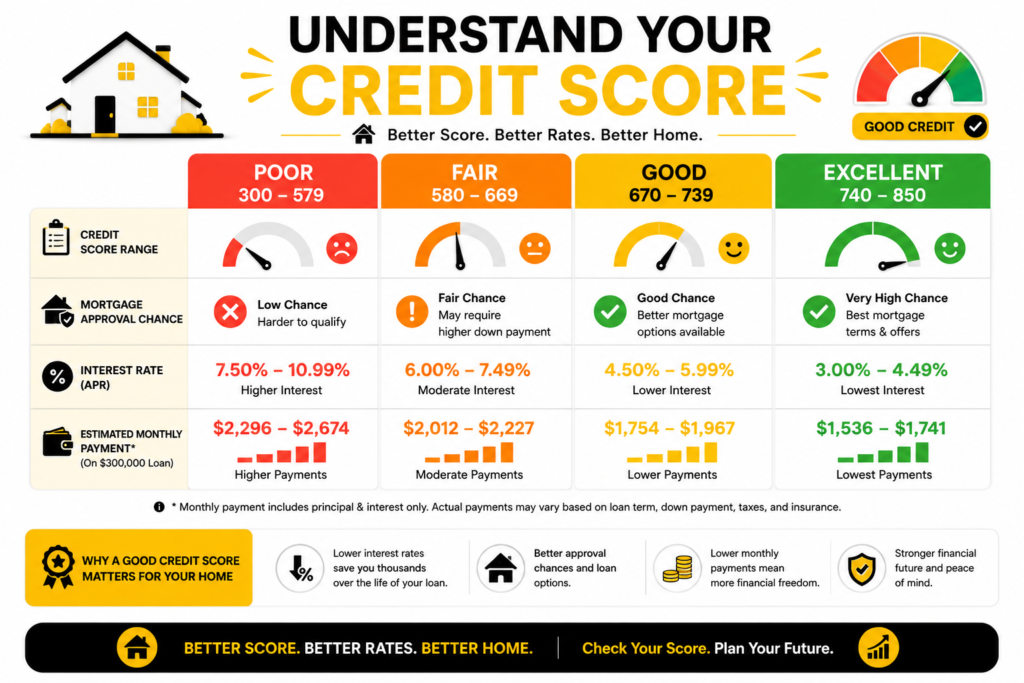
Credit Score Ranges Explained
Understanding score ranges helps buyers evaluate mortgage readiness.
| Credit Score Range | Rating |
| 800–850 | Excellent |
| 740–799 | Very Good |
| 670–739 | Good |
| 580–669 | Fair |
| Below 580 | Poor |
Higher scores usually lead to better loan conditions and lower interest rates.
How Credit Scores Affect Mortgage Interest Rates
Interest rates are one of the biggest long-term costs of homeownership.
A borrower with a higher credit score often receives lower mortgage rates.
For example:
| Credit Score | Estimated Mortgage Rate |
| 760+ | Lower rate |
| 620 | Higher rate |
Over a 30-year mortgage even a 1% rate difference can add thousands of dollars in extra interest.
Example of Mortgage Cost Differences
Suppose two buyers each borrow $350000 for a 30-year mortgage.
- Buyer A has excellent credit
- Buyer B has fair credit
Buyer B may receive a higher interest rate resulting in:
- Larger monthly payments
- More total interest
- Higher lifetime loan costs
This demonstrates why improving credit scores before applying for mortgages can create substantial savings.
How Mortgage Payments Are Calculated
Mortgage lenders calculate payments using formulas that include:
- Loan amount
- Interest rate
- Loan term
The standard mortgage formula is:
M = P \times \frac{r(1+r)^n}{(1+r)^n-1}
Where:
- M = Monthly payment
- P = Loan principal
- r = Monthly interest rate
- n = Total number of monthly payments
Mortgage calculators simplify these calculations instantly.
Factors Lenders Consider Besides Credit Scores
Although credit scores are important lenders also evaluate other financial details.
Debt-to-Income Ratio (DTI)
DTI compares monthly debt payments to monthly income.
Lower DTI ratios improve mortgage approval chances.
Employment History
Stable employment demonstrates reliable income.
Down Payment Amount
Larger down payments reduce lender risk.
Savings and Assets
Emergency savings and financial reserves strengthen mortgage applications.
How to Improve Your Credit Score Before Buying a House
Pay Bills on Time
Payment history is one of the most important credit score factors.
Consistent on-time payments improve credit health over time.
Reduce Credit Card Balances
High credit utilization may lower scores.
Many experts recommend keeping utilization below 30%.
Avoid Opening Too Many New Accounts
Frequent credit applications can temporarily reduce scores.
Check Credit Reports Regularly
Review reports for errors or fraudulent activity.
Keep Older Accounts Open
Longer credit history can support stronger scores.
Common Mistakes Homebuyers Make
Applying for New Loans Before Closing
Opening new credit accounts during mortgage approval may create problems.
Ignoring Credit Report Errors
Incorrect information can lower scores unnecessarily.
Spending Savings on Nonessential Purchases
Large purchases before buying a home may reduce financial stability.
Focusing Only on Approval
Buyers should evaluate affordability not just loan eligibility.
First-Time Homebuyers and Credit Scores
Many first-time buyers worry they need perfect credit to purchase a house.
In reality several mortgage programs support moderate credit scores.
First-time buyers often benefit from:
- FHA loans
- Down payment assistance programs
- Government-backed mortgages
- Credit counseling resources
Preparation and planning are more important than perfection.
Real-World Applications of Credit Scores in Home Buying
Mortgage Approval
Credit scores directly influence mortgage eligibility.
Refinancing
Higher scores may qualify homeowners for lower refinance rates.
Real Estate Investing
Investors often rely on strong credit to secure financing.
Financial Planning
Improving credit scores can reduce borrowing costs across many financial products.

How Mortgage Calculators Help Buyers
Mortgage calculators simplify home financing analysis.
They estimate:
- Monthly mortgage payments
- Interest costs
- Loan affordability
- Down payment scenarios
Buyers can compare different loan options quickly and make informed decisions.
Related Financial Tools
EMI Calculator
EMI Calculators estimate monthly installment payments for loans.
ROI Calculator
ROI Calculators help evaluate real estate investment returns.
SIP Calculator
SIP Calculators estimate long-term investment growth.
Compound Interest Calculator
Compound interest growth is calculated using:
genui{“math_block_widget_always_prefetch_v2”:{“content”:”A = P\left(1+\frac{r}{n}\right)^{nt}”}}
Where:
- A = Final amount
- P = Initial investment
- r = Interest rate
- n = Number of compounding periods
- t = Time
Loan Calculator
Loan Calculators estimate repayment schedules and borrowing costs.
Tax Calculator
Tax Calculators help estimate property tax and income tax impacts.
The Historical Role of Credit Scores in Lending
Credit scoring systems became widely used during the 20th century as banks sought more standardized ways to evaluate borrowers.
Over time computerized credit scoring improved lending efficiency and expanded access to mortgages.
Today credit scores remain central to modern banking and home financing systems.
Advantages of Having a Higher Credit Score
Lower Interest Rates
Better scores often reduce borrowing costs significantly.
Easier Loan Approval
Lenders generally prefer lower-risk borrowers.
Lower Monthly Payments
Reduced interest rates lower long-term mortgage expenses.
Better Financial Opportunities
Strong credit improves access to loans credit cards and refinancing options.
Challenges of Buying a House With Low Credit
Higher Interest Rates
Lower scores usually increase borrowing costs.
Larger Down Payment Requirements
Some programs require bigger upfront payments for lower-credit borrowers.
Stricter Approval Standards
Lenders may request additional documentation or financial reserves.
Limited Loan Choices
Borrowers with poor credit may have fewer financing options.
Tips for Preparing Financially Before Buying a House
Improve Credit Early
Start improving credit several months before applying for a mortgage.
Save for a Down Payment
Larger down payments reduce monthly costs and improve approval chances.
Reduce Existing Debt
Lower debt improves debt-to-income ratios.
Compare Multiple Lenders
Mortgage terms vary significantly between lenders.
Use Mortgage Calculators Frequently
Mortgage tools help buyers understand affordability before making commitments.
Conclusion
Understanding what credit score do you need to buy a house is one of the most important steps in preparing for homeownership. While many buyers assume they need perfect credit the reality is that mortgage options exist for a wide range of credit profiles. However stronger credit scores usually lead to lower interest rates smaller monthly payments and better loan terms.
Mortgage lenders evaluate more than just credit scores. They also consider income debt levels employment history savings and down payment size. This means buyers can improve their approval chances through smart financial planning even if their scores are not perfect.
Using tools like Mortgage Calculators EMI Calculators Loan Calculators ROI Calculators SIP Calculators Compound Interest Calculators and Tax Calculators can make the home-buying process easier and more transparent. With preparation discipline and financial awareness buyers can move closer to achieving successful and sustainable homeownership.
FAQs
What credit score do you need to buy a house?
Most conventional lenders prefer credit scores of at least 620 although some government-backed loans allow lower scores.
Can I buy a house with a 580 credit score?
Yes. FHA loans may allow borrowers with 580 credit scores to qualify with a smaller down payment.
Is a 700 credit score good for buying a house?
Yes. A 700 credit score is generally considered good and may qualify borrowers for competitive mortgage rates.
Do higher credit scores lower mortgage payments?
Yes. Higher scores often qualify borrowers for lower interest rates reducing monthly payments.
What is the minimum credit score for an FHA loan?
Many FHA loans require:
- 580 for 3.5% down payment
- 500–579 for 10% down payment
Can I buy a house with bad credit?
It may still be possible through specialized loan programs although interest rates and down payment requirements may be higher.
How long does it take to improve a credit score?
Improvement timelines vary but consistent on-time payments and debt reduction often help over several months.
What other factors matter besides credit score?
Lenders also evaluate:
- Income
- Debt-to-income ratio
- Employment history
- Savings
- Down payment amount