
Managing money wisely has become one of the most important life skills in the modern financial world. People save money for different reasons including emergency funds education vacations retirement future investments and financial security. While saving money in a bank account is considered safe and reliable many people fail to understand how interest helps their money grow over time. This is where a savings account interest calculator becomes an extremely useful financial tool for individuals of all income levels.
A savings account interest calculator helps users estimate how much their savings can grow based on factors like deposit amount annual percentage yield interest rate monthly contributions and compounding frequency. Instead of manually calculating future balances users can instantly see projections that help them make smarter financial decisions. Whether someone is opening their first savings account or planning long-term wealth growth understanding how interest works can make a major difference in financial outcomes.
In today’s economy banks and financial institutions offer many types of savings accounts with varying interest rates and compounding methods. Some accounts provide simple interest while others offer compound interest that accelerates growth over time. A calculator simplifies these calculations and provides clear estimates that are easy to understand. This helps users compare accounts set realistic goals and build financial discipline.
The popularity of online banking and digital finance platforms has also increased the demand for financial calculators. Consumers now expect instant information before making decisions. A savings account interest calculator provides transparency and helps users avoid confusion about interest earnings. It turns complex financial mathematics into practical insights that anyone can use regardless of financial experience.
Understanding how savings grow is not only important for adults but also for students young professionals families and retirees. Learning to calculate interest encourages better saving habits and supports long-term financial planning. This guide explores everything about savings calculators interest growth compounding banking strategies and how to maximize earnings effectively.
Understanding How Savings Account Interest Works
Interest is the amount a bank pays customers for keeping money deposited in a savings account. Banks use deposited funds for lending and other financial activities and in return they compensate depositors through interest payments. Although interest may seem small at first over time it can significantly increase total savings especially when compounded regularly.
Savings accounts generally use annual percentage yield or APY to show expected yearly returns. APY includes the effects of compounding which means interest is earned not only on the original deposit but also on previously earned interest. This creates a snowball effect where savings gradually grow faster over time. Understanding this process is essential for making the best use of a savings account interest calculator.
There are two primary types of interest used in savings accounts. Simple interest is calculated only on the original principal amount deposited. Compound interest is calculated on both the principal and accumulated interest. Most modern savings accounts use compound interest because it rewards long-term savers more effectively.
The frequency of compounding also impacts savings growth. Some accounts compound annually while others compound quarterly monthly daily or continuously. The more frequently interest compounds the faster money grows. Even small differences in compounding frequency can create noticeable increases in long-term balances.
Inflation is another important factor connected to savings interest. Although savings accounts help protect money inflation can reduce purchasing power over time. This is why finding competitive interest rates matters. Using calculators helps individuals compare potential returns and choose accounts that better support financial growth.
Interest rates can also change depending on economic conditions central bank policies and competition among financial institutions. Online banks often offer higher interest rates than traditional banks because they have lower operational costs. Understanding these differences helps users maximize the benefits of their savings accounts.
What Is a Savings Account Interest Calculator
A savings account interest calculator is an online or digital financial tool designed to estimate future savings growth. It uses mathematical formulas to calculate interest earnings over a specified period. Users enter details such as initial deposit monthly contributions interest rate compounding frequency and time duration to generate projected balances.
These calculators simplify financial planning because manual interest calculations can become complicated especially with compound interest. Instead of using spreadsheets or formulas users can instantly view future earnings within seconds. This convenience makes calculators valuable for beginners and experienced savers alike.
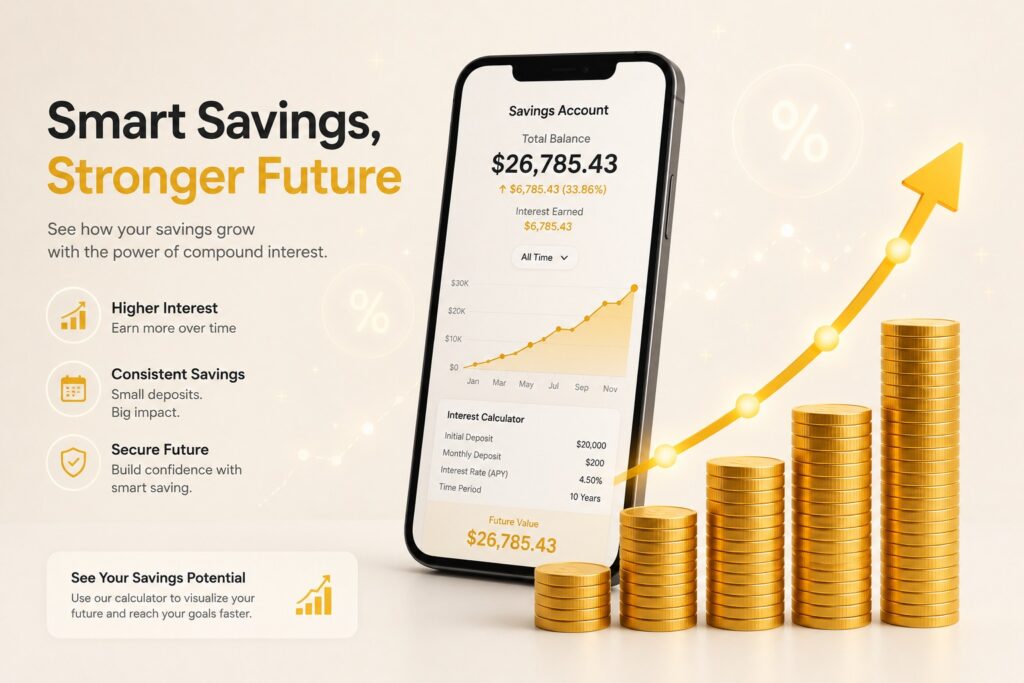
Most calculators display results including total balance total deposits total interest earned and estimated growth over time. Some advanced tools also provide graphs and yearly breakdowns that visually demonstrate savings progress. These visual insights encourage consistent saving habits and help users remain motivated.
A savings account interest calculator can also assist people in comparing multiple savings scenarios. For example someone may compare the impact of saving $100 monthly versus $300 monthly. Others may evaluate how switching from a lower interest rate to a higher one affects future wealth accumulation. These comparisons help users make smarter financial decisions.
Many financial websites and banking platforms provide free calculators that are easy to use. These tools are particularly useful for budgeting and goal planning. Whether someone wants to save for a car home emergency fund or retirement a calculator provides realistic estimates that support strategic financial planning.
The tool also teaches important financial concepts through practical experience. Users quickly learn how time consistency and compound interest influence long-term savings growth. This educational value makes calculators beneficial for students and individuals who want to improve financial literacy.
Why Compound Interest Is So Powerful
Compound interest is often called one of the most powerful concepts in finance because it allows money to grow exponentially over time. Unlike simple interest compound interest continuously builds upon previous earnings. This means savers earn interest on both their original deposits and accumulated interest.
The longer money remains in a savings account the greater the effects of compounding become. Small deposits made consistently over several years can eventually grow into substantial amounts. This demonstrates why starting early is one of the best financial decisions anyone can make.
A savings account interest calculator clearly illustrates the power of compounding. For example someone depositing a modest amount monthly may initially see slow growth. However after several years the accumulated interest begins accelerating balance growth significantly. This visual representation motivates people to save regularly.
Time is one of the most important factors in compound interest growth. Two people saving the same monthly amount can end up with drastically different balances depending on when they start. Starting earlier allows more compounding periods which creates larger long-term gains even if contributions are smaller.
Compounding frequency also matters greatly. Daily compounding generates slightly more interest than monthly or yearly compounding because earnings are added to the balance more frequently. While the difference may appear small initially over long periods it becomes more noticeable.
Consistency is another major component of successful compounding. Regular contributions create steady growth and increase future interest earnings. Even during difficult financial periods maintaining consistent savings habits helps build long-term wealth more effectively than occasional large deposits.

Factors That Affect Savings Growth
Several factors determine how quickly savings accounts grow over time. Understanding these variables helps users make better decisions and use financial calculators more effectively. Every factor works together to influence total interest earnings and future account balances.
The initial deposit amount plays an important role because larger starting balances generate more interest immediately. However even small starting deposits can grow substantially when combined with consistent contributions and long-term compounding. Many successful savers begin with modest amounts and gradually increase contributions.
Interest rate is another critical factor affecting savings growth. Higher interest rates increase yearly earnings and accelerate compound growth. Comparing different banks and financial institutions can help savers identify accounts offering better returns. Even a small percentage increase can create meaningful differences over several years.
Monthly contributions significantly impact long-term savings outcomes. Regular deposits continuously increase the principal balance which generates more interest over time. People who automate monthly transfers into savings accounts often achieve better financial growth because consistency becomes easier.
The duration of saving is equally important. Longer saving periods allow compound interest to work more effectively. Short-term saving may produce limited interest while long-term saving creates exponential growth. This is why financial experts encourage starting early even with smaller contributions.
Compounding frequency also changes savings results. Accounts that compound interest daily or monthly generally produce higher returns compared to annual compounding. A savings account interest calculator helps users compare these differences clearly and understand how compounding affects overall earnings.
Inflation indirectly affects savings growth by reducing purchasing power over time. Although savings accounts provide safety and liquidity choosing accounts with competitive yields helps minimize inflation’s impact. Understanding real growth versus nominal growth is essential for long-term financial planning.
Benefits of Using a Savings Account Interest Calculator
One of the biggest benefits of using a savings account interest calculator is financial clarity. Many people struggle to estimate future savings growth because compound interest calculations can become complicated. Calculators provide instant answers that help users understand potential outcomes more confidently.
The tool also supports goal-oriented financial planning. Whether someone wants to save for a home down payment travel expenses education or retirement a calculator shows how much needs to be saved regularly to reach those goals. This transforms vague ambitions into practical financial strategies.
Another advantage is improved motivation. Watching projected balances grow over time encourages people to continue saving consistently. Visualizing future results often inspires better financial discipline because users can clearly see the benefits of regular contributions and long-term patience.
A savings account interest calculator also helps compare banking products. Different savings accounts offer varying APYs compounding methods and contribution options. By entering different variables users can determine which account best suits their financial goals and expected returns.
Financial education is another important benefit. Many individuals learn about compound interest APY and savings growth for the first time through calculators. This improves financial literacy and encourages smarter money management decisions that support long-term stability.
Calculators are also useful for budgeting because they help individuals determine realistic monthly savings targets. Instead of guessing how much to save users can work backward from desired goals and create structured financial plans that align with their income and expenses.
Different Types of Savings Accounts
Traditional savings accounts are among the most common banking products available today. These accounts provide safety liquidity and modest interest earnings. They are ideal for emergency funds and short-term financial goals because money remains easily accessible while still generating interest.
High-yield savings accounts have become increasingly popular due to their higher interest rates compared to traditional accounts. Many online banks offer competitive APYs that significantly improve savings growth. These accounts are especially attractive for individuals focused on maximizing interest earnings while maintaining liquidity.
Money market accounts combine features of savings and checking accounts. They often provide higher interest rates and limited transaction capabilities including checks or debit card access. However some money market accounts require higher minimum balances to avoid fees or maintain premium interest rates.
Certificates of deposit or CDs are another savings option offering fixed interest rates for specific time periods. In exchange for keeping money locked for months or years banks usually provide higher yields than regular savings accounts. A savings account interest calculator can help compare CD returns against standard savings accounts.
Children’s savings accounts encourage financial education and saving habits from a young age. These accounts often include lower minimum balance requirements and educational tools designed for younger users. Parents frequently use them to teach children the value of consistent saving and compound interest.
Retirement-focused savings products also exist including IRAs and tax-advantaged accounts. Although technically different from standard savings accounts they still benefit from compound growth. Understanding the differences between these account types helps individuals choose the best tools for specific financial goals.
How Online Banks Changed Savings Strategies
Online banking has transformed the savings industry by providing more competitive interest rates and greater convenience. Without physical branches online banks typically operate with lower overhead costs which allows them to offer higher APYs compared to many traditional banks.
Consumers now have access to digital savings tools mobile apps automated transfers and advanced calculators that simplify financial management. These innovations make saving easier and more transparent. Many users can monitor interest earnings and account growth in real time from their smartphones.
High-yield online savings accounts have become particularly attractive for emergency funds and long-term savings goals. Some online banks offer interest rates multiple times higher than traditional banks. Over time these differences can significantly impact total savings growth.
Online banks also encourage better financial habits through automation features. Automatic transfers from checking to savings accounts reduce the temptation to spend money and help users save consistently. Small recurring deposits combined with compound interest create substantial long-term benefits.
Security concerns initially discouraged some people from online banking but modern digital banks use advanced encryption and fraud protection systems similar to traditional financial institutions. Most reputable online banks are also insured which provides additional confidence for depositors.
A savings account interest calculator becomes even more valuable when comparing online banking options because users can directly evaluate how different APYs influence future balances. This transparency helps consumers make informed decisions based on actual projected growth instead of marketing claims alone.
Common Mistakes People Make With Savings Accounts
One common mistake is choosing savings accounts with extremely low interest rates without comparing alternatives. Many people leave money in accounts earning minimal returns simply because they opened the account years earlier. Over time this can lead to missed opportunities for greater growth.
Another mistake is neglecting regular contributions. Some individuals assume that opening a savings account alone will create meaningful wealth but consistent deposits are essential for long-term success. Even small monthly contributions can significantly increase balances through compound interest.
Many savers also underestimate the importance of time. Delaying savings for several years reduces the benefits of compounding. Starting early provides a substantial advantage because interest has more time to accumulate and accelerate future growth.
Failing to use a savings account interest calculator is another common issue. Without projections people often misjudge how much they need to save or how long it will take to reach financial goals. Calculators provide realistic expectations that improve planning accuracy.
Some users withdraw money too frequently which interrupts compound growth. Savings accounts work best when funds remain untouched for extended periods. Constant withdrawals reduce the principal balance and decrease future interest earnings.
Ignoring inflation can also hurt financial progress. While savings accounts provide security low interest rates may fail to outpace rising living costs. Savers should seek competitive APYs and consider diversified financial strategies to preserve long-term purchasing power.
Strategies to Maximize Interest Earnings
One effective strategy for maximizing interest earnings is choosing high-yield savings accounts with competitive APYs. Even slightly higher rates can create noticeable differences over time especially when combined with regular deposits and long-term compounding.
Automating savings contributions is another powerful method. Automatic transfers ensure consistent deposits regardless of spending habits or busy schedules. This approach strengthens saving discipline and gradually increases account balances without requiring constant manual effort.
Increasing contribution amounts gradually can also improve results significantly. For example adding a small percentage of salary increases or bonuses into savings accounts accelerates growth without dramatically affecting daily budgets. Over time these incremental increases create substantial benefits.
Comparing compounding frequencies is another useful strategy. Accounts with daily compounding typically generate slightly higher returns than those compounding monthly or annually. Although differences may appear minor initially they accumulate over longer periods.
Reducing unnecessary withdrawals helps maximize compound interest growth. Treating savings accounts as long-term financial tools instead of spending accounts preserves balances and allows interest earnings to continue building steadily.
Using a savings account interest calculator regularly helps users evaluate progress and adjust strategies. By experimenting with different contribution levels and interest rates savers can identify the most effective approaches for reaching financial goals faster and more efficiently.

The Role of Savings in Financial Security
Savings accounts play a crucial role in financial security because they provide protection against unexpected expenses and economic uncertainty. Emergencies such as medical bills job loss or home repairs can create financial stress but a healthy savings balance offers stability and peace of mind.
Emergency funds are one of the most important reasons people maintain savings accounts. Financial experts often recommend saving several months of living expenses to prepare for unforeseen circumstances. A calculator helps individuals estimate how long it will take to build adequate emergency reserves.
Savings also support financial independence by reducing dependence on loans and credit cards. Individuals with savings are less likely to accumulate high-interest debt during emergencies or unexpected expenses. This improves long-term financial health and reduces financial anxiety.
For families savings accounts provide flexibility for future goals including education vacations home purchases and retirement planning. Consistent saving creates opportunities and improves overall quality of life. Even modest savings habits can produce meaningful results over time.
Retirees particularly benefit from stable savings because predictable interest earnings supplement other retirement income sources. While savings accounts alone may not generate large wealth they offer liquidity and security that support broader retirement strategies.
Using a savings account interest calculator encourages proactive financial planning and helps individuals understand the long-term impact of saving consistently. This awareness strengthens financial confidence and supports smarter decision-making throughout different stages of life.
How Technology Is Changing Financial Planning
Technology has revolutionized personal finance by making banking tools more accessible and user-friendly. Mobile apps budgeting software digital wallets and online calculators now allow individuals to manage finances with greater convenience and efficiency than ever before.
Financial calculators have evolved from simple desktop tools into interactive platforms offering graphs forecasts and customized savings plans. These innovations help users understand complex financial concepts more easily and make informed decisions quickly.
Artificial intelligence and machine learning are also influencing financial planning. Some banking apps now analyze spending habits and recommend automated savings strategies based on individual financial behavior. This personalization improves saving consistency and long-term financial outcomes.
Cloud-based financial platforms allow users to access savings information anytime from multiple devices. Real-time updates help people monitor account balances interest earnings and financial goals instantly. This increased visibility encourages greater engagement with personal finances.
Educational content integrated into banking apps has also improved financial literacy. Many institutions now include tutorials calculators and goal-tracking systems designed to help users learn about interest budgeting and wealth building while actively managing accounts.
As digital banking continues growing tools like the savings account interest calculator will likely become even more advanced. Future calculators may integrate predictive analytics inflation forecasting and investment recommendations that provide deeper insights into long-term financial planning.
Conclusion
A savings account interest calculator is far more than a simple mathematical tool. It represents a practical guide for smarter financial planning disciplined saving and long-term wealth growth. By helping users understand how interest compounding and regular contributions influence future balances calculators transform financial uncertainty into clear and actionable strategies.
Savings accounts remain one of the safest and most accessible financial products available today. Whether used for emergency funds future purchases retirement planning or general financial security they provide stability and consistent growth opportunities. Understanding how interest works empowers individuals to maximize earnings and make better banking choices.
Compound interest remains one of the strongest forces in personal finance because it rewards patience consistency and time. Even modest savings can grow substantially when contributions are made regularly and left untouched for extended periods. This demonstrates why starting early and maintaining disciplined saving habits are essential for financial success.
Technology has also made financial planning easier than ever before. Online banking platforms mobile apps and calculators provide instant access to information that once required complex calculations and professional assistance. These tools improve financial literacy and encourage more responsible money management.
Using a savings account interest calculator regularly can help individuals stay motivated compare savings strategies and monitor progress toward financial goals. It simplifies complex financial concepts and allows users to make informed decisions with confidence.
In a world filled with financial uncertainty consistent saving remains one of the most reliable ways to build security and independence. Understanding interest growth and using financial tools wisely can create long-term benefits that improve financial stability and overall quality of life.
FAQs
What is a savings account interest calculator?
A savings account interest calculator is a financial tool that estimates how much money a savings account can earn over time. It uses factors such as deposit amount interest rate compounding frequency and monthly contributions to calculate future balances and interest earnings.
How does compound interest increase savings?
Compound interest increases savings by allowing interest to earn additional interest over time. Instead of earning returns only on the original deposit savers also earn returns on previously accumulated interest which accelerates overall growth.
Why are high-yield savings accounts popular?
High-yield savings accounts are popular because they offer significantly higher interest rates than traditional savings accounts. These higher rates help savers grow their balances faster while still maintaining liquidity and account safety.
How often should I use a savings calculator?
Using a calculator regularly is helpful for tracking financial progress and adjusting savings goals. Many people use calculators monthly or whenever interest rates contribution amounts or financial objectives change.
What factors affect savings account growth?
Savings growth depends on several factors including interest rate initial deposit monthly contributions compounding frequency and time. Longer saving periods and higher interest rates generally produce larger balances.
Is a savings account better than keeping cash at home?
Yes savings accounts are generally safer and more beneficial because banks provide security insurance protection and interest earnings. Keeping cash at home exposes money to theft damage and missed growth opportunities.
Can savings accounts beat inflation?
Some savings accounts can partially offset inflation especially high-yield accounts with competitive APYs. However inflation rates sometimes exceed savings interest rates which is why diversified financial planning is important for long-term wealth preservation.

I am a professional finance content writer with expertise in personal finance investing, banking, loans, insurance, credit cards, budgeting, and market related topics. I create clear, SEO optimized, and reader friendly finance content that helps audiences understand complex financial concepts in simple words. My goal is to write trustworthy and engaging content that improves search visibility, builds credibility, and supports business growth.