Net Income Formula Explained: A Complete Guide to Understanding Business Profit Calculation and Financial Performance
Shanzay Arain·May 15, 2026
Understanding financial performance is one of the most important skills in both business management and personal finance. Among all financial concepts the net income formula stands out as a core measure of profitability. It tells you exactly how much money remains after all expenses taxes and costs are deducted from total revenue. Whether you are analyzing a small business a corporate organization or even personal freelance earnings this concept plays a critical role in evaluating true financial success.
When people first encounter accounting or financial statements they often focus on revenue or sales numbers. However revenue alone does not reflect real profit. A company might generate millions in sales but still struggle financially if its expenses are too high. This is where understanding the net income formula becomes essential as it reveals the actual earnings after all financial obligations are settled.
In modern financial reporting net income is considered one of the most reliable indicators of a company’s health. Investors analysts and business owners use it to make informed decisions about growth investment opportunities and operational efficiency. Without a clear understanding of this concept it becomes difficult to interpret financial statements accurately or assess whether a business is truly successful.
This detailed guide will walk you through every aspect of the net income formula including its components calculation methods real-world applications and importance in financial decision-making. By the end you will have a strong and practical understanding of how net income works and why it matters in every financial context.
What Is Net Income Formula and Why It Matters
The net income formula is a financial calculation used to determine the actual profit of a business after all expenses have been deducted from total revenue. In simple terms it represents what remains after paying for operating costs taxes interest and other financial obligations. This final figure is often referred to as the “bottom line” in financial statements because it appears at the end of the income statement.
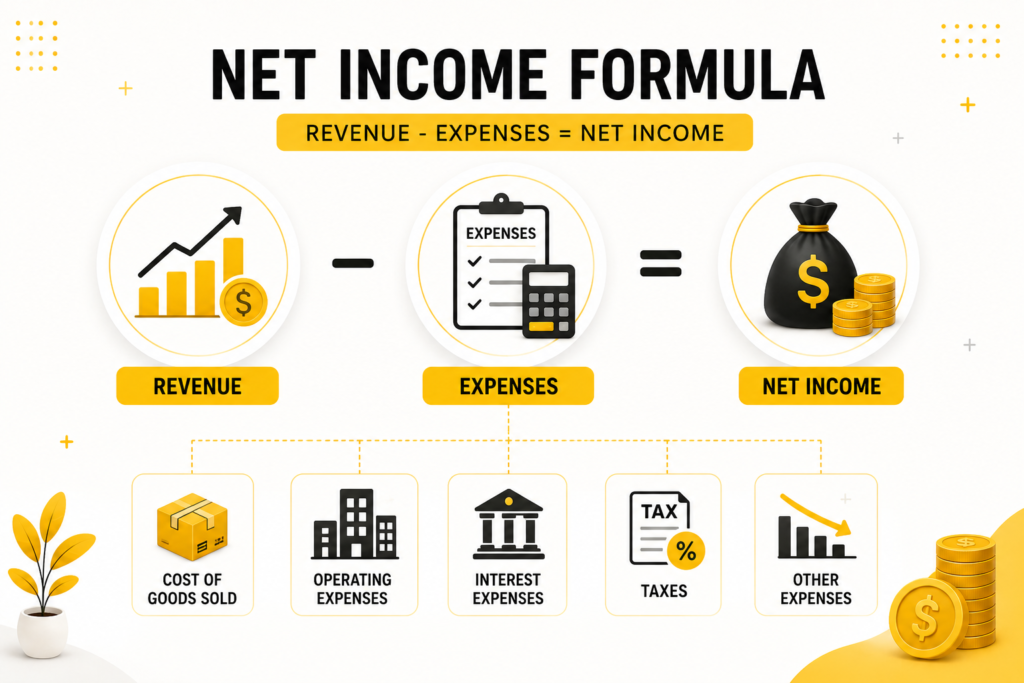
The basic structure of the net income formula is typically written as total revenue minus total expenses. However in real financial analysis the formula may include multiple layers of costs such as cost of goods sold operating expenses depreciation interest and taxes. Each of these elements contributes to the final calculation and provides a more accurate picture of financial performance.
Understanding this formula is essential because it helps businesses determine whether they are operating at a profit or a loss. A company may appear successful based on sales alone but net income reveals the true financial reality. Investors rely heavily on this metric when deciding whether to invest in a company as it reflects long-term sustainability and operational efficiency.
The net income formula is also important for individuals managing personal businesses or freelance work. It helps them understand how much actual income they are earning after deducting business-related costs. Without this clarity it becomes easy to overestimate financial success and make poor budgeting decisions that can affect long-term stability.
Net Income Formula Explained in Financial Context
In accounting and financial reporting the net income formula is more than just a subtraction equation. It represents a structured approach to measuring profitability across different stages of business operations. The calculation starts with total revenue which includes all income generated from goods sold or services provided during a specific period.
From revenue businesses subtract the cost of goods sold which includes direct costs associated with producing products or delivering services. This step results in gross profit which is an important intermediate measure. After that operating expenses such as salaries rent utilities marketing and administrative costs are deducted to determine operating income.
Finally additional expenses like interest payments and taxes are subtracted to reach the final net income figure. This layered approach ensures that all financial aspects are considered before determining profitability. It provides a more realistic view of how efficiently a business operates under real-world conditions.
When professionals refer to the net income formula they are often discussing this complete structure rather than a simple subtraction. It is used in income statements financial reports and investment analysis to assess performance over time. Understanding each stage of the calculation helps businesses identify areas where costs can be reduced or efficiency can be improved.
Components of the Net Income Formula
The net income formula consists of several key components that work together to determine final profitability. The first and most important component is revenue which represents the total amount of money generated from business activities. Revenue is the starting point of all financial calculations and reflects the scale of business operations.
The second component is cost of goods sold which includes direct production costs such as materials labor and manufacturing expenses. These costs are directly tied to product creation or service delivery. Subtracting these costs from revenue provides a clearer picture of gross earnings before operational expenses are considered.
Operating expenses form the third major component. These include all indirect costs required to run the business such as rent utilities employee salaries marketing and administrative expenses. These costs are essential for maintaining daily operations but do not directly contribute to product creation.
The final components include interest expenses and taxes. Interest expenses arise from borrowed capital while taxes are mandatory payments to government authorities. These final deductions ensure that the net income formula reflects the actual profit available after fulfilling all financial obligations. Together these components provide a complete financial overview.
Step-by-Step Guide to Calculating Net Income
Calculating net income involves a structured step-by-step process that ensures accuracy in financial reporting. The first step is identifying total revenue which includes all income generated during a specific accounting period. This figure serves as the foundation for all subsequent calculations and must be recorded accurately.
The next step is subtracting the cost of goods sold from total revenue. This calculation produces gross profit which reflects the efficiency of production and pricing strategies. Businesses often analyze gross profit to understand how effectively they are managing production costs before considering other expenses.
After determining gross profit operating expenses are deducted. These expenses include salaries rent utilities and other overhead costs. This step is crucial because it reflects the efficiency of day-to-day operations. Poor management of operating expenses can significantly reduce profitability even if revenue is strong.
Finally interest and taxes are subtracted from operating income to arrive at net income. This final figure represents the true profit of the business. Many financial analysts refer to this final stage as the most important part of the net income formula because it shows what the company actually earns after all obligations are met.
Net Income vs Gross Income vs Operating Income
Many people confuse net income with gross income and operating income but each term represents a different stage of financial analysis. Gross income refers to revenue minus the cost of goods sold. It shows how efficiently a company produces goods or services but does not account for operating expenses or taxes.
Operating income on the other hand is calculated by subtracting operating expenses from gross income. It reflects the profitability of core business operations without considering financing or tax-related costs. This metric is often used to evaluate operational efficiency.
Net income is the final and most comprehensive measure of profitability. It includes all expenses including interest and taxes making it the most accurate reflection of overall financial performance. This is why the net income formula is considered the ultimate indicator of business success.
Understanding the differences between these three metrics helps businesses and investors interpret financial statements more accurately. Each stage provides unique insights into financial health but net income remains the most widely used measure for decision-making.
Importance of Net Income for Businesses and Individuals
Net income plays a crucial role in determining financial success for both businesses and individuals. For companies it represents the actual profit available for reinvestment expansion or distribution to shareholders. A strong net income indicates efficient operations and sustainable growth potential.
Investors closely analyze net income before making investment decisions. It helps them assess whether a company is financially stable and capable of generating consistent returns. Companies with stable or increasing net income are generally considered safer investments compared to those with fluctuating or negative earnings.
For individuals running small businesses or freelance operations understanding the net income formula is equally important. It helps them determine whether their efforts are financially sustainable and whether adjustments are needed in pricing expenses or workload. Without this clarity financial planning becomes unreliable.
Net income also plays a key role in budgeting and forecasting. Businesses use historical net income data to predict future performance and set realistic financial goals. This makes it an essential tool for long-term planning and strategic decision-making in all types of financial environments.
Common Mistakes in Net Income Calculation
One of the most common mistakes in calculating net income is failing to account for all expenses. Many businesses overlook indirect costs such as maintenance administrative fees or depreciation. This leads to inflated profit figures that do not reflect actual financial performance.
Another frequent error is confusing revenue with profit. Some business owners assume that high sales automatically mean high earnings but without applying the net income formula correctly this assumption can be misleading. Revenue alone does not determine financial success.
Incorrect tax estimation is also a common issue. Taxes vary depending on location business structure and income level. Failing to include accurate tax calculations can significantly distort net income results and create financial planning problems.
Finally inconsistent accounting practices can lead to inaccurate net income reporting. Businesses must maintain consistent records and follow standardized accounting principles to ensure reliable financial data. Proper understanding and application of the net income formula help prevent these mistakes.
Real-World Examples of Net Income Calculation
To better understand the concept consider a small business that earns $100000 in revenue during a year. If the cost of goods sold is $40000 and operating expenses are $30000 the remaining amount before taxes is $30000. After deducting $5000 in taxes and interest the final net income would be $25000.
In larger corporations the same process applies but on a much more complex scale. Companies like retail chains or technology firms may deal with multiple revenue streams international operations and varying tax structures. Despite this complexity the net income formula remains the same fundamental calculation.
These examples show how net income provides a clear picture of profitability regardless of business size. It simplifies complex financial data into a single figure that reflects overall performance. This makes it one of the most widely used metrics in financial reporting.
How Net Income Is Used in Financial Statements
Financial statements rely heavily on net income as a key performance indicator. It appears at the bottom of the income statement and summarizes the financial activity of a business over a specific period. This makes it one of the most important figures for accountants and analysts.
Investors use net income to calculate financial ratios such as earnings per share and profit margins. These ratios help evaluate company performance and compare it with competitors. A strong net income often leads to higher investor confidence and improved market valuation.
Lenders also review net income when assessing loan applications. It helps them determine whether a business has the ability to repay borrowed funds. Consistent profitability increases the likelihood of loan approval and favorable lending terms.
Because of its importance the net income formula is considered a foundational concept in accounting and finance education. It is taught as one of the first major calculations in financial literacy programs and business studies.
Strategies to Improve Net Income
Improving net income requires a combination of increasing revenue and reducing unnecessary expenses. Businesses often focus on expanding sales through marketing product development and customer retention strategies. Higher revenue directly contributes to improved profitability when managed effectively.
Cost control is another important strategy. Businesses can reduce operating expenses by improving efficiency negotiating better supplier contracts or automating processes. Even small reductions in costs can significantly improve net income over time.
Pricing strategies also play a key role. Adjusting prices based on market demand and value perception can increase profit margins. However pricing decisions must be balanced carefully to avoid losing customers.
Financial planning and regular analysis of the net income formula help businesses identify weaknesses and opportunities for improvement. By monitoring financial performance consistently companies can make informed decisions that support long-term profitability.
Conclusion
The net income formula is one of the most important concepts in finance and accounting providing a clear and accurate measure of profitability. It goes beyond simple revenue tracking and reveals the true financial position of a business after all expenses are considered.
Understanding how net income is calculated what factors influence it and how it is used in financial statements is essential for business owners investors and individuals alike. It plays a central role in financial planning decision-making and long-term growth strategies.
By mastering this concept anyone can gain deeper insight into financial health and make more informed economic decisions. Whether analyzing a large corporation or managing a small business the net income formula remains a powerful tool for understanding real financial success.
FAQs
What is the net income formula in simple terms?
The net income formula calculates profit by subtracting total expenses from total revenue. It shows how much money remains after all business costs taxes and interest are paid.
Why is net income important?
Net income is important because it reflects the true profitability of a business. It helps investors owners and analysts understand financial performance beyond just revenue numbers.
Is net income the same as profit?
Yes net income is often referred to as profit. However it is the most accurate form of profit because it includes all expenses not just production or operating costs.
Can net income be negative?
Yes if expenses exceed revenue net income becomes negative. This situation is known as a net loss and indicates that a business is operating at a financial deficit.
How often is net income calculated?
Net income is usually calculated on a monthly quarterly or yearly basis depending on the business reporting structure and financial analysis requirements.
What affects net income the most?
Revenue levels operating expenses cost of goods sold and taxes all significantly affect net income. Changes in any of these factors can increase or decrease profitability.
How can businesses improve net income?
Businesses can improve net income by increasing sales reducing unnecessary costs optimizing pricing strategies and improving operational efficiency.
I am a professional finance content writer with expertise in personal finance investing, banking, loans, insurance, credit cards, budgeting, and market related topics. I create clear, SEO optimized, and reader friendly finance content that helps audiences understand complex financial concepts in simple words. My goal is to write trustworthy and engaging content that improves search visibility, builds credibility, and supports business growth.
I am a professional finance content writer with expertise in personal finance investing, banking, loans, insurance, credit cards, budgeting, and market related topics. I create clear, SEO optimized, and reader friendly finance content that helps audiences understand complex financial concepts in simple words. My goal is to write trustworthy and engaging content that improves search visibility, builds credibility, and supports business growth.