
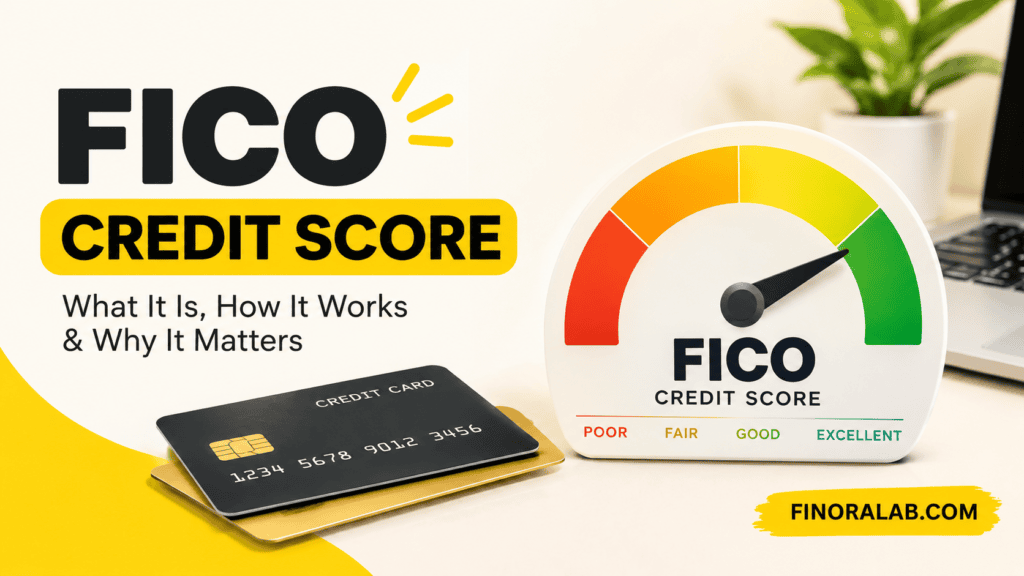
Your FICO credit score is the three digit number most U.S. lenders check before they decide whether to approve a loan and how much interest to charge. It runs from 300 to 850, and a higher number means lower risk in the eyes of the lender. A score of 740 or more usually qualifies you for the best advertised rates, while a score under 580 can mean denial or a very expensive loan. The gap between those two ends can cost thousands of dollars on a single car loan, and tens of thousands over the life of a mortgage.
The good news is that a FICO score is not a mystery. It is calculated from the information in your credit reports using five categories with known weights. Once you see what drives the number, you can usually predict which habits will help and which will hurt. This article explains what the score measures, how the FICO score range is divided, what FICO Score 8 is, how the other versions differ, and what you can do to improve your number.
What Is a FICO Score and Who Uses It?
A FICO score is a credit score created by the Fair Isaac Corporation, the company behind the model. It takes the data in your credit report from Equifax, Experian, or TransUnion and turns it into a single number that predicts how likely you are to fall 90 days or more behind on a payment within the next two years. Lenders use that prediction to decide on credit cards, auto loans, personal loans, mortgages, and sometimes apartment rentals or insurance pricing. According to FICO, the large majority of top U.S. lenders use its scores in their lending decisions, which is why the name shows up so often.
Two details trip people up. First, you do not have just one FICO score. You have many, because each of the three credit bureaus holds slightly different information about you, and FICO publishes several score versions. Your Experian based score can differ from your TransUnion based score by a few points or more. Second, FICO does not look at your income, savings, job title, age, race, or where you live. It only looks at how you have handled credit.
To receive a FICO score at all, you generally need at least one account that has been open for six months or longer and at least one account that has reported to the bureaus within the past six months. People who are new to credit or who have been inactive for a long time may be unscorable until those conditions are met.
FICO Score Range What the Numbers Mean
The standard FICO score range is 300 to 850. FICO groups scores into five bands, and lenders often build their pricing tiers around similar cutoffs.
| Score Range | Rating | What It Usually Means |
| 800–850 | Exceptional | Best available rates and easiest approvals |
| 740–799 | Very Good | Strong approval odds and rates close to the best |
| 670–739 | Good | Approved by most lenders, often at average rates |
| 580–669 | Fair | Approvals possible, but higher rates and tighter terms |
| 300–579 | Poor | Hard to qualify deposits or secured products common |
These labels are guidelines, not promises. Every lender sets its own cutoffs, and a bank might approve you at 660 for one card and decline you at 690 for another because of your income, existing debt, or the product itself. Mortgage lenders and auto lenders also tend to use their own tiers, which is why a score that qualifies for the best car loan rate may still sit one tier below the best mortgage rate.
Moving between bands matters more than moving a few points within a band. Going from 664 to 674 pushes you from Fair to Good and could change your offer. Going from 782 to 792 usually changes nothing in practice, because both are Very Good and most lenders price them the same.
How Your FICO Credit Score Is Calculated
FICO publishes the general weights of the five categories that feed the score. The exact formula is private, but the percentages below are the ones the company shares for most people.
Payment History About 35%
Payment history is the single biggest factor. It tracks whether you paid your credit cards, auto loans, student loans, mortgages, and other accounts on time. Creditors generally report a payment as late once it is 30 days past due, so paying a few days after the due date usually costs you a late fee but does not hit your credit report. Once a payment reaches the 30 day mark, the damage starts, and it grows at 60, 90, and 120 days.
The size of the hit depends on where you start. In examples FICO has published, a single 30 day late payment could cost someone with a 780 score roughly 90 to 110 points, while someone starting at 680 might lose 60 to 80. Higher scores fall further because they have more to lose. Late payments can stay on your report for seven years, though their effect fades as they age. Collections, charge offs, and judgments also fall into this category. Chapter 7 bankruptcy can remain on a report for up to 10 years, and Chapter 13 for up to seven.
Amounts Owed About 30%
This category looks at how much of your available credit you are using, which is called credit utilization. Utilization is your balance divided by your credit limit, calculated for each card and across all your revolving accounts.
Here is a simple example. Say you have two cards. Card A has a $4,000 limit and a $1,800 balance. Card B has a $6,000 limit and a $600 balance. Your total balances are $2,400 and your total limits are $10,000, so overall utilization is $2,400 ÷ $10,000 = 24%. Card A on its own is at 45%, and that individual card can still weigh on your score even though your overall figure looks fine.
If you paid Card A down to $400, your balances would total $1,000, and overall utilization would fall to $1,000 ÷ $10,000 = 10%. Many people hear that staying under 30% is the target, and that is a reasonable ceiling, but people with the highest scores tend to keep utilization in the single digits. Installment loan balances matter too, though revolving balances usually move the score faster.
Length of Credit History About 15%
FICO considers the age of your oldest account, the age of your newest account, and the average age across all of them. Longer histories help because they give the model more evidence. This is why closing your oldest credit card can backfire. A closed account in good standing generally stays on your report for years, but it eventually drops off, and by then you have lost both its age and its credit limit.
New Credit About 10%
Applying for credit usually triggers a hard inquiry. For most people a single inquiry lowers the score by fewer than five points, and its effect on the score fades within a year, though the inquiry stays on your report for two. Opening several accounts in a short period can look risky, and it also lowers the average age of your accounts.
Rate shopping gets special treatment. When you apply for several mortgages, auto loans, or student loans within a short window, the scoring model treats them as a single inquiry. With newer FICO versions the window is 45 days, and some older versions use as little as 14, so it is safest to keep your comparison shopping inside two weeks. Credit card applications do not get this protection.
Credit Mix About 10%
Credit mix looks at whether you have handled different kinds of credit, such as credit cards, a car loan, a mortgage, or a student loan. It is the least powerful of the five factors, and you should never take out a loan you do not need just to improve your mix. If you already have a card and one installment loan, you are not likely to gain much by adding another type.
FICO Score 8 and Other Versions
When people search for FICO score 8, they are usually trying to figure out which score a lender sees or which one a free app is showing them. FICO Score 8 was released in 2009 and became the most widely used general purpose version for credit cards and many other consumer loans. It uses the same 300 to 850 range and the same five categories, but compared with older models it is a little tougher on high utilization and it ignores collection accounts with an original balance under $100.
FICO Score 8 does not erase paid collections. A paid collection still counts as a negative item in this version. FICO Score 9 changed that by giving less weight to paid collections and treating medical collections more gently. Separately, the three bureaus have changed their own reporting rules in recent years, including removing paid medical collections and delaying the reporting of new medical debt, so what appears on your report may already be different from what older articles describe.
Newer Versions and Industry Scores
FICO has released later general versions, including FICO Score 9 and FICO Score 10, and a trended data version called FICO Score 10 T that looks at how your balances have moved over time instead of just a snapshot. Adoption has been gradual because lenders have to update their systems and, in mortgage lending, get approval from the agencies that buy loans.
FICO also sells industry specific scores. Auto lenders may use a FICO Auto Score and card issuers may use a FICO Bankcard Score. These run on a 250 to 900 scale and put extra weight on how you have performed on that particular type of loan. Because of that, the score you see on a free app might not match the score a dealer pulls.
Mortgage lending has used older versions, often called FICO Score 2, 4, and 5, which differ from FICO Score 8. The rules about which scores mortgage lenders can use have been changing in recent years, so ask your lender which versions it will pull before you assume the number from your credit card app is the one it will see.
FICO vs. VantageScore
VantageScore is a competing model created by the three bureaus. Like FICO, it uses a 300 to 850 range, but it calculates the number differently and can generate a score for some people with a shorter credit history. Many free credit monitoring apps show a VantageScore, which is one reason your credit score can look different depending on where you check it. Neither number is fake. They are different models reading the same underlying reports.
What a FICO Credit Score Costs You in Real Dollars
The difference between score tiers is easiest to see in a loan payment. The numbers below are hypothetical rates chosen for illustration, not current offers, so check lenders for what is actually available. Imagine a $25,000 car loan with a 60 month term.
At a 7% annual rate, the monthly payment comes to about $495, and over 60 months you would pay a total of roughly $29,700, of which about $4,700 is interest. At a 12% annual rate, the payment rises to about $556 per month, and the total paid is roughly $33,370, with about $8,370 in interest. The borrower with the lower rate saves around $61 a month and about $3,660 over the loan.
That is a single loan, and only a few percentage points of rate. On a 30 year mortgage the same type of gap applies to a much larger balance for a much longer time. Even small improvements in your score can matter when they push you across a lenders pricing tier.
How to Check Your FICO Score and Credit Reports
You are entitled to free credit reports from each bureau at AnnualCreditReport.com, which is the official site. The three bureaus currently offer free weekly access to your reports there. Reports are not scores, but they contain the information that determines your score, so they are the first place to look for errors.
Your FICO score itself is available through several routes. Many credit card issuers and banks now show a FICO score for free inside their apps or on your statement, and some show a FICO Score 8 based on one bureau. You can also pay for scores directly from myFICO, which shows multiple versions and all three bureaus. When you look at any score, check which version and which bureau it is based on, because that explains most differences between sources.
If you find an error, such as an account that is not yours or a payment marked late that you paid on time, dispute it with the bureau and with the company reporting it. The Consumer Financial Protection Bureau and the Federal Trade Commission both offer plain language instructions for filing a dispute.
How to Raise Your FICO Credit Score
Credit scores respond to behavior, and the fastest gains tend to come from the biggest categories. Start with the items that carry the most weight.
Pay every account on time, every month. If you have trouble remembering, set up autopay for at least the minimum payment so you never hit the 30 day mark by accident. If you are already behind, bring the account current as soon as possible, because the damage continues to build the longer it stays past due.
Lower your credit card balances. This is often the quickest legitimate way to see your score improve, because utilization updates as soon as the issuer reports a new balance. Paying a card down before the statement closes can help, since many issuers report the statement balance rather than the amount you carry after paying. If you cannot pay down balances quickly, asking for a credit limit increase can also lower your utilization, as long as the issuer does not run a hard inquiry and you do not spend the extra room.
Leave old accounts open when you can. If a card has no annual fee, keeping it and using it for one small purchase every few months can protect your account age and your available credit.
Apply for new credit only when you need it. Space out applications, and keep rate shopping for a mortgage or car loan inside a short window.
If your file is thin or damaged, there are tools built for that situation. A secured credit card, where your deposit becomes your limit, can create a positive payment record. Some lenders also offer credit builder loans, which hold the funds while you make payments. Services that report your rent or utility payments can help in some cases, but only some FICO versions use that data, so it is not a guaranteed boost. Be cautious about any company that promises to erase accurate negative information for a fee. Accurate items generally stay until they age off under federal reporting limits.
Common Mistakes and Myths About FICO Scores
One common myth is that checking your own credit hurts your score. It does not. Looking at your own score or reports is a soft inquiry and has no effect. Another myth is that carrying a balance from month to month helps your score. It does not, and it only costs you interest. Paying in full each month is as good for your score as carrying a balance, and cheaper.
People also assume that closing a paid off loan will help, or that paying off a mortgage will raise their score. Closing an installment account can actually lower your score slightly because it removes an active account from your mix, even though it is the right financial decision if it saves you interest. A small drop after a payoff is usually temporary, and it is not a reason to avoid paying off debt.
Finally, many people check one score and treat it as the final word. Because of different versions and bureaus, it is more useful to track the trend. If your number is moving in the right direction across sources, your habits are working.
Conclusion
Your FICO credit score is a 300 to 850 summary of how you have managed credit, built mainly from payment history, amounts owed, length of history, new credit, and credit mix. The score range sorts borrowers into five bands, and the borders between those bands are where loan offers tend to change. FICO Score 8 is the version most people encounter on cards and consumer loans, but newer versions and industry specific scores exist, and the one a lender uses can differ from the one in your app.The practical takeaway is simple. Pay on time, keep balances low relative to your limits, avoid unnecessary applications, and keep old accounts open when they cost you nothing. Check your reports at AnnualCreditReport.com for errors, and confirm with your lender which score it will use before a big application. Small, steady habits matter more than any trick, and the savings show up in the rates you are offered.
You may also read more blogs
FAQs
What is a good FICO credit score?
A score of 670 or higher is generally considered Good on the FICO scale, and 740 or higher is Very Good. Lenders set their own cutoffs, so good for a credit card might not be good for a mortgage. Aim for the highest tier you can reach, since the best pricing usually goes to borrowers above 740.
How long does it take to improve a FICO score?
It depends on what is holding you back. Lowering credit card balances can raise your score within a month or two, once the new balances are reported. Rebuilding after late payments or collections takes longer, because those items fade gradually over several years.
Is FICO Score 8 the same as the score my bank shows me?
Not always. Many banks and card issuers show a FICO Score 8, but it may be based on only one bureau, and some show a VantageScore instead. The label on the screen should say which model and which bureau you are seeing.
Does paying off a collection raise my FICO score?
In FICO Score 8, a paid collection still counts as negative, so paying it may not raise your score. Newer versions, such as FICO Score 9, give less weight to paid collections. Paying a legitimate debt can still help in other ways, like stopping collection calls and making loan approvals easier with some lenders.
Do hard inquiries lower my FICO score a lot?
Usually not. A single hard inquiry often lowers a score by fewer than five points, and the effect fades after about a year. Multiple inquiries for the same type of loan within a short window are generally treated as one.
What is the minimum credit history needed to get a FICO score?
FICO generally requires one account open for at least six months and at least one account reported in the past six months. Without both, you may not have a FICO score yet, even if you have a credit file.
Why are my FICO score and my VantageScore different?
They are different models that weigh the same credit report data in different ways, and they may also be calculated from different bureau reports. A gap of 20 or 30 points is not unusual and does not mean one of them is wrong.
Does checking my own FICO score hurt it?
No. Checking your own score or credit reports is a soft inquiry and does not affect your score. Only applications for new credit typically create hard inquiries.

Pingback: Chase Online Banking vs BMO & BECU: Easy Login & Top Features