CD Interest Calculator: Calculate Your Earnings, APY & Maturity Value Instantly
Shanzay Arain·Jul 28, 2026
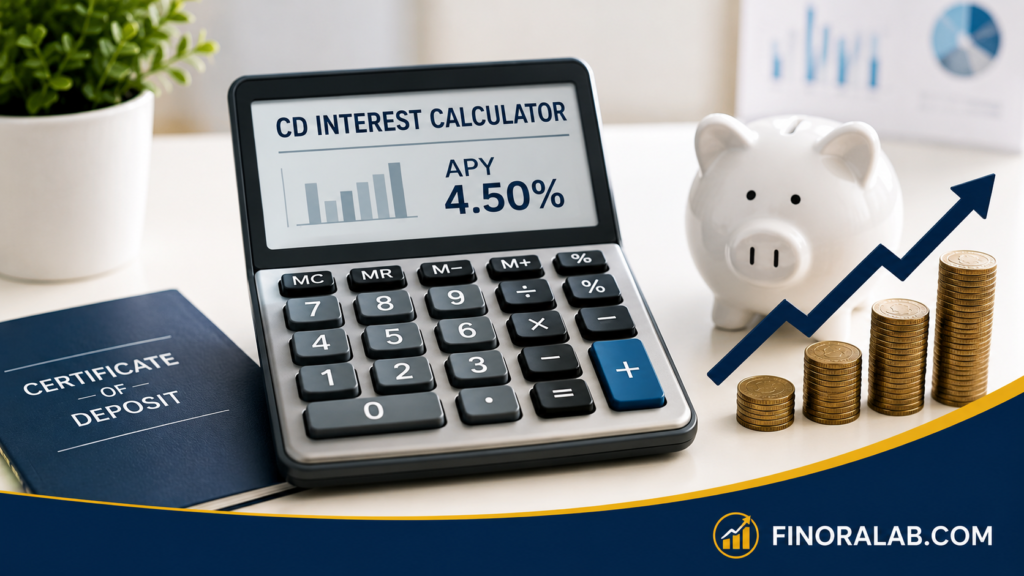
A CD interest calculator is one of the most useful financial tools for anyone looking to grow their savings with minimal risk. Whether youre saving for a home, retirement, an emergency fund, or a future purchase, understanding how much your money can earn before opening a Certificate of Deposit (CD) helps you make smarter financial decisions.
Unlike regular savings accounts, CDs generally offer fixed interest rates for a predetermined period. In exchange for leaving your money untouched until maturity, banks and credit unions typically reward savers with higher annual percentage yields (APYs). A CD interest calculator simplifies the math by estimating how much interest youll earn based on your initial deposit, interest rate, compounding frequency, and term length.
As interest rates continue to fluctuate, comparing different CD options has become more important than ever. A small difference in APY can translate into hundreds—or even thousands of dollars over time. This guide explains how a CD interest calculator works, the factors that influence your returns, common mistakes to avoid, and practical strategies for maximizing your earnings while managing financial risk.
What Is a CD Interest Calculator?
A CD interest calculator is an online financial tool designed to estimate how much money a Certificate of Deposit will earn over a specific period. Instead of manually calculating compound interest, users simply enter information such as the deposit amount, interest rate, compounding schedule, and term length. The calculator then estimates the maturity value and total interest earned.
These calculators are especially helpful when comparing multiple CD offers from different banks. For example, a 4.10% APY and a 4.40% APY may appear similar at first glance, but over several years and larger balances, the difference can become meaningful. A calculator makes these comparisons easy and eliminates calculation errors.
Another benefit is planning. Whether youre saving for retirement, college tuition, or a future home purchase, knowing your expected returns allows you to align savings strategies with long term financial goals. Rather than guessing future earnings, you can make data driven decisions based on realistic projections.
Most calculators also allow users to test different scenarios. You can compare various deposit amounts, interest rates, and investment terms to determine which option provides the best balance between liquidity and return.
Understanding How Certificate of Deposit Accounts Work
A Certificate of Deposit is a savings product offered by banks and credit unions that pays a fixed interest rate for a predetermined period. Common CD terms range from three months to five years, although some institutions offer longer maturities. During this period, the interest rate remains fixed regardless of changes in market rates.
Because your funds remain locked until maturity, CDs generally pay higher interest than traditional savings accounts. However, withdrawing money before the maturity date usually triggers an early withdrawal penalty, reducing some of your earned interest.
At maturity, account holders typically have several options. They may withdraw both principal and interest, renew the CD for another term, or transfer the funds into another financial product. Many banks automatically renew CDs unless customers provide instructions during the grace period.
Certificates of Deposit are particularly attractive for conservative investors seeking stable returns without stock market volatility. Since most CDs are insured by the Federal Deposit Insurance Corporation (FDIC) or National Credit Union Administration (NCUA) within applicable limits, they represent one of the safest places to hold cash.
How a CD Interest Calculator Estimates Your Earnings
The primary purpose of a CD interest calculator is to estimate future account value using compound interest. Unlike simple interest, compound interest allows you to earn interest not only on your original deposit but also on previously earned interest.
Several variables influence the calculation. The first is your initial deposit, often called the principal. Larger deposits naturally generate greater interest because earnings are calculated as a percentage of the principal balance.
The second factor is the Annual Percentage Yield (APY). APY reflects both the stated interest rate and the effects of compounding throughout the year, making it a more accurate comparison than interest rate alone.
Compounding frequency also affects total earnings. Interest may compound daily, monthly, quarterly, or annually. More frequent compounding generally results in slightly higher returns because interest begins earning additional interest sooner.
Finally, the investment term determines how long your money remains invested. Longer terms provide more opportunities for compound growth but also reduce access to your funds during the investment period.
Factors That Affect CD Interest Earnings
Interest rates remain the most significant factor affecting CD performance. Higher APYs generate larger returns over identical investment periods. Because banks regularly adjust rates in response to Federal Reserve policy and market conditions, comparing current offers before opening a CD can significantly increase long term earnings.
The size of your deposit also influences total returns. While percentage earnings remain the same, larger balances naturally produce greater dollar amounts of interest. For example, a £1,000 deposit earning 4% APY produces substantially less interest than a £25,000 deposit at the same rate.
Term length is equally important. Short term CDs offer greater flexibility, while longer term CDs often provide higher fixed rates. Choosing the appropriate maturity depends on your financial goals, expected cash needs, and future interest rate expectations.
Inflation should also be considered. Even when a CD generates positive returns, purchasing power may decline if inflation exceeds the earned interest. Savers should evaluate real returns rather than focusing solely on nominal interest rates.
Why APY Matters More Than Interest Rate
Many new investors mistakenly compare only advertised interest rates without considering APY. Although these numbers appear similar, APY includes the effects of compound interest, making it a better measure of actual earnings.
Consider two CDs with identical nominal interest rates but different compounding schedules. The account that compounds daily will produce slightly higher returns than one compounding annually, even if both advertise the same interest rate.
Because federal regulations require financial institutions to disclose APY, consumers can compare different products more accurately. When using a CD interest calculator, entering the APY rather than only the stated interest rate generally provides more realistic estimates.
Understanding APY also improves financial literacy. Savers who recognize how compound interest works are better equipped to compare savings accounts, money market accounts, and other fixed income investments alongside CDs.
Benefits of Using a CD Interest Calculator
A CD interest calculator removes much of the uncertainty from financial planning by giving you a realistic estimate of how much your savings can grow over time. Instead of relying on rough assumptions, you can instantly calculate projected earnings using your deposit amount, APY, and investment term. This makes it easier to compare multiple banks and determine which Certificate of Deposit best aligns with your savings goals.
Another major advantage is scenario planning. You can adjust different variables—such as increasing your deposit, selecting a longer term, or choosing a higher APY—to see how each decision affects your final balance. This flexibility helps investors make informed choices without committing money before understanding the potential outcome.
The calculator is also useful for budgeting and financial planning. If youre saving for a house down payment, college expenses, retirement, or a major purchase, knowing the estimated maturity value helps establish realistic timelines and monthly savings goals.
Because the calculations are automated, users avoid mathematical errors that can occur when manually computing compound interest. This makes the tool valuable for beginners and experienced investors alike.
CD vs. High Yield Savings Account Which Is Better?
Both Certificates of Deposit and high yield savings accounts are considered relatively safe places to keep cash, but each serves a different purpose. A CD typically offers a fixed interest rate for a specific period, while a high yield savings account provides variable interest rates with immediate access to your funds.
A CD may be the better choice if you know you will not need the money until the maturity date. Locking in todays competitive APY protects you from future rate declines and provides predictable returns. This makes CDs particularly attractive during periods when interest rates are expected to decrease.
High yield savings accounts, however, provide greater flexibility. Depositors can withdraw funds whenever necessary without facing early withdrawal penalties. While interest rates may fluctuate, these accounts are ideal for emergency funds or short term savings goals that require liquidity.
Many financial advisors recommend using both products together. An emergency fund can remain in a high yield savings account, while excess savings intended for future expenses can be placed in CDs to earn higher guaranteed returns.
Common Mistakes to Avoid When Investing in CDs
One of the most common mistakes is selecting a CD term without considering future cash needs. Since early withdrawals often trigger penalties, locking away money that may be needed unexpectedly can reduce the overall benefit of the investment.
Another mistake is choosing the highest advertised APY without reading the account terms. Some CDs require larger minimum deposits, while others automatically renew at maturity unless the customer takes action during the grace period. Understanding all conditions before opening an account helps avoid unpleasant surprises.
Many investors also overlook inflation. Although CDs protect principal and provide guaranteed returns, purchasing power can decline if inflation exceeds the earned interest. Comparing real returns rather than simply focusing on the advertised APY provides a more accurate picture of long term value.
Finally, failing to compare multiple financial institutions can cost money. Interest rates vary significantly among banks, online banks, and credit unions. Spending a few extra minutes shopping around can substantially increase earnings over the life of the investment.
Strategies to Maximize CD Returns
One of the most effective strategies is building a CD ladder. Instead of investing all your money into a single long term Certificate of Deposit, you divide it among multiple CDs with different maturity dates. As each CD matures, you can either withdraw the funds or reinvest them into a new long term CD, creating regular access to cash while maintaining higher average yields.
Another strategy involves shopping for promotional rates. Online banks often offer higher APYs than traditional brick and mortar institutions because they have lower operating costs. Comparing offers regularly can significantly improve long term returns.
Investors should also consider jumbo CDs if they have substantial savings. These accounts usually require larger deposits but may offer slightly better interest rates. However, its essential to compare actual APYs rather than assuming every jumbo CD provides superior returns.
Timing also matters. When interest rates are expected to fall, locking in a longer term CD can preserve higher yields for several years. Conversely, if rates are expected to rise, shorter term CDs may provide greater flexibility to reinvest at better rates later.
Tax Considerations for CD Interest
Interest earned from a Certificate of Deposit is generally taxable as ordinary income in the year it is credited, even if the funds remain inside the CD until maturity. Investors should include this interest when preparing their annual federal and, where applicable, state income tax returns.
For individuals in higher tax brackets, taxes can reduce the effective return on a CD investment. Understanding your after tax yield helps provide a more realistic estimate of actual earnings and may influence whether other savings vehicles better suit your financial goals.
Tax advantaged retirement accounts such as Traditional IRAs and Roth IRAs can sometimes hold Certificates of Deposit. In these cases, the tax treatment depends on the account type rather than the CD itself. Investors should consult a qualified tax professional before making retirement investment decisions.
Keeping accurate records of annual interest statements also simplifies tax preparation and helps ensure compliance with reporting requirements.
Current Trends in CD Interest Rates
Certificate of Deposit rates are closely linked to broader economic conditions and monetary policy. When central banks raise benchmark interest rates to combat inflation, banks often increase CD yields to attract deposits. Conversely, rates generally decline during periods of monetary easing.
Online banks continue to lead the market with some of the most competitive APYs available. Because they operate with lower overhead expenses, these institutions frequently pass savings on to customers through higher interest rates and reduced account fees.
Consumers are increasingly using digital comparison tools and CD interest calculators before opening accounts. This trend has encouraged greater transparency among financial institutions and intensified competition for customer deposits.
Financial experts recommend monitoring rate trends rather than chasing every short term fluctuation. Choosing a CD should balance competitive returns with your overall financial objectives, liquidity needs, and risk tolerance.
How a CD Fits Into a Complete Financial Plan
A Certificate of Deposit should be viewed as one component of a diversified financial strategy rather than a standalone investment. CDs provide stability and guaranteed returns, making them ideal for conservative investors or individuals approaching retirement who prioritize preserving capital.
For younger investors with longer investment horizons, CDs may complement higher risk assets such as stocks and exchange traded funds (ETFs). While equities offer greater growth potential, CDs provide predictable income and reduce portfolio volatility during uncertain market conditions.
Budgeting also plays a role. Before investing in a CD, ensure you maintain an adequate emergency fund in a liquid savings account. This reduces the likelihood of early withdrawals and associated penalties.
Integrating CDs into broader retirement, tax, and estate planning strategies can improve overall financial resilience. A balanced portfolio often combines liquidity, growth investments, fixed income assets, and insured savings products to meet both short term and long term financial goals.
Conclusion
A CD interest calculator is more than a simple online tool—it is an essential resource for anyone seeking to make informed savings decisions. By estimating future earnings, comparing APYs, and illustrating the power of compound interest, it helps investors choose the right Certificate of Deposit with confidence.Whether you are saving for retirement, a home purchase, education expenses, or simply looking for a secure place to grow your money, using a CD interest calculator can improve your financial planning and eliminate guesswork. Combined with careful comparison shopping and a clear understanding of your financial goals, it becomes a valuable part of a smart personal finance strategy.Certificates of Deposit remain one of the safest investment options available. When used strategically alongside budgeting, emergency savings, and diversified investments, they can provide predictable growth while protecting your principal from market volatility.
A CD interest calculator is an online tool that estimates how much interest a Certificate of Deposit will earn based on your deposit amount, APY, compounding frequency, and investment term.
How accurate is a CD interest calculator?
The calculator provides highly accurate estimates when you enter the correct APY, deposit amount, compounding schedule, and term. Actual earnings may vary slightly if rates or account conditions change.
What information do I need to use a CD interest calculator?
Most calculators require your initial deposit, annual percentage yield (APY), CD term, and compounding frequency. Some also allow recurring deposits or tax estimates.
What is the difference between APY and interest rate?
The interest rate is the base rate paid on your deposit, while APY includes the effects of compound interest over one year. APY provides a more accurate comparison between different CDs.
Are CD earnings taxable?
Yes. In most cases, interest earned on a Certificate of Deposit is taxable as ordinary income during the year it is credited, even if you leave the money in the account until maturity.
Can I withdraw money before my CD matures?
Yes, but most banks charge an early withdrawal penalty. The penalty typically equals several months of interest and varies depending on the institution and term length.
Are Certificates of Deposit safe?
Yes. CDs offered by FDIC insured banks and NCUA insured credit unions are protected up to applicable insurance limits, making them among the safest savings products available.
Is a CD better than a savings account?
It depends on your financial goals. CDs generally offer higher fixed returns but limit access to your money. High yield savings accounts provide greater liquidity but often have variable interest rates.
What is a CD ladder?
A CD ladder is a strategy that divides savings among multiple CDs with different maturity dates. This approach provides regular access to funds while helping investors benefit from competitive long term interest rates.
How often should I compare CD rates?
Financial experts recommend reviewing CD rates whenever you plan to invest new money or when an existing CD approaches maturity. Comparing offers from multiple banks can help maximize your earnings.
I am a professional finance content writer with expertise in personal finance investing, banking, loans, insurance, credit cards, budgeting, and market related topics. I create clear, SEO optimized, and reader friendly finance content that helps audiences understand complex financial concepts in simple words. My goal is to write trustworthy and engaging content that improves search visibility, builds credibility, and supports business growth.
I am a professional finance content writer with expertise in personal finance investing, banking, loans, insurance, credit cards, budgeting, and market related topics. I create clear, SEO optimized, and reader friendly finance content that helps audiences understand complex financial concepts in simple words. My goal is to write trustworthy and engaging content that improves search visibility, builds credibility, and supports business growth.