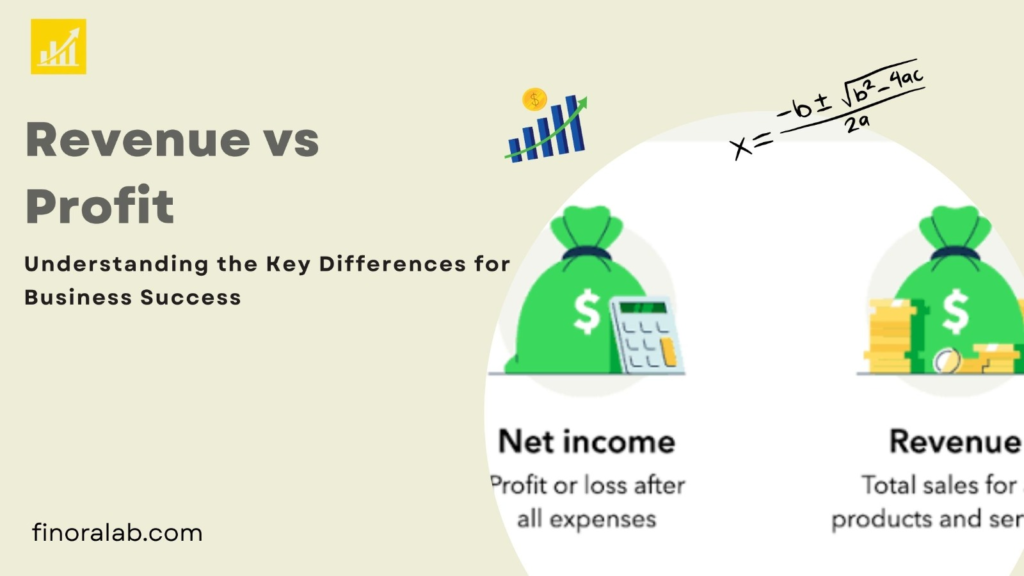
Revenue vs Profit: Understanding the Key Differences for Business Success
Shanzay Arain·Jun 14, 2026
In business and finance few terms are as commonly used—and as frequently misunderstood—as revenue and profit. Whether you’re an entrepreneur investor student or business owner understanding the difference between revenue vs profit is essential for making smarter financial decisions.
Many people assume that companies generating billions in revenue are automatically highly profitable. However this isn’t always true. A business may produce enormous sales yet struggle to earn profits due to high expenses debt or operational costs.
This guide explains revenue and profit in simple terms shows how they differ and demonstrates why both metrics are critical for evaluating a company’s financial health.
What Is Revenue?
Revenue refers to the total amount of money a company earns from selling goods or services before deducting any expenses. It is often called the top line because it appears at the top of an income statement.
Revenue represents the gross inflow of cash generated through normal business operations. It measures a company’s ability to generate sales and attract customers.
For example if an online store sells products worth $100000 in one month its revenue for that period is $100000.
Types of Revenue
Businesses can generate different forms of revenue depending on their operations.
Operating Revenue
Operating revenue comes directly from a company’s core business activities. For example a software company earns revenue from subscriptions.
Non-Operating Revenue
Non-operating revenue comes from secondary activities such as investments interest income or asset sales.
Recurring Revenue
Recurring revenue is predictable income generated repeatedly such as monthly subscriptions.
One-Time Revenue
This includes income from occasional events like selling equipment or property.
Revenue Formula
The basic revenue formula is:
Revenue = Price × Quantity Sold
For example:
Product price: $50
Units sold: 1000
Revenue = $50 × 1000 = $50000
Revenue is often considered a measure of business growth because increasing sales generally indicate expanding market demand.
What Is Profit?
Profit is the amount of money left after subtracting all business expenses from revenue. It reflects how efficiently a company manages its costs and operations.
Unlike revenue profit shows whether a company is actually making money.
A business with high sales but even higher expenses may generate little or no profit.
Types of Profit
Understanding profit requires knowing its different forms.
Gross Profit
Gross profit measures earnings after subtracting the cost of goods sold (COGS).
Formula:
Gross Profit = Revenue − Cost of Goods Sold
Operating Profit
Operating profit subtracts operating expenses such as rent salaries and utilities.
It indicates the profitability of core operations.
Net Profit
Net profit is often called the bottom line because it appears at the bottom of an income statement.
It accounts for all expenses taxes and interest payments.
Formula:
Net Profit = Revenue − Total Expenses
Net profit is the most comprehensive measure of financial performance.
Revenue vs Profit: Key Differences
The difference between revenue vs profit is simple yet crucial.
Revenue measures total sales generated by a business while profit measures earnings remaining after expenses.
Revenue
Profit
Total income from sales
Income after expenses
Appears at top of income statement
Appears at bottom
Indicates business size
Indicates business health
Does not include expenses
Includes all expenses
Can be high with losses
Reflects actual earnings
Revenue shows how much money enters the business while profit reveals how much money stays.
A company can have high revenue but low profit if expenses are excessive.
Why Revenue and Profit Matter
Both revenue and profit are essential indicators of business success.
Revenue demonstrates market demand and customer acquisition. Investors often monitor revenue growth because it signals expansion opportunities.
Financial analysts use both metrics together to evaluate performance because relying on only one can provide an incomplete picture.
Companies with consistent revenue growth and strong profit margins are often viewed as financially healthy.
Revenue Without Profit
It is possible for businesses to generate large amounts of revenue while remaining unprofitable.
Startups frequently experience this situation. They invest heavily in marketing hiring and infrastructure to accelerate growth.
For example a company may earn $1 million in revenue but spend $1.2 million on expenses resulting in a loss of $200000.
This illustrates why revenue alone cannot determine success.
Investors often look beyond sales figures and focus on profitability trends and cash flow.
Profit Without Revenue Growth
Some mature companies prioritize maximizing profit instead of aggressively increasing revenue.
They may achieve this through:
Reducing costs
Improving efficiency
Increasing prices
Automating operations
A company with stable sales can still improve profits by managing expenses effectively.
Profit growth often attracts investors because it reflects operational efficiency and strong management.
Real-World Examples of Revenue vs Profit
Understanding real examples makes the difference clearer.
Example One
A retailer records:
Revenue: $500000
Expenses: $450000
Profit = $50000
Example Two
Another retailer records:
Revenue: $300000
Expenses: $200000
Profit = $100000
Despite lower revenue the second company earns higher profit.
This demonstrates that profit often provides deeper insight into business performance.
Revenue vs Profit in Financial Statements
Revenue and profit appear in the income statement.
Revenue is listed first because it reflects total sales.
Expenses are deducted sequentially to calculate gross profit operating profit and net profit.
Investors analyze these figures to assess:
Financial stability
Growth potential
Operational efficiency
Risk levels
Understanding financial statements helps business owners make informed decisions.
Common Misconceptions About Revenue and Profit
Many people mistakenly believe revenue equals earnings.
This misunderstanding can lead to poor financial decisions.
Some common myths include:
High Revenue Means Success
Large sales figures do not guarantee profitability.
Profit Is the Same as Cash Flow
Profit and cash flow are different financial metrics.
Revenue Is More Important Than Profit
Both metrics serve unique purposes and should be evaluated together.
Recognizing these distinctions improves financial literacy and business strategy.
Which Metric Is More Important?
The answer depends on business objectives.
Early-stage companies often prioritize revenue growth to gain market share.
Established companies may focus on profit optimization.
Investors usually analyze:
Revenue growth rate
Gross margin
Operating margin
Net profit margin
Ultimately sustainable businesses balance both revenue and profit.
Without revenue there is no income. Without profit there is no long-term survival.
Latest Update on Business Metrics
In recent years investors and analysts have increasingly focused on profitability alongside revenue growth.
Many businesses now emphasize:
Sustainable growth
Higher profit margins
Efficient operations
Cost optimization
Economic uncertainty and rising operating costs have shifted attention toward profitability metrics.
Companies that balance strong revenue with healthy profit margins are generally viewed more favorably.
Best Practices for Improving Revenue and Profit
Businesses can strengthen financial performance through strategic actions.
Increase Revenue
Launch new products
Expand into new markets
Improve customer retention
Increase pricing strategically
Improve Profit
Reduce operating costs
Automate repetitive tasks
Negotiate supplier contracts
Optimize marketing spending
Successful businesses continuously monitor both metrics to drive growth.
Conclusion
Understanding revenue vs profit is fundamental for anyone involved in business or finance. Revenue measures the money a company earns from sales while profit shows what remains after expenses.
Both metrics provide valuable insights into financial performance. Revenue reflects growth potential whereas profit reveals sustainability and efficiency.
Businesses that successfully increase revenue while maintaining healthy profit margins are more likely to achieve long-term success. By understanding these concepts entrepreneurs investors and students can make better financial decisions and evaluate companies more effectively.
FAQS
What is the difference between revenue and profit?
Revenue is total sales before expenses while profit is the amount remaining after expenses.
Can a company have revenue but no profit?
Yes. If expenses exceed revenue the company records a loss.
Which is more important: revenue or profit?
Both are important. Revenue measures growth while profit measures sustainability.
Why is revenue called the top line?
Because it appears at the top of an income statement.
Why is profit called the bottom line?
Because it appears at the bottom after all expenses are deducted.
How do investors evaluate companies?
Investors examine revenue growth profit margins cash flow and other financial metrics.
Is net profit the same as gross profit?
No. Gross profit excludes only production costs while net profit includes all expenses.
Can profit increase while revenue stays flat?
Yes. Businesses can improve profit by reducing costs and increasing efficiency.
I am a professional finance content writer with expertise in personal finance investing, banking, loans, insurance, credit cards, budgeting, and market related topics. I create clear, SEO optimized, and reader friendly finance content that helps audiences understand complex financial concepts in simple words. My goal is to write trustworthy and engaging content that improves search visibility, builds credibility, and supports business growth.
I am a professional finance content writer with expertise in personal finance investing, banking, loans, insurance, credit cards, budgeting, and market related topics. I create clear, SEO optimized, and reader friendly finance content that helps audiences understand complex financial concepts in simple words. My goal is to write trustworthy and engaging content that improves search visibility, builds credibility, and supports business growth.