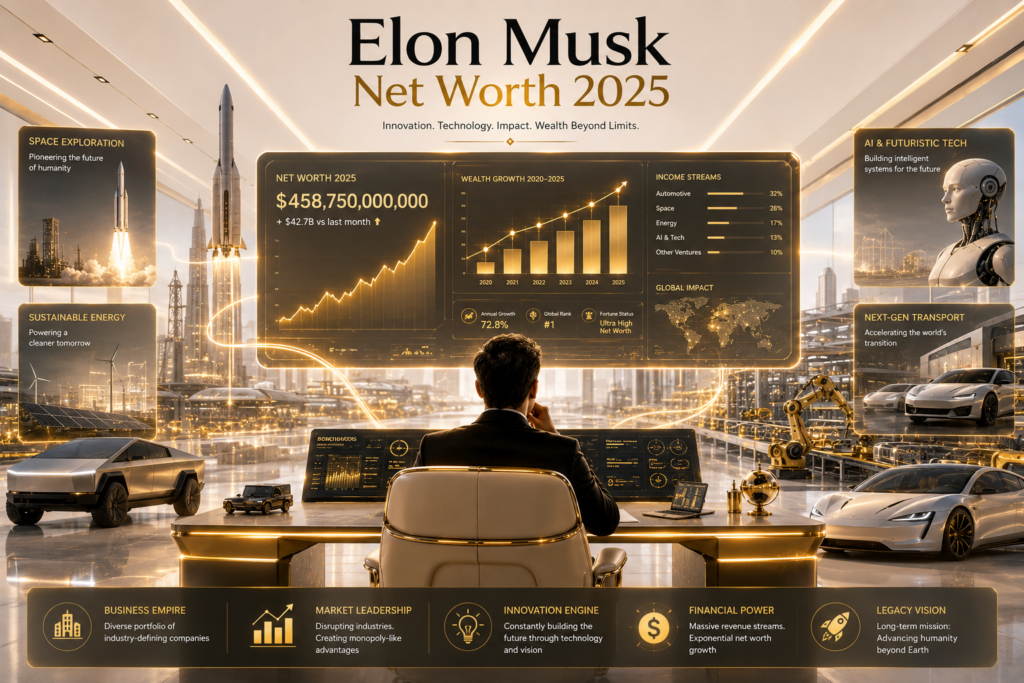
Few individuals in modern business history have transformed industries financial markets and internet culture the way Elon Musk has. From electric vehicles and space exploration to artificial intelligence and social media Musk’s influence extends far beyond traditional entrepreneurship. That is why searches for “Elon Musk net worth 2025” continue dominating finance-related topics across Google YouTube and social platforms.
People are not only curious about how much money Musk has. They want to understand how one entrepreneur managed to build wealth at a scale previously associated with oil dynasties global banking families or tech monopolies. His financial story represents a new era of wealth creation driven by innovation equity ownership technological disruption and long-term market conviction rather than conventional salary-based income.
At the same time Musk’s fortune is one of the most volatile and fascinating wealth stories in modern finance. His net worth can rise or fall by billions of dollars within days because much of his wealth is tied to publicly traded stocks and private company valuations. Unlike celebrities who primarily earn through endorsements or entertainment contracts Musk’s fortune reflects ownership risk-taking and aggressive reinvestment into future-oriented industries.
This article explores Elon Musk net worth 2025 in detail including how his wealth is calculated the businesses fueling his fortune the psychology behind his financial decisions his investment strategies luxury spending habits and the broader lessons entrepreneurs and investors can learn from his journey. It also examines the risks associated with concentrated stock wealth public perception versus financial reality and why Musk remains one of the most influential figures in global business.
Estimated Elon Musk Net Worth 2025
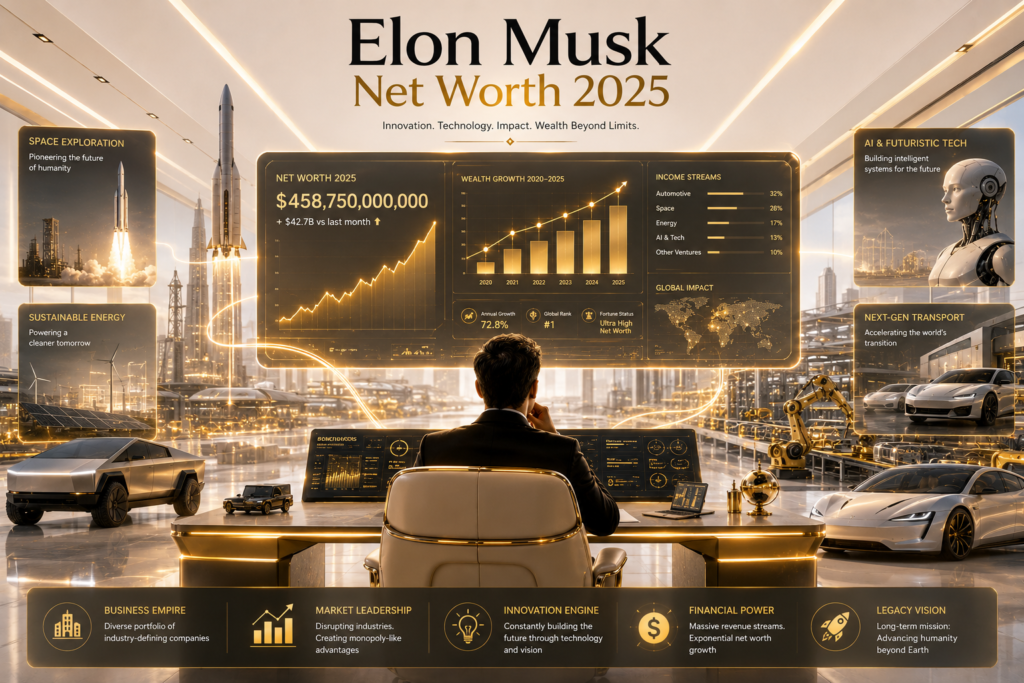
As of 2025 most major financial trackers estimate Elon Musk has a net worth ranging between $210 billion and $260 billion depending on daily stock market performance private company valuations and institutional estimates. His fortune fluctuates constantly because the majority of his wealth is connected to equity ownership rather than liquid cash.
Unlike traditional billionaires who hold diversified portfolios across real estate banking and industrial assets Musk’s wealth is heavily concentrated in technology companies. The largest portion comes from his ownership stake in Tesla which remains one of the world’s most valuable automotive and artificial intelligence-related companies. Additional wealth comes from stakes in SpaceX xAI and other ventures.
One important aspect of billionaire finance is understanding the difference between net worth and cash availability. Musk may technically be worth hundreds of billions but much of that value exists on paper through stock ownership. Selling large portions of shares could impact market prices trigger taxes and alter investor confidence. This means his practical liquidity differs significantly from the headline figures seen online.
Another reason Elon Musk net worth 2025 receives enormous attention is because it symbolizes modern technological capitalism. Investors and entrepreneurs see Musk as someone who repeatedly turned risky startups into industry-defining companies. His wealth reflects how innovation scalability and investor confidence can create extraordinary financial outcomes in the digital age.
How Elon Musk Built His Fortune
The foundation of Musk’s fortune began long before Tesla became a global brand. Early in his career he co-founded Zip2 a software company that provided online business directories and mapping services. The company was eventually sold for hundreds of millions of dollars during the dot-com boom giving Musk his first major financial breakthrough.
After Zip2 Musk helped launch X.com an online financial services company that later evolved into PayPal. When PayPal was acquired by eBay Musk earned a substantial payout that became the financial fuel for his future ventures. Instead of preserving his wealth conservatively he reinvested aggressively into industries many investors considered too risky or unrealistic.
This willingness to take extreme risks became one of the defining characteristics of his financial strategy. Musk invested heavily in Tesla when electric vehicles were viewed skeptically by mainstream automakers. He also poured money into SpaceX despite the enormous costs and technical challenges of private aerospace development. In several interviews over the years Musk admitted he was close to financial collapse during difficult periods for both companies.
The modern business world rarely produces entrepreneurs who simultaneously lead multiple transformative industries. Musk’s fortune grew because he positioned himself at the intersection of future-focused technologies including electric transportation artificial intelligence renewable energy robotics space commercialization and digital communication platforms.
His story also highlights an important principle in wealth creation: ownership matters more than salary. Musk’s compensation often came through stock-based incentives tied to company performance rather than traditional executive pay structures. This allowed his net worth to compound dramatically as company valuations increased.
Tesla’s Role in Elon Musk Net Worth 2025
No company has contributed more to Elon Musk net worth 2025 than Tesla. What began as a niche electric vehicle startup evolved into one of the most influential companies in the global automotive and technology sectors.
Tesla’s success fundamentally changed investor perceptions about electric vehicles. Traditional automakers initially underestimated EV demand while Tesla built a powerful combination of branding software integration battery innovation and direct-to-consumer sales strategies. As a result Tesla’s stock price experienced extraordinary growth over the last decade dramatically increasing Musk’s personal wealth.
However Tesla’s valuation is not based solely on car sales. Many investors view the company as a broader technology ecosystem connected to artificial intelligence autonomous driving robotics clean energy infrastructure and future transportation systems. This perception significantly impacts how financial markets price Tesla shares.
Musk’s compensation package at Tesla also became one of the most talked-about executive pay structures in corporate history. Instead of receiving a standard salary he earned stock-based rewards tied to aggressive market capitalization and operational milestones. As Tesla achieved those targets the value of his holdings expanded enormously.
At the same time Tesla remains highly volatile. Economic slowdowns competition from Chinese EV manufacturers interest rate changes regulatory issues and investor sentiment can heavily influence stock prices. Because Musk’s fortune is closely tied to Tesla shares fluctuations in the company’s valuation directly impact his global wealth ranking.
Tesla’s role in Musk’s fortune also demonstrates how founder-led companies can create extraordinary shareholder value when they dominate emerging industries early. Investors who recognized Tesla’s long-term potential years ago experienced gains rarely seen in public markets.
SpaceX and the Rise of Private Space Wealth
While Tesla receives most public attention many financial analysts believe SpaceX may eventually become the most valuable part of Musk’s empire. The private aerospace company transformed space commercialization and created entirely new markets around reusable rocket technology.
SpaceX achieved what many governments and corporations struggled to accomplish for decades: significantly lowering the cost of launching payloads into space. Reusable rockets dramatically improved efficiency and disrupted the economics of the aerospace industry. This innovation helped attract major government contracts private partnerships and global investor interest.
One of the most important drivers of SpaceX valuation growth is Starlink the company’s satellite internet business. Starlink aims to provide global internet coverage through thousands of low-orbit satellites. The project created a recurring revenue model that extends far beyond traditional aerospace operations.
Recurring revenue businesses are particularly attractive to investors because they provide long-term cash flow potential. If Starlink continues scaling internationally it could become one of the world’s largest telecommunications and internet infrastructure businesses. This possibility contributes heavily to SpaceX’s rising valuation in private markets.
SpaceX also highlights a broader trend in modern wealth creation: private market dominance. Some of the world’s most valuable companies now remain private far longer than previous generations of startups. This allows founders like Musk to retain larger ownership stakes while building enormous wealth before public listings occur.
From a finance perspective SpaceX represents long-term strategic thinking. Musk invested in an industry many considered financially impossible for private entrepreneurs yet the company eventually became central to global aerospace innovation.
xAI Artificial Intelligence and Future Wealth Expansion
Artificial intelligence became one of the biggest investment themes of the decade and xAI positioned Musk directly within that rapidly expanding market. Investors increasingly view AI as a transformative force comparable to the rise of the internet or smartphones.
Musk has repeatedly expressed concerns about artificial intelligence risks while simultaneously investing heavily in the sector. This dual approach reflects a broader trend among technology leaders who believe AI will reshape productivity communication finance transportation and labor markets over the next several decades.
The valuation potential of AI companies is enormous because the technology can scale globally with relatively low marginal costs. Software-driven businesses often produce higher profit margins than traditional industrial companies. If xAI successfully competes within the AI ecosystem it could significantly increase Musk’s future net worth.
Another factor supporting AI-related wealth growth is investor psychology. Financial markets reward companies perceived as leaders in transformative industries. Similar to how Tesla benefited from EV enthusiasm AI firms receive premium valuations because investors anticipate massive future demand.
The AI sector also connects directly to other Musk businesses. Tesla relies heavily on autonomous driving software and machine learning systems. X formerly Twitter increasingly integrates AI-driven tools and content systems. SpaceX uses advanced engineering automation and data modeling. This interconnected ecosystem strengthens Musk’s broader technology empire.
For entrepreneurs and investors Musk’s AI strategy demonstrates the importance of positioning within future growth industries rather than focusing solely on current market conditions.
Social Media Influence and the Financial Power of Personal Branding
One overlooked factor behind Elon Musk net worth 2025 is the extraordinary financial power of his personal brand. Musk is not simply a CEO. He functions as a global media personality whose online activity influences stock prices cryptocurrency markets consumer trends and investor sentiment.
Through platforms like X Musk built direct communication channels with hundreds of millions of people. This allows him to shape narratives without relying entirely on traditional media institutions. In modern finance audience attention itself has become a valuable economic asset.
Musk’s online presence generates enormous engagement because he combines technological optimism internet humor controversy futurism and unpredictability. This creates a unique form of digital influence rarely seen among corporate executives. Investors traders journalists and consumers constantly monitor his statements for market-moving signals.
The acquisition of X demonstrated how personal branding and financial strategy increasingly overlap. While critics debated the business rationale behind the purchase Musk appeared focused on controlling a global communication platform capable of influencing politics media advertising and AI development.
Personal branding also affects company valuations indirectly. Consumers often associate Tesla SpaceX and other ventures closely with Musk’s identity. This strengthens customer loyalty and media visibility but also creates reputational concentration risk if public perception shifts negatively.
The broader lesson is that modern billionaires increasingly operate as media ecosystems rather than purely corporate executives. Influence itself now functions as a monetizable financial asset.

Elon Musk’s Investments and Business Ecosystem
Although Tesla and SpaceX dominate discussions around Musk’s fortune his wealth ecosystem extends into multiple sectors including renewable energy AI fintech robotics infrastructure transportation and digital communications.
One reason Musk became exceptionally wealthy is because his businesses often reinforce one another strategically. Tesla contributes expertise in batteries AI systems and robotics. SpaceX advances aerospace engineering and satellite communications. X provides data distribution and digital influence infrastructure. Neuralink explores brain-computer interface technology while The Boring Company focuses on transportation tunnels and infrastructure innovation.
This interconnected structure creates long-term synergy advantages. Companies sharing technological research engineering talent and AI development capabilities may accelerate innovation faster than isolated competitors. Investors often reward these ecosystems because they suggest scalable future opportunities.
Musk also demonstrates the power of concentrated conviction investing. Many wealthy individuals diversify broadly to minimize risk. Musk instead concentrated enormous financial resources into a smaller number of industries he believed would dominate the future economy. This approach dramatically increased upside potential but also exposed him to higher volatility.
Another important aspect of his financial strategy involves reinvestment. Rather than maximizing personal luxury spending early Musk consistently redirected wealth into ambitious projects. This allowed compounding business growth over decades. Entrepreneurs studying his career often overlook how aggressively he reinvested capital during difficult years.
In finance asymmetric risk-taking sometimes produces extraordinary outcomes. Most startups fail but a few transformative companies generate wealth large enough to outweigh countless losses. Musk’s career represents one of the clearest examples of high-risk high-reward entrepreneurial capitalism.
Luxury Lifestyle Spending Habits and Wealth Psychology
Despite being one of the wealthiest people in history Elon Musk often presents an unusual relationship with luxury compared to traditional billionaires. Unlike celebrities who constantly showcase extravagant mansions yachts or fashion collections Musk frequently emphasizes engineering projects and technological missions over personal consumption.
That does not mean he avoids luxury entirely. Private jets elite security high-value properties and executive-level convenience remain part of his lifestyle. However much of his public image focuses more on innovation and futurism than classic luxury branding.
This difference matters psychologically. Many billionaires use status consumption to display wealth while Musk often markets ambition and technological vision instead. His followers are inspired less by designer products and more by the idea of changing industries or colonizing Mars. This creates a different type of aspirational branding.
Financial psychology also plays a major role in his decision-making. Musk consistently prioritizes long-term growth over short-term comfort. Investors often admire founders willing to sacrifice stability for transformational goals because those mindsets can produce category-defining companies.
Another interesting factor is how public narratives shape perceptions of wealth. Some critics argue Musk’s lifestyle appears less extravagant than expected for someone worth hundreds of billions. Others point out that ownership and influence themselves may be more psychologically valuable to him than visible luxury.
Ultimately Musk’s spending habits reinforce a broader trend among technology billionaires where innovation influence and legacy increasingly matter as much as material consumption.
Risks That Could Affect Elon Musk Net Worth
Although Elon Musk net worth 2025 remains extraordinarily high his fortune carries significant financial risks. Concentrated equity ownership creates volatility because company valuations can change rapidly during market downturns or economic uncertainty.
Tesla faces increasing competition from global EV manufacturers particularly in China. Governments are also adjusting subsidy policies environmental regulations and trade frameworks that influence the automotive sector. Slower growth expectations could impact investor confidence and stock prices.
SpaceX while highly innovative operates in capital-intensive industries with technical regulatory and geopolitical challenges. Aerospace businesses require massive ongoing investment and delays or operational failures can affect valuations significantly.
Reputation risk also matters. Musk’s public statements frequently generate controversy influencing advertisers political relationships and market sentiment. In the digital era executive reputation directly affects brand performance and investor psychology.
Another major factor is taxation. Billionaires whose wealth comes primarily from stock appreciation may face substantial tax obligations when selling shares. Regulatory discussions around wealth taxes corporate governance and executive compensation could eventually impact future financial structures.
Interest rates and macroeconomic conditions also influence technology valuations broadly. Growth-focused companies tend to receive higher valuations during low-interest-rate environments. If borrowing costs remain elevated investors may become more cautious about speculative future-oriented businesses.
Still diversified technological leadership provides resilience. Musk’s exposure across multiple industries reduces dependence on any single revenue source even though Tesla remains central to his overall fortune.
What Entrepreneurs and Investors Can Learn From Elon Musk
The financial story behind Elon Musk net worth 2025 offers several important lessons for entrepreneurs investors and digital business creators. The first lesson is the extraordinary power of long-term thinking. Musk repeatedly invested in industries years before they became mainstream market trends.
Another major takeaway is the importance of ownership. Wealth on Musk’s scale came primarily from equity appreciation rather than salary income. Entrepreneurs who retain meaningful ownership stakes in scalable businesses often create far greater long-term wealth than those focused only on immediate cash flow.
Risk tolerance also played a crucial role. Musk repeatedly entered industries considered financially dangerous including electric vehicles private space exploration and AI. Most people avoid uncertainty but transformative wealth often emerges from calculated exposure to emerging sectors.
Branding and narrative control matter as well. Musk understands media attention better than most executives. His ability to maintain public interest continuously benefits his companies through visibility consumer loyalty and investor engagement.
For investors Musk’s journey reinforces the importance of identifying structural technological trends early. Markets reward companies capable of dominating industries with long-term global demand. Electric vehicles AI renewable energy robotics and digital infrastructure represent sectors likely to influence wealth creation for decades.
At the same time his story highlights the dangers of emotional investing. Many retail investors buy stocks purely based on personality-driven enthusiasm without understanding valuation risks or market cycles. Sustainable investing requires balancing optimism with financial discipline.
Conclusion
The story of Elon Musk net worth 2025 is ultimately a story about modern innovation high-risk entrepreneurship and the changing structure of global wealth creation. Musk did not become wealthy through traditional inheritance systems or conservative investing. Instead he built an empire by identifying future-oriented industries and aggressively committing resources toward them long before mainstream adoption occurred.
His fortune reflects the immense value financial markets place on technological disruption. Tesla transformed the global automotive industry. SpaceX revolutionized private aerospace economics. AI ventures like xAI position Musk within another rapidly expanding frontier capable of reshaping entire sectors.
At the same time Musk’s wealth highlights the volatility of modern billionaire finance. Much of his fortune exists in stock ownership tied to investor confidence market psychology and long-term technological expectations. This creates enormous upside potential but also substantial risk exposure.
For entrepreneurs investors and finance enthusiasts Musk’s journey demonstrates several enduring principles: ownership compounds wealth innovation creates opportunity attention functions as economic power and long-term conviction often separates transformational founders from ordinary business leaders.
Whether admired as a visionary or criticized as a controversial public figure Elon Musk remains one of the most financially influential individuals of the modern era. His net worth is not merely a number. It represents the intersection of technology branding investing entrepreneurship and the evolving future of global capitalism.
FAQs
What is Elon Musk net worth in 2025?
Most financial estimates place Elon Musk’s net worth between $210 billion and $260 billion in 2025 depending on stock prices private company valuations and market conditions.
What company contributes most to Elon Musk’s wealth?
Tesla remains the largest contributor to Musk’s fortune because he owns a substantial stake in the company. SpaceX is also becoming an increasingly valuable part of his overall wealth portfolio.
Is Elon Musk richer than other tech billionaires?
In many periods Musk has ranked as the world’s richest person depending on daily market fluctuations. His ranking changes frequently because technology stocks are highly volatile.
How does Elon Musk make money?
Musk earns wealth primarily through equity ownership in companies including Tesla SpaceX xAI and X. Unlike traditional executives much of his compensation comes through stock-based incentives.
Does Elon Musk own luxury assets?
Yes Musk uses private jets and owns valuable assets but compared to many billionaires his public image focuses more on technology and innovation than traditional luxury consumption.
Why does Elon Musk’s net worth fluctuate so much?
Most of Musk’s wealth is tied to company shares especially Tesla stock. When market prices rise or fall his net worth can change by billions of dollars within days.
What lessons can entrepreneurs learn from Elon Musk?
Entrepreneurs can learn the importance of long-term vision ownership calculated risk-taking innovation-driven business models and reinvesting profits into scalable future industries.

I am a professional finance content writer with expertise in personal finance investing, banking, loans, insurance, credit cards, budgeting, and market related topics. I create clear, SEO optimized, and reader friendly finance content that helps audiences understand complex financial concepts in simple words. My goal is to write trustworthy and engaging content that improves search visibility, builds credibility, and supports business growth.