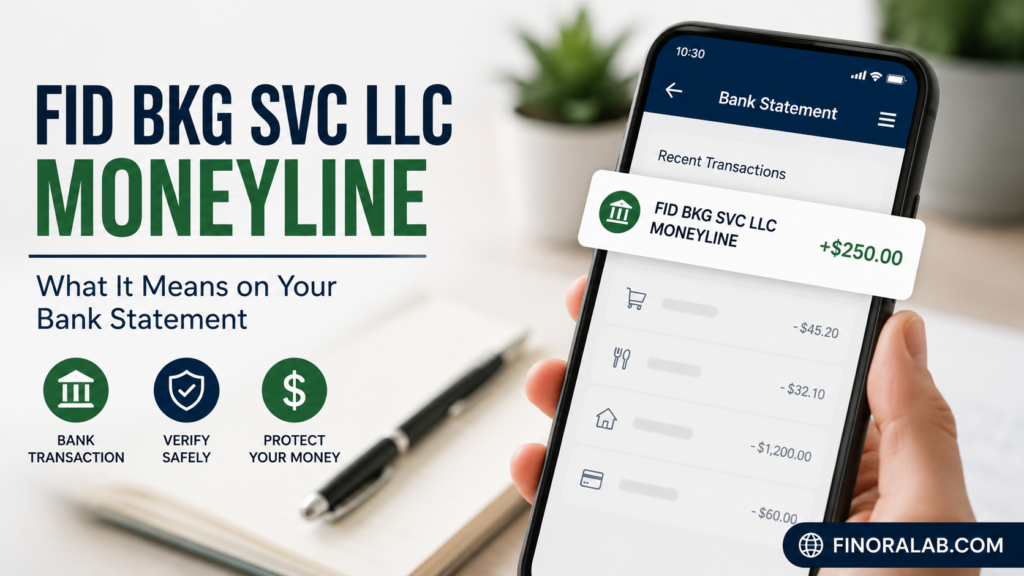
FID BKG SVC LLC MoneyLine: What It Means on Your Bank Statement & What to D
Shanzay Arain·Jul 30, 2026
If youve recently reviewed your bank statement and noticed a transaction labeled FID BKG SVC LLC MoneyLine, youre not alone. Thousands of consumers search this phrase every month because they want to know whether the charge is legitimate, whether its connected to their bank or brokerage account, or if it could indicate unauthorized activity.
Seeing unfamiliar transaction descriptions can be concerning, especially when managing your personal finances. While many statement descriptions are abbreviated by banks and payment processors, they often dont clearly identify the actual merchant or financial institution involved. As a result, even legitimate transactions can appear suspicious.
In many cases, FID BKG SVC LLC refers to Fidelity Brokerage Services LLC, a well known U.S. financial services company. The term Money Line may appear in connection with cash management features, transfers, brokerage related activity, or linked financial services, depending on how your account is configured. However, the exact meaning of the transaction depends on your individual account activity and should always be verified before assuming its legitimate.
This guide explains what FID BKG SVC LLC MoneyLine means, why it appears on bank statements, how to verify whether a transaction is legitimate, what warning signs to watch for, and the best practices for protecting your financial accounts.
What Does FID BKG SVC LLC MoneyLine Mean?
FID BKG SVC LLC is commonly recognized as an abbreviation for Fidelity Brokerage Services LLC, a major brokerage firm offering investment accounts, retirement accounts, cash management services, and other financial products. Banks often shorten merchant names due to statement character limits, resulting in descriptions that appear unfamiliar even when theyre associated with reputable companies.
The MoneyLine portion of the description is less standardized and may relate to a cash management feature, electronic transfer service, or linked financial account. Because banks and payment processors use different transaction descriptors, identical Fidelity transactions may appear differently depending on the financial institution involved.
If you recently transferred money between a Fidelity brokerage account and your checking account, deposited funds into an investment account, withdrew cash, purchased securities, or used a Fidelity Cash Management Account, the transaction may correspond to legitimate account activity. Reviewing your recent financial transactions often helps identify the source quickly.
However, you should never assume every transaction labeled FID BKG SVC LLC MoneyLine is automatically legitimate. Fraudsters occasionally exploit familiar looking merchant descriptions. Verifying the transaction directly through your financial institution remains the safest approach.
Why Does This Transaction Appear on Your Bank Statement?
Bank statements typically display abbreviated merchant information rather than detailed transaction descriptions. Financial institutions compress merchant names to fit limited statement fields, which explains why recognizable companies sometimes appear as confusing abbreviations.
A FID BKG SVC LLC MoneyLine transaction may appear for several reasons. Investors who maintain brokerage accounts frequently move money between checking accounts and investment accounts to purchase stocks, ETFs, mutual funds, bonds, or other securities. These transfers often generate abbreviated statement descriptions rather than detailed explanations.
Retirement contributions represent another common reason. Individuals contributing to Traditional IRAs, Roth IRAs, SEP IRAs, or other retirement accounts through Fidelity may notice similar transaction descriptions. Likewise, dividend reinvestments, automatic investment plans, scheduled deposits, or cash management transfers can generate entries associated with Fidelity Brokerage Services.
Some customers also use Fidelitys Cash Management Account as an alternative to traditional banking. These accounts support electronic transfers, bill payments, ATM withdrawals, and direct deposits, increasing the likelihood of seeing Fidelity related statement descriptions throughout the month.
Is FID BKG SVC LLC MoneyLine Legitimate?
In many situations, yes. Fidelity Brokerage Services LLC is one of the largest and most established financial services firms in the United States, serving millions of individual investors and retirement account holders. Legitimate transactions connected to Fidelity generally reflect investment activity, account funding, withdrawals, transfers, or cash management services.
The legitimacy of a specific transaction, however, depends entirely on whether you authorized it. Simply recognizing Fidelity as a reputable institution doesnt guarantee every transaction displaying its abbreviated name belongs to you. Identity theft, unauthorized account access, payment fraud, and banking errors remain possible regardless of the merchant involved.
Start by reviewing your recent account activity. Ask yourself whether youve transferred money into an investment account, scheduled automatic deposits, purchased securities, sold investments, received distributions, or linked external bank accounts. Matching the transaction amount and date often resolves the mystery quickly.
If you cannot connect the transaction to any known financial activity, investigate immediately. Prompt action significantly improves your chances of resolving unauthorized transactions before additional financial losses occur.
Common Reasons You May See This Transaction
Several routine financial activities can generate a FID BKG SVC LLC MoneyLine entry on your bank statement. Understanding these possibilities helps distinguish legitimate account activity from potential fraud.
Automatic investment contributions remain one of the most common explanations. Many investors schedule recurring monthly transfers from checking accounts into brokerage accounts to build long term wealth through consistent investing. These automated deposits may appear using abbreviated transaction descriptions.
Similarly, dividend reinvestment plans, retirement savings contributions, mutual fund purchases, ETF investments, and portfolio rebalancing transactions may trigger related statement entries. Cash transfers between linked accounts, including Fidelity Cash Management Accounts and external financial institutions, also produce electronic transaction records.
Employer sponsored retirement plans occasionally contribute as well. Employees participating in workplace retirement programs managed through Fidelity may notice transfers associated with payroll contributions, rollover activity, or benefit distributions depending on account settings.
Less frequently, account corrections, returned transfers, settlement activity, or investment proceeds from security sales may generate similar descriptions. Reviewing both your bank statement and Fidelity account history together typically provides the clearest explanation.
How to Verify Whether the Transaction Is Yours
Whenever you encounter an unfamiliar banking transaction, verification should be your first priority. Avoid making assumptions based solely on the merchant description. Instead, compare the transaction amount, posting date, and timing with your recent financial activity.
Log into your brokerage account and review recent deposits, withdrawals, transfers, investment purchases, and scheduled transactions. Most financial institutions maintain detailed online histories that provide significantly more information than abbreviated bank statements.
Next, review any automatic investment plans you previously established. Many consumers forget recurring monthly transfers created months or even years earlier. Automatic retirement contributions, education savings deposits, or recurring investment purchases may explain the transaction.
If uncertainty remains, contact your bank and Fidelity directly using verified customer service numbers obtained from official websites or account documents not numbers found through unverified online sources. Representatives can often identify transaction details unavailable through standard banking statements.
Never provide sensitive personal information in response to unsolicited emails, text messages, or phone calls claiming to verify financial transactions. Always initiate contact yourself through official customer service channels.
What Should You Do If You Dont Recognize the Transaction?
Finding an unfamiliar transaction on your bank statement can be stressful, but taking a systematic approach helps you determine whether the charge is legitimate or potentially fraudulent. Before reporting the transaction as unauthorized, gather as much information as possible by reviewing your recent financial activity.
Start by checking your online banking and brokerage accounts for matching transfers, deposits, withdrawals, or investment purchases. Look beyond the transaction description and compare the amount, posting date, and any notes associated with the transaction. If you recently transferred funds into a brokerage account, contributed to a retirement account, or sold investments, the transaction may simply appear under an abbreviated name on your bank statement.
If you still cannot identify the transaction, contact your financial institution immediately using the customer service number listed on your debit card, bank statement, or the official website. Explain that you noticed a FID BKG SVC LLC MoneyLine transaction you dont recognize and ask for additional transaction details, such as the originating account or merchant information.
If the representative confirms that the transaction was unauthorized, request that your account be secured immediately. This may include freezing your debit card, replacing compromised cards, filing a fraud claim, and monitoring your account for additional suspicious activity. Acting quickly can minimize financial losses and simplify the dispute process.
Could FID BKG SVC LLC MoneyLine Be Fraud?
Although many FID BKG SVC LLC MoneyLine transactions are legitimate, consumers should never ignore unfamiliar financial activity. Financial fraud continues to evolve, and criminals frequently target banking and investment accounts through phishing emails, stolen credentials, malware, and identity theft.
Unauthorized transactions sometimes resemble legitimate merchant names to reduce suspicion. For example, scammers may exploit familiar financial institution names, hoping consumers assume the transaction is valid without investigating. While banks employ sophisticated fraud detection systems, no security system is perfect.
Several warning signs may indicate fraud rather than legitimate account activity
You have never opened a Fidelity account.
The transaction amount doesnt match any recent financial activity.
Multiple small transactions appear unexpectedly.
You receive unexpected verification emails or password reset notifications.
Your account login history shows unfamiliar devices or locations.
Personal information has recently been exposed in a data breach.
If any of these situations apply, immediately change your passwords, enable multi factor authentication (MFA), review recent account activity, and contact your banks fraud department. You should also monitor your credit reports for signs of identity theft and consider placing a fraud alert or credit freeze if appropriate.
How to Protect Your Financial Accounts
Preventing fraud is far easier than recovering from it. Maintaining strong financial security habits can significantly reduce the likelihood of unauthorized transactions affecting your bank or investment accounts.
One of the most effective strategies is enabling multi factor authentication on every financial account. MFA requires an additional verification step beyond your password, making unauthorized access much more difficult even if your login credentials are compromised.
Strong password management is equally important. Use unique, complex passwords for each financial institution and avoid reusing passwords across multiple websites. Password managers can securely generate and store strong credentials while reducing the temptation to reuse passwords.
Regular account monitoring provides another valuable layer of protection. Reviewing your bank statements, brokerage activity, and credit card transactions every few days allows you to identify suspicious activity before it escalates. Many banks also offer real time transaction alerts through mobile apps or text messages, enabling immediate notification whenever money enters or leaves your accounts.
Finally, remain cautious when sharing personal information online. Avoid clicking links in unsolicited emails, verify website addresses before entering login credentials, and never disclose account numbers or verification codes to unknown callers claiming to represent financial institutions.
How Fidelity Brokerage Services Fits Into Personal Financial Planning
For many investors, Fidelity Brokerage Services plays an important role in long term financial planning. The company offers brokerage accounts, retirement plans, health savings accounts (HSAs), education savings accounts, cash management products, and financial advisory services designed to help individuals build wealth over time.
Investors commonly transfer funds from checking accounts into brokerage accounts on a recurring schedule. This disciplined investing approach, often called dollar cost averaging, allows individuals to purchase investments consistently regardless of short term market fluctuations. As a result, recurring transfers associated with Fidelity may regularly appear on bank statements.
Retirement planning represents another common use case. Individuals saving through Traditional IRAs, Roth IRAs, rollover IRAs, or employer sponsored retirement accounts frequently establish automatic contributions that generate electronic transfers each month. These recurring investments support long term financial goals such as retirement income, education funding, or wealth accumulation.
While investing offers opportunities for growth, it also involves risk. Investment values fluctuate based on market conditions, economic trends, interest rates, and company performance. Maintaining a diversified portfolio aligned with your financial objectives and risk tolerance remains one of the most effective long term investment strategies.
Common Mistakes People Make When Reviewing Bank Statements
Many consumers glance only at account balances instead of reviewing individual transactions. While monitoring balances is important, carefully examining transaction details helps identify errors, duplicate charges, and unauthorized activity before they become larger problems.
Another common mistake is assuming every unfamiliar transaction is fraudulent. Banks frequently abbreviate merchant names, making legitimate purchases appear confusing. Before reporting fraud, compare transaction dates, amounts, receipts, and account activity to determine whether the transaction corresponds to a recent purchase or transfer.
Conversely, some consumers ignore unfamiliar charges because they assume the amount is too small to matter. Fraudsters sometimes begin with small test transactions before attempting larger withdrawals. Reporting suspicious activity promptly protects both your finances and your credit profile.
Finally, delaying action can complicate fraud investigations. Most financial institutions encourage customers to report unauthorized transactions as soon as possible. Timely reporting improves the likelihood of recovering funds and preventing additional unauthorized activity.
Banking and Investment Best Practices
Effective money management extends beyond identifying unfamiliar transactions. Developing strong banking and investing habits helps protect your financial future while reducing unnecessary risk.
Maintaining an emergency fund is one of the cornerstones of sound financial planning. Financial advisors commonly recommend keeping three to six months of essential living expenses in a readily accessible savings account. This reserve helps cover unexpected costs without forcing the sale of long term investments during market downturns.
Budgeting also supports financial stability. Tracking income, expenses, savings goals, and investment contributions provides greater visibility into your cash flow. Automated budgeting apps and online banking tools make monitoring finances easier than ever before.
Debt management should remain another priority. Paying credit card balances on time, reducing high interest debt, and maintaining a healthy credit score can improve borrowing opportunities while lowering overall financial stress.
For investors, diversification remains a fundamental principle. Spreading investments across different asset classes, industries, and geographic regions reduces exposure to any single investment while supporting more balanced long term portfolio growth.
Conclusion
Seeing FID BKG SVC LLC MoneyLine on your bank statement can initially seem confusing, but in many cases, the transaction is connected to legitimate activity involving Fidelity Brokerage Services LLC. Automatic investment contributions, retirement account funding, brokerage transfers, and cash management services are among the most common reasons this description appears.However, every unfamiliar transaction deserves careful review. Comparing transaction details with your recent financial activity, checking your brokerage account, and contacting your financial institution when necessary are essential steps in verifying legitimacy. Never ignore suspicious transactions, even if they involve recognizable financial institutions.Maintaining strong cybersecurity practices, reviewing bank statements regularly, enabling multi factor authentication, and monitoring your credit reports can significantly reduce the risk of financial fraud. Whether youre actively investing for retirement or simply managing everyday banking, staying informed about your financial accounts remains one of the best ways to protect your money and achieve long term financial security.
It commonly refers to a transaction associated with Fidelity Brokerage Services LLC. The MoneyLine portion may relate to electronic transfers, cash management features, or brokerage account activity, although the exact meaning depends on your specific account.
Is FID BKG SVC LLC MoneyLine a legitimate transaction?
In many cases, yes. Fidelity Brokerage Services LLC is a legitimate financial institution. However, you should always verify that the transaction matches your own financial activity before assuming it is authorized.
Why is FID BKG SVC LLC on my bank statement?
The transaction may result from brokerage account funding, investment purchases, retirement contributions, dividend activity, automatic transfers, or Fidelity Cash Management Account services.
What should I do if I dont recognize the transaction?
Review your recent banking and brokerage activity, compare transaction dates and amounts, and contact your bank or Fidelity through official customer service channels if the transaction remains unexplained.
Can someone use my bank account without my permission?
Unfortunately, unauthorized transactions can occur due to fraud, identity theft, stolen credentials, or account compromise. Report suspicious activity immediately to your financial institution.
How do I stop unauthorized bank transactions?
Contact your bank immediately, dispute the transaction, request a replacement debit card if necessary, update passwords, enable multi factor authentication, and continue monitoring your accounts for unusual activity.
Does Fidelity offer automatic investment transfers?
Yes. Many Fidelity accounts allow recurring transfers from checking accounts into brokerage accounts or retirement accounts as part of automated investing strategies.
Can recurring investments create bank statement entries every month?
Yes. Automatic investment plans, retirement contributions, and scheduled transfers frequently generate recurring electronic transactions that appear on monthly bank statements.
Should I dispute every unfamiliar bank transaction?
No. First verify whether the transaction relates to a legitimate purchase, subscription, investment transfer, or automatic payment. If you cannot identify it after careful review, contact your financial institution promptly.
How can I better protect my financial accounts?
Use strong passwords, enable multi factor authentication, monitor your bank statements regularly, avoid phishing scams, keep your devices updated, and review your credit reports periodically for signs of unauthorized activity.
I am a professional finance content writer with expertise in personal finance investing, banking, loans, insurance, credit cards, budgeting, and market related topics. I create clear, SEO optimized, and reader friendly finance content that helps audiences understand complex financial concepts in simple words. My goal is to write trustworthy and engaging content that improves search visibility, builds credibility, and supports business growth.
I am a professional finance content writer with expertise in personal finance investing, banking, loans, insurance, credit cards, budgeting, and market related topics. I create clear, SEO optimized, and reader friendly finance content that helps audiences understand complex financial concepts in simple words. My goal is to write trustworthy and engaging content that improves search visibility, builds credibility, and supports business growth.