Accounting Equation Made Easy: Formula, Examples and Simple Guide
Shanzay Arain·Jul 20, 2026
Every business transaction affects a companys financial position. Buying equipment changes its assets, taking out a loan increases both cash and debt, and earning a profit can increase the owners claim on the business.
The accounting equation organizes these financial changes into one simple formula
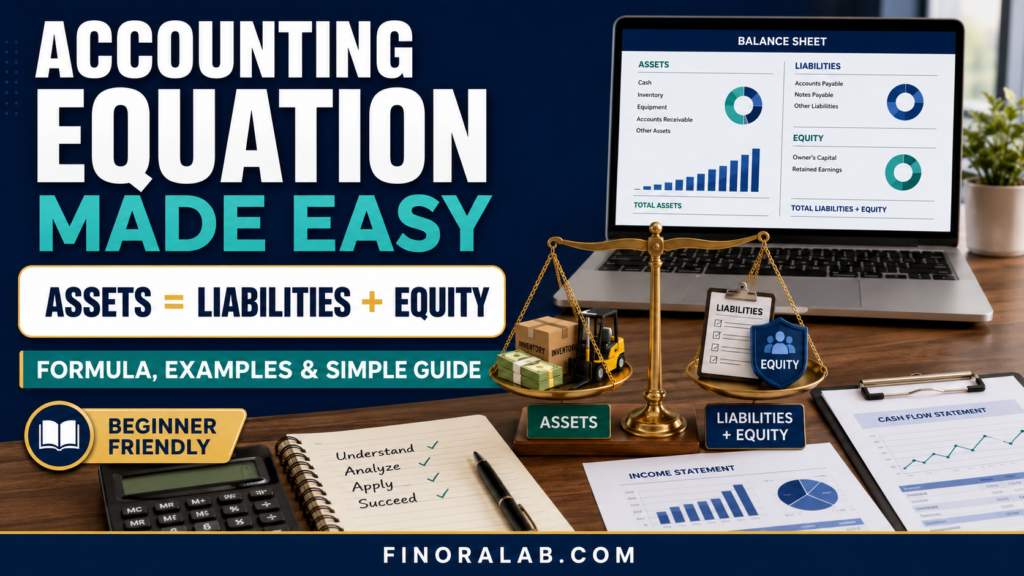
Assets = Liabilities + Owners Equity
This formula is the foundation of double entry bookkeeping and the balance sheet. It shows what a business owns, what it owes, and how much of its net value belongs to its owners.
Although the formula looks basic, it supports nearly every financial transaction recorded by a business. Understanding it can help entrepreneurs interpret financial statements, identify bookkeeping mistakes, evaluate debt, and make more informed financial decisions.
This beginner friendly guide explains the accounting equation, each of its components, its expanded version, practical examples, benefits, limitations, and common mistakes.
What Is the Accounting Equation?
The accounting equation is a formula showing that a companys total assets must equal the combined value of its liabilities and owners equity.
The basic formula is
Assets = Liabilities + Owners Equity
Assets represent economic resources controlled by the business. Liabilities represent obligations owed to other people or organizations. Owners equity represents the remaining claim belonging to the owner after liabilities are deducted.
The equation must remain balanced because every asset is financed from one of two broad sources money provided by creditors or money attributable to the owners.
For example, if an entrepreneur invests $20,000 in a new company, the business gains $20,000 in cash. Its assets increase by $20,000, while owners equity also increases by $20,000.
The equation becomes
$20,000 in assets = $0 in liabilities + $20,000 in equity
Both sides remain equal.
Quick Summary Table
Component
Simple meaning
Common examples
Assets
Resources owned or controlled by the business
Cash, inventory, equipment and receivables
Liabilities
Amounts the business owes
Loans, unpaid bills and taxes payable
Owners equity
Owners residual claim
Contributed capital and retained profits
Basic formula
Relationship between the three elements
Assets = Liabilities + Equity
Net assets formula
Another way to calculate equity
Equity = Assets − Liabilities
Core purpose
Keeps financial records balanced
Supports double entry bookkeeping
Main financial statement
Where the equation appears
Balance sheet
Main limitation
Does not measure market value automatically
Book values may differ from current values
Common mistake
Treating revenue as an immediate cash increase
Revenue can create accounts receivable
Best practice
Analyze both sides of every transaction
Confirm that the equation remains balanced
Understanding Assets
Assets are resources a business owns or controls that are expected to provide economic value. They are reported on the asset side of the balance sheet.
Common business assets include
Cash
Bank balances
Accounts receivable
Inventory
Prepaid expenses
Office supplies
Equipment
Vehicles
Buildings
Land
Investments
Patents and certain other intangible assets
Assets are often divided into current and noncurrent categories.
Current assets are expected to be used, sold, or converted into cash within the companys normal operating cycle or approximately one year. Cash, inventory, and accounts receivable are typical current assets.
Noncurrent assets are expected to benefit the business for longer periods. Buildings, machinery, vehicles, and certain long term investments are examples.
An asset is not necessarily the same as an expense. Purchasing a computer may initially create an equipment asset because the computer will be used for several accounting periods. A portion of its cost may later be recognized as depreciation expense.
Personal property belonging to the owner is not automatically a business asset. The item must be contributed to, purchased by, or otherwise controlled by the business and recorded appropriately.
Understanding Liabilities
Liabilities are financial obligations the business must pay or settle in the future. They usually arise when a company borrows money, receives goods before paying for them, or incurs an expense that has not yet been paid.
Common liabilities include
Accounts payable
Bank loans
Credit card balances
Wages payable
Taxes payable
Interest payable
Customer deposits
Unearned revenue
Lease liabilities
Mortgages
Notes payable
Like assets, liabilities are commonly classified as current or noncurrent.
Current liabilities generally need to be settled within the operating cycle or approximately one year. Supplier bills, short term debt, wages payable, and certain taxes payable are common examples.
Noncurrent liabilities are due over a longer period. Long term loans, bonds payable, and some lease obligations may fall into this category.
Liabilities are not automatically negative for a business. Responsible borrowing can help finance equipment, inventory, expansion, or working capital. However, excessive liabilities can increase financial risk and reduce the owners equity.
Understanding Owners Equity
Owners equity is the residual interest in a business after its liabilities are deducted from its assets.
The formula can be rearranged as
Owners Equity = Assets − Liabilities
If a business has $150,000 in assets and $90,000 in liabilities, its accounting equity is
$150,000 − $90,000 = $60,000
The $60,000 represents the owners recorded claim on the net assets of the company.
Equity generally increases when
Owners invest money or other assets
The business earns revenue
The business generates net income
Equity generally decreases when
Owners withdraw money or assets
The business incurs expenses
The business experiences a net loss
Dividends are distributed by a corporation
The exact equity accounts depend on the legal structure. A sole proprietorship may use owners capital and owners drawings. A partnership maintains separate capital accounts for its partners. A corporation may report share capital, additional paid in capital, retained earnings, and treasury stock.
Accounting equity should not automatically be treated as the companys market value. The balance sheet may report assets at historical cost or another required accounting measurement rather than their current selling price.
How the Accounting Equation Works
Every properly recorded transaction maintains the balance between assets and the sources used to finance those assets.
A transaction may affect
An asset and equity
An asset and a liability
Two different assets
A liability and equity
Two liability accounts
Several accounts on both sides
Consider a company that borrows $30,000 from a bank. Cash increases by $30,000, but the company also incurs a $30,000 loan liability.
The equation changes as follows
Assets +$30,000 = Liabilities +$30,000 + No change in equity
The company has more cash, but it has not become $30,000 wealthier because it also owes the bank $30,000.
Now suppose the company uses $8,000 of that cash to buy equipment. Cash decreases by $8,000, while equipment increases by $8,000.
Total assets do not change. Only their composition changes
Cash −$8,000 + Equipment +$8,000 = No overall change
The equation remains balanced throughout both transactions.
Accounting Equation Examples
Assume Sophia starts a consulting business named ClearPath Consulting.
Owner invests cash
Sophia contributes $25,000 to the business.
Cash increases by $25,000
Owners equity increases by $25,000
$25,000 assets = $0 liabilities + $25,000 equity
Business buys equipment with cash
The company purchases office equipment for $6,000 in cash.
Equipment increases by $6,000
Cash decreases by $6,000
Total assets remain $25,000
The company now has $19,000 in cash and $6,000 in equipment.
$25,000 assets = $0 liabilities + $25,000 equity
Business purchases supplies on credit
The company buys $2,000 of supplies and agrees to pay the supplier later.
Paying the supplier does not create a new expense at this stage if the supplies were previously recorded as an asset. It settles an existing liability.
Owner withdraws cash
Sophia withdraws $1,000 for personal use.
Cash decreases by $1,000
Owners equity decreases by $1,000
$31,800 assets = $0 liabilities + $31,800 equity
The withdrawal is not normally classified as a business operating expense. It represents a distribution to the owner.
Transaction Analysis Table
Transaction
Assets
Liabilities
Equity
Owner invests $25,000
+$25,000
No change
+$25,000
Buy equipment for $6,000 cash
No net change
No change
No change
Buy $2,000 supplies on credit
+$2,000
+$2,000
No change
Earn $5,000 cash revenue
+$5,000
No change
+$5,000
Earn $4,000 revenue on credit
+$4,000
No change
+$4,000
Pay $1,200 rent
−$1,200
No change
−$1,200
Pay $2,000 supplier balance
−$2,000
−$2,000
No change
Owner withdraws $1,000
−$1,000
No change
−$1,000
The Expanded Accounting Equation
The basic formula combines all equity related activity into one category. The expanded accounting equation separates the major elements that change equity.
Different textbooks may present the expanded equation in slightly different formats. The fundamental relationship remains the same assets must equal liabilities plus equity.
Accounting Equation and Double Entry Bookkeeping
Double entry bookkeeping requires every financial transaction to affect at least two accounts. The total debit amount must equal the total credit amount.
The accounting equation explains why this system works. Debits and credits record changes within assets, liabilities, equity, revenue, and expenses while preserving the overall balance.
However, debit does not always mean an increase, and credit does not always mean a decrease.
The typical rules are
Account category
Increase recorded as
Decrease recorded as
Assets
Debit
Credit
Liabilities
Credit
Debit
Owners equity
Credit
Debit
Revenue
Credit
Debit
Expenses
Debit
Credit
Owners drawings
Debit
Credit
Suppose a business pays $500 for utilities. The company debits utilities expense by $500 and credits cash by $500.
The expense reduces equity, while the cash payment reduces assets. The equation stays balanced.
Balanced entries do not guarantee that the transaction was recorded in the correct accounts. A bookkeeper could debit the wrong expense account and still create equal debits and credits. Review and reconciliation remain important.
Relationship With the Balance Sheet
The balance sheet is a financial statement built around the accounting equation. It reports assets, liabilities, and equity at a specific date.
A simplified balance sheet may look like this
Assets
Amount
Cash
$40,000
Accounts receivable
$15,000
Inventory
$20,000
Equipment
$25,000
Total assets
$100,000
Liabilities and equity
Amount
Accounts payable
$12,000
Bank loan
$38,000
Total liabilities
$50,000
Owners equity
$50,000
Total liabilities and equity
$100,000
The two totals agree
$100,000 = $50,000 + $50,000
The income statement and statement of owners equity also connect with this equation. Revenue and expenses determine net income, net income affects equity, and ending equity appears on the balance sheet.
Step by Step Guide to Analyzing a Transaction
Identify the event
Determine what happened financially. Did the business borrow money, earn revenue, pay an expense, buy an asset, or receive an owner contribution?
Identify the accounts
List the accounts involved. A cash equipment purchase affects cash and equipment, while a loan affects cash and notes payable.
Classify each account
Decide whether each account is an asset, liability, equity, revenue, expense, or withdrawal.
Determine the direction
Establish whether each account increases or decreases.
Record the amount
Use the transactions supported monetary value. Keep invoices, contracts, receipts, and bank records as evidence.
Check the equation
Confirm that the total change in assets equals the total change in liabilities and equity.
Record the journal entry
Apply the correct debit and credit rules.
Update the ledger
Post the entry to the relevant account balances and verify that the trial balance remains equal.
Benefits of Understanding the Accounting Equation
The equation gives beginners a clear framework for understanding how a business is financed. It distinguishes resources from obligations and the owners residual interest.
It also helps business owners evaluate borrowing. Receiving a large loan increases cash, but it increases liabilities by the same amount and does not immediately create profit.
The equation supports accurate bookkeeping by requiring every transaction to remain balanced. An imbalance signals that a transaction may be incomplete or entered incorrectly.
It also helps readers interpret the balance sheet. Someone who understands the relationship between assets, liabilities, and equity can better assess liquidity, leverage, solvency, and capital structure.
Finally, the equation explains how profitability affects financial position. Revenue can increase equity, while expenses and losses reduce it.
Risks and Limitations
The accounting equation is essential, but it does not provide a complete picture of business performance.
A company can have a balanced equation and still suffer from poor cash flow. It might hold substantial inventory and receivables but lack enough cash to pay current obligations.
The equation also does not automatically reflect market value. A building purchased years ago may be reported using an accounting value that differs significantly from its current selling price.
Balanced books do not prove that every entry is correct. Fraudulent or incorrect transactions can still be recorded with matching debits and credits.
The formula also does not explain profitability by itself. Two businesses may have similar assets and liabilities but very different revenue, costs, cash flow, and operating risks.
Users must review the accounting equation alongside the income statement, cash flow statement, notes, budgets, and supporting records.
Accounting Equation vs Working Capital
The accounting equation describes the relationship among all assets, liabilities, and equity
Assets = Liabilities + Equity
Working capital focuses only on short term financial resources and obligations
Working Capital = Current Assets − Current Liabilities
A business can have positive total equity but weak working capital if most of its assets are tied up in long term property or equipment.
The two concepts answer different questions. The accounting equation asks how the companys assets are financed. Working capital asks whether it has enough short term resources to cover near term obligations.
Accounting Equation vs Net Worth
For a business, equity is sometimes informally described as net worth
Net Worth or Equity = Total Assets − Total Liabilities
However, accounting equity may differ from what an owner could receive by selling the company. Accounting values, selling costs, taxes, goodwill, customer relationships, future earnings, and market conditions can all affect the real transaction value.
For personal finance, a similar net worth formula is used
Personal Net Worth = Personal Assets − Personal Liabilities
Bank balances, investments, property, vehicles, mortgages, loans, and credit card debt may be included. Personal net worth is useful, but it is not identical to business owners equity reported under formal accounting rules.
Common Mistakes to Avoid
Assuming every asset purchase is immediately an expense
Treating borrowed money as revenue
Recording owner investments as business sales
Classifying owner withdrawals as operating expenses
Forgetting that credit sales create accounts receivable
Forgetting that credit purchases create accounts payable
Confusing revenue with cash receipts
Confusing expenses with cash payments
Treating every balanced entry as automatically correct
Mixing personal and business transactions
Ignoring depreciation and accumulated depreciation
Using current market prices without an accounting basis
Recording transactions without supporting documents
Failing to reconcile bank and ledger balances
Reviewing the balance sheet without the income and cash flow statements
Latest Update and Modern Accounting Use
The accounting equation is a foundational concept rather than a market trend, interest rate, or regulation that changes annually. Its basic relationship remains
Assets = Liabilities + Equity
Modern cloud accounting software applies this principle automatically whenever a properly configured transaction is entered. Bank feeds, payment platforms, payroll applications, inventory systems, and invoicing tools can all generate double entry records.
Automation makes bookkeeping faster, but it does not eliminate the need for accounting knowledge. Software may place a transaction in the wrong account, duplicate imported activity, or apply an incorrect tax treatment if the setup or user instruction is wrong.
Artificial intelligence is also being used to suggest classifications, identify unusual transactions, and automate reconciliations. These tools can assist accountants, but businesses should still review material entries and maintain appropriate internal controls.
Accounting standards, tax rules, and financial reporting requirements can change. Businesses preparing formal financial statements should confirm the latest applicable requirements through recognized accounting bodies and qualified professionals.
Expert Tips for Better Bookkeeping
Keep personal and business bank accounts separate. This makes transaction classification and financial reporting much clearer.
Record transactions regularly rather than waiting until the end of the year. Delays increase the risk of missing documents and incorrect classifications.
Reconcile bank, credit card, loan, receivable, and payable accounts every month. Reconciliation verifies that accounting balances agree with independent records.
Review a comparative balance sheet. Looking at changes from one month or year to another can reveal unexpected borrowing, falling cash, rising receivables, or shrinking equity.
Do not judge financial health from one number. Analyze the accounting equation alongside profitability, cash flow, working capital, debt ratios, and business conditions.
When uncertain, consult a qualified accountant. Correcting a transaction early is usually easier than rebuilding inaccurate records after months or years.
Conclusion
The accounting equation shows the fundamental relationship between a businesss resources, obligations, and ownership interest
Assets = Liabilities + Owners Equity
Every properly recorded transaction keeps this equation balanced. Loans increase both assets and liabilities, revenue generally increases equity, expenses reduce equity, and owner withdrawals decrease both assets and equity.Understanding the accounting equation makes financial statements easier to read and double entry bookkeeping easier to learn. It is not a complete measure of business performance, but it provides the structural foundation for reliable financial records.
FAQs
What is the basic accounting equation?
The basic formula is Assets = Liabilities + Owners Equity. It shows that everything a business controls is financed either through obligations to creditors or through the owners interest.
Why must the accounting equation always balance?
It must balance because every business resource has a financing source. That source is either a liability, such as a loan, or equity attributable to the owners.
What happens when a business earns revenue?
Revenue generally increases an asset, such as cash or accounts receivable, and increases owners equity through profit.
What happens when a business pays an expense?
Paying an expense usually reduces cash and reduces owners equity. Under accrual accounting, an expense can also create or reduce a liability.
Is a business loan considered income?
No. A loan generally increases cash and liabilities by the same amount. It does not create revenue because the borrowed money must be repaid.
What is the expanded accounting equation?
A common version is Assets = Liabilities + Owners Capital + Revenue − Expenses − Drawings. It separates the major activities that change equity.
Can the accounting equation balance if the books contain errors?
Yes. An entry can have equal debits and credits but use the wrong accounts or amounts. A balanced equation is necessary, but it does not guarantee completely accurate records.
I am a professional finance content writer with expertise in personal finance investing, banking, loans, insurance, credit cards, budgeting, and market related topics. I create clear, SEO optimized, and reader friendly finance content that helps audiences understand complex financial concepts in simple words. My goal is to write trustworthy and engaging content that improves search visibility, builds credibility, and supports business growth.
I am a professional finance content writer with expertise in personal finance investing, banking, loans, insurance, credit cards, budgeting, and market related topics. I create clear, SEO optimized, and reader friendly finance content that helps audiences understand complex financial concepts in simple words. My goal is to write trustworthy and engaging content that improves search visibility, builds credibility, and supports business growth.