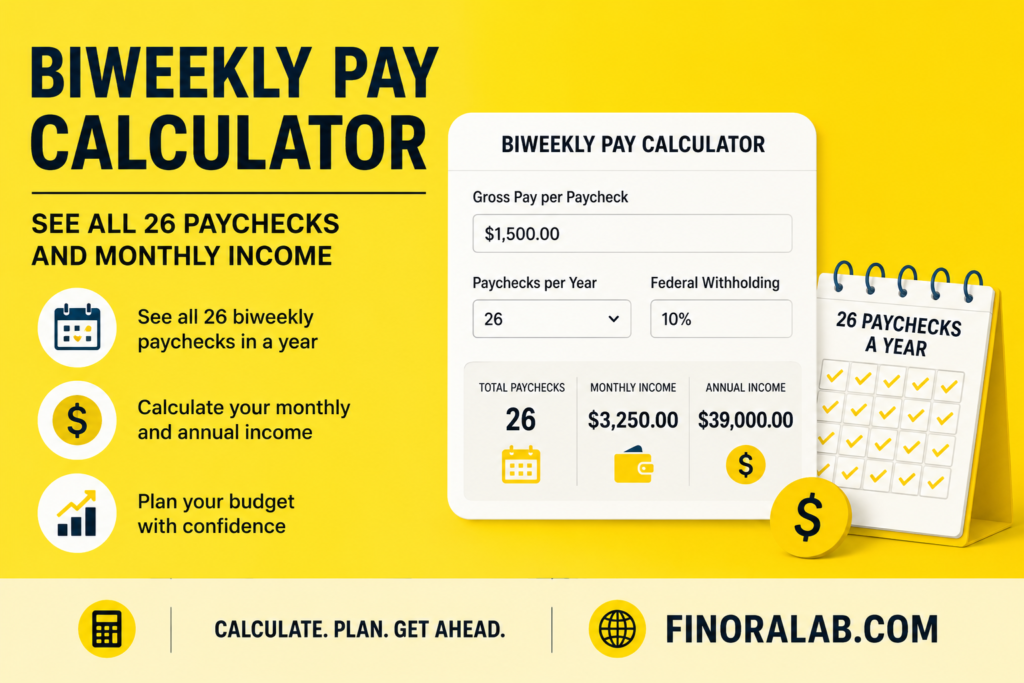
Biweekly Pay Calculator: See All 26 Paychecks and Monthly Income
Shanzay Arain·Jul 16, 2026
A job offer may provide an annual salary but say that employees receive biweekly pay. This schedule affects the size and timing of each paycheck, even though it does not normally change the total annual compensation stated in the employment agreement.
In payroll terminology, biweekly usually means an employee receives a paycheck once every two weeks. Because a standard year contains 52 weeks, this arrangement ordinarily produces 26 paychecks. Most months contain two paydays, while two months generally contain three.
Biweekly payroll is often confused with semimonthly pay, which provides two checks each calendar month and 24 checks per year. The difference can affect paycheck size, monthly budgeting, benefit deductions and the way workers plan for rent, loans and other expenses.
This guide explains how the schedule works, how to calculate gross earnings and how to use three paycheck months without disrupting your budget.
Biweekly Pay Quick Summary
Feature
Explanation
Basic meaning
Payment once every two weeks
Typical pay period length
14 days
Normal annual paychecks
26
Occasional exception
Some calendar years may contain 27 paydays
Typical monthly paydays
Two
Three paycheck months
Normally two each year
Salary calculation
Annual salary ÷ 26
Hourly calculation
Hourly rate × hours worked
Monthly income conversion
Biweekly pay × 26 ÷ 12
Common payday
Every other Friday, although employers choose the day
Main advantage
Predictable payment on the same weekday
Main challenge
Paydays do not align with fixed monthly bills
Different from semimonthly
Semimonthly normally provides 24 checks
What Is Biweekly Pay?
Biweekly pay is a payroll schedule under which an employer normally pays workers every 14 days. The payday usually falls on the same weekday, such as every other Friday.
A typical schedule might look like this
Friday, January 2
Friday, January 16
Friday, January 30
Friday, February 13
Friday, February 27
The employee receives three paychecks in January and two in February. This happens because paydays are separated by 14 days rather than tied to fixed dates such as the 15th and last day of each month.
Although the word biweekly can be linguistically ambiguous, it almost always means every two weeks in a U.S. payroll context. An employment agreement should still state the precise pay frequency and payday to avoid confusion.
How Does Biweekly Pay Work?
A biweekly pay period normally covers 14 calendar days. During that period, the employer records
Regular hours
Overtime hours
Paid leave
Commissions
Bonuses
Shift differentials
Other taxable compensation
At the end of the pay period, payroll calculates gross wages. Applicable taxes and employee deductions are then removed.
The basic calculation is
Gross pay − Taxes − Benefit deductions − Other deductions = Net pay
Gross pay represents earnings before deductions. Net pay is the amount deposited into the employees account.
There may be a short delay between the end of the pay period and the official payday. Employers use this time to review working hours, approve overtime and process payroll.
How Many Biweekly Paychecks Are in a Year?
A standard biweekly payroll schedule produces 26 checks
52 weeks ÷ 2 = 26 pay periods
This is two more checks than a semimonthly schedule, which normally provides 24 checks.
However, a calendar year does not contain exactly 364 days. It has 365 days, or 366 during a leap year. Because the extra calendar days accumulate, an occasional year may have 27 biweekly paydays, depending on the employers payday alignment.
A 27 paycheck year does not necessarily increase a salaried workers annual compensation. An employer may divide the agreed salary across 27 checks rather than 26. Employees should ask payroll how salary and benefit deductions will be handled.
Why Do Some Months Have Three Paychecks?
Most months have two biweekly paydays, but two months in a normal 26 paycheck year generally have three.
For example, if paydays fall on the following Fridays
May 1
May 15
May 29
May is a three paycheck month.
These additional checks are not bonuses. They are part of the employees regular annual compensation. The timing makes them feel like extra money because many monthly budgets are built around two checks.
Three paycheck months can be useful for
Building emergency savings
Paying down credit card debt
Making an additional loan payment
Funding vehicle or home repairs
Covering annual insurance premiums
Increasing retirement savings
Preparing for holiday expenses
Replenishing sinking funds
Before allocating the entire third check, verify which taxes and benefit deductions will apply.
How to Calculate Biweekly Pay From Annual Salary
For a normal 26 pay period year, use this formula
Gross biweekly pay = Annual salary ÷ 26
Suppose an employee earns $65,000 annually
$65,000 ÷ 26 = $2,500
The gross biweekly paycheck is $2,500 before taxes and deductions.
Here are additional examples
Annual salary
Gross biweekly paycheck
$40,000
$1,538.46
$50,000
$1,923.08
$60,000
$2,307.69
$65,000
$2,500.00
$75,000
$2,884.62
$80,000
$3,076.92
$100,000
$3,846.15
These figures show gross earnings. Actual deposits will usually be lower after payroll withholding and benefits.
How to Calculate Biweekly Pay for Hourly Employees
Hourly employees calculate gross wages using the actual number of hours worked during the pay period.
Use this formula
Gross pay = Hourly rate × Regular hours
Suppose an employee earns $22 per hour and works 80 regular hours over two weeks
$22 × 80 = $1,760
The gross biweekly wage is $1,760 before taxes and deductions.
If the employee works a different number of hours in each week, payroll should still track the weeks separately for overtime purposes.
For example
Week one 45 hours
Week two 35 hours
Total biweekly hours 80
The total is 80, but the employee may still have five qualifying overtime hours from week one. The 35 hour second week does not ordinarily erase overtime earned during the 45 hour week.
The U.S. Department of Labor specifically warns that covered employers cannot delay overtime until an employee exceeds 80 hours in a biweekly period because each workweek normally stands alone. U.S. Department of Labor
How Overtime Affects a Biweekly Paycheck
Under the federal Fair Labor Standards Act, covered nonexempt employees generally receive at least one and a half times their regular rate for hours worked beyond 40 in a workweek.
Consider an employee earning $20 per hour
Week One
Regular hours 40
Overtime hours 5
Regular pay $800
Overtime rate $30
Overtime pay $150
Total week one pay $950
Week Two
Regular hours 35
Regular pay $700
Overtime pay $0
Total Biweekly Gross Pay
$950 + $700 = $1,650
The employee receives $1,650 before payroll deductions.
State laws, employment contracts and worker classifications may create different requirements. The Department of Labor explains that covered nonexempt employees generally receive time and a half after 40 hours in a workweek. DOL Overtime Guidance
How to Convert Biweekly Pay to Monthly Income
Multiplying one biweekly check by two does not produce an accurate average monthly income. That method counts only 24 checks, while a normal biweekly year contains 26.
Use this formula
Average monthly income = Biweekly pay × 26 ÷ 12
Suppose gross biweekly pay is $2,000
$2,000 × 26 ÷ 12 = $4,333.33
The average gross monthly income is approximately $4,333.33.
The annual calculation confirms the result
$2,000 × 26 = $52,000 annual gross income
$52,000 ÷ 12 = $4,333.33 average monthly income
For everyday budgeting, some employees still use two paychecks per month as a conservative baseline. They then assign the third checks to savings or irregular expenses.
How to Convert Biweekly Pay to Annual Income
Use this formula
Annual gross income = Biweekly gross pay × 26
If the biweekly paycheck is $2,500
$2,500 × 26 = $65,000
The estimated annual gross income is $65,000.
This calculation assumes 26 equal checks. Hourly employees with changing schedules, overtime or unpaid leave should total actual earnings rather than assuming that each check will be identical.
Biweekly Pay vs. Semimonthly Pay
Biweekly and semimonthly payroll often appear similar because both commonly provide two checks during a month. The key difference is their timing.
Feature
Biweekly
Semimonthly
Frequency
Every two weeks
Twice each month
Standard annual checks
26
24
Payday pattern
Same weekday
Usually fixed dates
Three paycheck months
Normally two
Generally none
Pay period length
Usually 14 days
Varies
Individual check size
Usually smaller
Usually larger
Hourly timekeeping
Often easier
Can split workweeks
Annual salary
Normally unchanged
Normally unchanged
A semimonthly employee may be paid on the 15th and last day of each month. A biweekly employee may be paid every other Friday.
For a $72,000 salary
Biweekly calculation
$72,000 ÷ 26 = $2,769.23
Semimonthly calculation
$72,000 ÷ 24 = $3,000
The semimonthly check is larger, but only 24 checks are issued. The biweekly employee receives smaller checks more frequently across the year.
Weekly pay can make short term cash flow easier because employees wait fewer days between checks. Biweekly payroll can reduce administrative work for employers while still giving employees a predictable schedule.
Neither method should change the employees agreed hourly rate or annual salary.
Biweekly Pay vs. Monthly Pay
Monthly employees receive one paycheck per month and normally have 12 annual checks.
A monthly check is larger, but the employee must make one payment last for the entire month. Biweekly pay divides income into smaller, more frequent amounts.
Biweekly payroll may be easier for employees who prefer paycheck based budgeting. Monthly payroll may work well for people whose major expenses are also due monthly and who maintain a strong cash reserve.
Pay frequency requirements vary by state and occupation. The U.S. Department of Labor provides a state by state summary, but employees should confirm current rules with the relevant state labor agency. State Payday Requirements
Taxes and Deductions on Biweekly Pay
A biweekly paycheck may include deductions for
Federal income tax
State income tax
Local income tax
Social Security
Medicare
Health insurance
Dental and vision coverage
Retirement contributions
Health savings accounts
Flexible spending accounts
Wage garnishments
Union dues
Other voluntary deductions
The amount withheld depends on taxable wages, location, benefit selections and withholding forms.
In the United States, employers use IRS withholding methods appropriate to the payroll period. The IRSs 2026 Publication 15 T recognizes 26 biweekly payroll periods and provides corresponding federal withholding methods. IRS Publication 15 T
Receiving a third paycheck in one month does not automatically create a special tax rate. Each check is processed under applicable withholding rules. Final income tax responsibility is generally determined using total annual income and the individuals tax return.
Biweekly Gross Pay vs. Net Pay
Gross biweekly pay is the amount earned before deductions. Net biweekly pay is the amount deposited after deductions.
This is an educational example. Actual tax and benefit deductions vary.
How Benefit Deductions Work in Three Paycheck Months
Employers do not all handle benefits the same way.
Possible approaches include
Deducting benefits from all 26 checks
Taking deductions from only 24 checks
Skipping selected deductions during two third paycheck months
Adjusting retirement contributions based on a percentage of each check
Applying fixed deductions to every payroll cycle
A third paycheck may therefore be larger than usual when some benefits are not deducted. It can also be similar to regular checks when all deductions continue.
Employees should review their benefits documents or ask payroll how deductions are distributed.
Step by Step Guide to Budgeting Biweekly Pay
List Every Payday
Use the employers payroll calendar and record all 26 expected paydays.
List Monthly Bills
Include
Rent or mortgage
Utilities
Insurance
Transportation
Minimum debt payments
Subscriptions
Childcare
Groceries
Savings contributions
Assign Bills to Paychecks
Match each expense with a paycheck arriving before the due date.
Divide Large Expenses
If rent is $1,600, reserve $800 from each of two checks rather than trying to fund it from one.
Create a Bills Account
Consider transferring reserved money to a separate account so it is not accidentally spent.
Build a Cash Buffer
Maintain enough money to handle timing differences between paydays and bill dates.
Plan Three Paycheck Months
Assign the third check to a goal before it arrives.
Benefits of Biweekly Pay
Predictable Payday
Payment normally arrives on the same weekday every two weeks.
More Checks Than Semimonthly Payroll
Employees generally receive 26 instead of 24 annual checks.
Useful Three Paycheck Months
Two months normally contain an additional payday that can support savings or debt reduction.
Convenient for Hourly Payroll
A 14 day period can contain two full seven day workweeks, making time tracking more straightforward.
Easier Paycheck Based Budgeting
Employees can organize bills and savings around each payday instead of managing an entire month at once.
Disadvantages and Risks
Misalignment With Monthly Bills
Biweekly paydays move through the calendar, while rent and many other expenses remain due on fixed dates.
Fourteen Day Gap
Workers accustomed to weekly pay may find the longer waiting period difficult.
Smaller Checks Than Semimonthly Payroll
A salaried employee receives 26 smaller installments instead of 24 larger ones.
Inconsistent Monthly Cash Flow
Most months contain two checks, but two months have three. Multiplying one check by two understates average monthly earnings.
Benefit Deduction Confusion
Net pay may change during a third paycheck month depending on payroll policy.
Occasional 27 Paycheck Year
A calendar alignment can create an extra pay date, requiring employers to decide how salary and fixed deductions will be distributed.
Common Mistakes to Avoid
Confusing Biweekly With Semimonthly
Biweekly normally means every two weeks. Semimonthly means twice per calendar month.
Multiplying One Check by 24
A standard biweekly year normally contains 26 checks.
Calculating Overtime After 80 Hours
For most covered nonexempt employees, each workweek must be evaluated separately.
Spending the Third Check in Advance
Confirm the payroll calendar and expected deductions before allocating it.
Budgeting With Gross Pay
Use net take home pay for household spending.
Assuming Every Check Will Be Identical
Overtime, unpaid leave, bonuses, deductions and tax withholding can change the amount.
Ignoring Processing Delays
The pay period end date and deposit date are not necessarily the same.
Comparing Job Offers by Paycheck Size
Compare annual compensation, benefits and working hours rather than one payment.
Latest Biweekly Pay Update for 2026
For 2026, IRS withholding guidance continues to recognize 26 biweekly payroll periods for federal withholding calculations.
Pay frequency requirements remain dependent on state law, occupation and employer policy. There is no universal federal rule requiring every private employer to use a biweekly schedule.
Federal overtime rules continue to require covered nonexempt employees to be evaluated by workweek rather than by a combined 80 hour biweekly total. State laws may provide additional protections.
Employees should verify current tax tables, state payday requirements and payroll policies before relying on older calculators or pay schedules.
Expert Tips
Request the annual payroll calendar.
Confirm whether the schedule contains 26 or 27 checks.
Calculate monthly income using pay × 26 ÷ 12.
Budget routine expenses using two checks per month.
Plan the use of third checks in advance.
Review every pay stub for errors.
Track overtime by individual workweek.
Ask how benefits are handled in three paycheck months.
Maintain a small checking account buffer.
Automate savings on each payday.
Update withholding forms after major life changes.
Compare job offers using annual compensation.
Keep copies of pay stubs and time records.
Conclusion
Biweekly pay normally means receiving a paycheck every two weeks, resulting in 26 checks during a standard year. Most months contain two paydays, while two months generally contain three.To calculate gross pay, divide annual salary by 26 or multiply the hourly rate by hours worked. To estimate average monthly income, multiply the biweekly amount by 26 and divide by 12.The schedule can provide predictable paydays and useful three paycheck months, but it requires planning because income dates do not align perfectly with monthly bills. Use net pay for budgeting, review overtime by workweek and confirm your employers deduction policy.
I am a professional finance content writer with expertise in personal finance investing, banking, loans, insurance, credit cards, budgeting, and market related topics. I create clear, SEO optimized, and reader friendly finance content that helps audiences understand complex financial concepts in simple words. My goal is to write trustworthy and engaging content that improves search visibility, builds credibility, and supports business growth.
I am a professional finance content writer with expertise in personal finance investing, banking, loans, insurance, credit cards, budgeting, and market related topics. I create clear, SEO optimized, and reader friendly finance content that helps audiences understand complex financial concepts in simple words. My goal is to write trustworthy and engaging content that improves search visibility, builds credibility, and supports business growth.