How Many Square Feet in an Acre? 43,560 Sq Ft Explained
Shanzay Arain·Aug 03, 2026
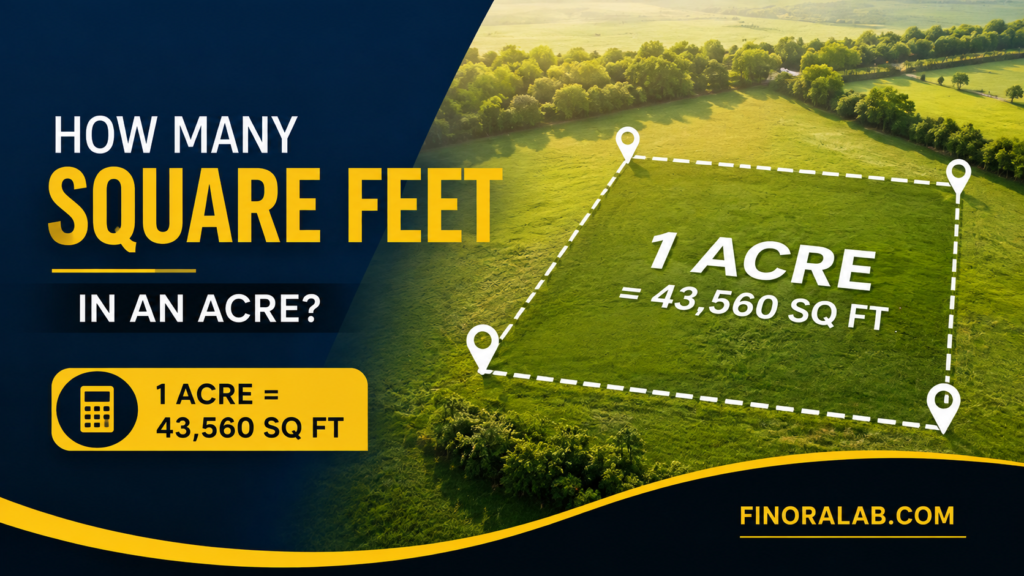
If you are wondering how many square feet in an acre, the exact answer is 43,560 square feet. This is the standard land area conversion used throughout the United States. One acre is a unit of area, while a square foot is a smaller unit used to measure floors, rooms, lots, buildings, and parcels of land. Knowing the conversion is useful when buying property, comparing land listings, planning construction, estimating landscaping needs, or simply understanding the size of a parcel. Once you know the basic conversion, calculating other acreage measurements becomes straightforward.
The interesting part is that an acre does not have to be a specific shape. An acre can be a square, rectangle, triangle, or irregular parcel, as long as its total area equals 43,560 square feet. For example, a perfectly square acre would measure approximately 208.71 feet by 208.71 feet. A rectangular acre could instead measure 100 feet by 435.6 feet. Both contain exactly the same area. This distinction matters when evaluating real estate because two properties with identical acreage can look dramatically different depending on their dimensions, frontage, access, and usable space.
How Many Square Feet Are in an Acre?
There are exactly 43,560 square feet in one acre. This is the standard conversion you can use for residential property, farmland, commercial land, vacant lots, and other real estate measurements in the United States. Therefore, if a property listing says a parcel contains 1 acre, its total area is equivalent to 43,560 square feet. If the property contains 2 acres, it has 87,120 square feet. Similarly, a half acre contains 21,780 square feet, while a quarter acre contains 10,890 square feet.
The basic formula is simple acres × 43,560 = square feet. To convert square feet back into acres, reverse the calculation square feet ÷ 43,560 = acres. For example, a 100,000 square foot property contains approximately 2.296 acres. These calculations are especially helpful when comparing listings that use different units. A developer might discuss land in acres, while a contractor or architect may work in square feet. Converting between the units allows you to compare the same property consistently.
Why Is an Acre 43,560 Square Feet?
The definition of an acre has historical roots rather than being based on a simple square measurement. The term is associated with older English land measurements and traditionally described an area that could be plowed by a team of oxen in a particular working arrangement. Over time, the acre became standardized as a unit of land area. In the modern United States, one acre is defined as exactly 43,560 square feet. The historical origin explains why the number may initially seem unusual compared with measurements such as 100 feet or 1,000 square feet.
An acre can be represented using many different dimensions because area measures the amount of two dimensional space rather than a particular length or width. For example, 1 acre could be 1 foot wide and 43,560 feet long, although such a parcel would obviously be impractical for many real world purposes. More realistically, it could be 200 feet by 217.8 feet. The dimensions can vary while the area remains constant. This is why acreage alone does not tell you everything about a propertys usability, shape, or development potential.
How Big Is One Acre of Land?
One acre is larger than many people initially imagine, particularly if they are accustomed to thinking about residential lots in square feet. A typical suburban lot might contain several thousand square feet, while a full acre contains 43,560 square feet. A half acre contains 21,780 square feet, and a quarter acre contains 10,890 square feet. These figures provide a useful mental framework when reviewing real estate listings. However, the apparent size of an acre depends heavily on the propertys shape, topography, trees, access roads, easements, and other physical characteristics.
For a simple visualization, imagine a square parcel measuring approximately 208.71 feet on every side. That square would contain exactly one acre. Walking around its perimeter would involve roughly 834.84 feet of boundary. This does not mean every acre looks like that square. A long, narrow parcel could contain the same area while having very different practical characteristics. For residential development, for example, frontage and setbacks could make a narrow acre less useful than a more regularly shaped parcel even though both contain exactly 43,560 square feet.
How Many Square Feet Are in Half an Acre?
A half acre contains 21,780 square feet. You can calculate this by dividing the standard acre measurement of 43,560 square feet by two. Half acre properties are common in suburban and semi rural real estate markets, where buyers may want more land than a conventional residential lot provides. A half acre can provide room for a larger home, driveway, yard, garden, workshop, pool, or other features, although local zoning and property restrictions determine what can actually be built or installed.
To visualize the measurement, a perfectly square half acre would have sides of approximately 147.58 feet. But again, a property does not need to have those dimensions to qualify as half an acre. A rectangular parcel measuring 100 feet by 217.8 feet also contains 21,780 square feet. When evaluating a property, therefore, do not rely solely on the acreage figure. Look at the survey, parcel dimensions, setbacks, easements, and zoning regulations to determine how much of the land can realistically be used.
How Many Square Feet Are in a Quarter Acre?
A quarter acre contains 10,890 square feet. The calculation is 43,560 ÷ 4, which equals 10,890. Quarter acre lots are frequently discussed in residential real estate because they offer substantially more space than very small urban lots while remaining manageable for many homeowners. Depending on local building regulations, a quarter acre property might accommodate a house, driveway, landscaping, outdoor living area, garage, and other improvements. The actual possibilities depend on setbacks, lot coverage restrictions, utilities, drainage, and the propertys physical configuration.
A square quarter acre would measure approximately 104.36 feet on each side. However, a parcel measuring 90 feet by 121 feet would also contain approximately 10,890 square feet. This illustrates why acreage and dimensions should be considered together. Two quarter acre properties could have very different values because one may have better road frontage, easier access, favorable topography, or a more practical building envelope. For buyers, understanding square footage is therefore useful, but it should be considered alongside the propertys location and legal and physical characteristics.
How to Convert Acres to Square Feet
The easiest way to convert acres to square feet is to multiply the number of acres by 43,560. For example, a 3 acre property contains 130,680 square feet because 3 × 43,560 equals 130,680. A 5 acre parcel contains 217,800 square feet, while a 10 acre parcel contains 435,600 square feet. The formula works regardless of whether the property is square, rectangular, or irregular because the calculation measures total area rather than the propertys shape.
Here are several common conversions that can help when reviewing land listings. One acre equals 43,560 square feet, two acres equal 87,120 square feet, three acres equal 130,680 square feet, five acres equal 217,800 square feet, and ten acres equal 435,600 square feet. For smaller parcels, half an acre equals 21,780 square feet and a quarter acre equals 10,890 square feet. Keeping these reference points available can make it easier to interpret property advertisements without repeatedly performing the same calculation.
How to Convert Square Feet to Acres
Converting square feet into acres requires division rather than multiplication. The formula is square feet ÷ 43,560 = acres. For example, if a property has 21,780 square feet, divide 21,780 by 43,560 to get 0.5 acre. A property measuring 10,890 square feet equals 0.25 acre. A 5,000 square foot parcel equals approximately 0.115 acre. This reverse conversion is particularly useful when a property listing provides land size in square feet but you want to understand how it compares with acreage based listings.
Suppose you are comparing two vacant lots. Lot A is advertised as 0.75 acre, while Lot B is listed as 32,000 square feet. Lot A contains 32,670 square feet because 43,560 × 0.75 equals 32,670. Lot B is therefore slightly smaller by 670 square feet. That difference may or may not matter depending on the intended use. When comparing properties, calculate the exact area first, then consider location, shape, access, zoning, utilities, and development restrictions before deciding which parcel provides better value.
Acreage Versus Square Footage in Real Estate
Acreage and square footage describe the same fundamental concept, but they are commonly used for different property scales. Square feet are frequently used to describe homes, apartments, offices, retail spaces, and smaller lots. Acres are more common when discussing larger parcels such as farmland, development sites, ranches, forests, and large residential properties. A real estate listing might therefore describe a house as 2,400 square feet while saying it sits on 0.4 acres. These two measurements describe different things and should not be confused.
For example, a 2,400 square foot home sitting on a 0.5 acre lot does not mean the property contains only 2,400 square feet. The houses floor area is 2,400 square feet, while the underlying parcel contains 21,780 square feet of land. Similarly, a two story home can have 2,400 square feet of interior living space while occupying only 1,200 square feet of ground footprint. This distinction is essential when comparing land size, building size, lot coverage, usable outdoor space, and development potential.
How Many Acres Are in Common Land Sizes?
Many land sizes can be converted quickly using the 43,560 square foot standard. For example, 43,560 square feet equals 1 acre, 87,120 square feet equals 2 acres, 130,680 square feet equals 3 acres, 217,800 square feet equals 5 acres, and 435,600 square feet equals 10 acres. Larger properties scale in the same way. A 20 acre property contains 871,200 square feet, while a 100 acre property contains 4,356,000 square feet. These conversions are useful when comparing rural property listings or estimating land requirements for development.
Smaller areas can also be expressed in acres. A 1,000 square foot parcel equals approximately 0.023 acre, while 5,000 square feet equals approximately 0.115 acre. A 10,000 square foot property equals approximately 0.23 acre, and a 20,000 square foot property equals approximately 0.459 acre. These comparisons can help buyers understand why a property described as almost half an acre may contain roughly 20,000 square feet. When accuracy matters, however, use the exact recorded parcel area rather than relying on rounded marketing descriptions.
Acre Dimensions and Square Acre Measurements
If an acre were a perfect square, each side would measure approximately 208.71 feet. This comes from taking the square root of 43,560 square feet. The result is useful as a visualization tool because it provides a practical sense of the width and depth of a square acre. However, it is important not to assume that an acre property will actually have these dimensions. Real parcels often have irregular boundaries created by roads, rivers, neighboring properties, historical divisions, zoning requirements, or geographic features.
Different dimensions can produce the same one acre area. A parcel measuring 100 feet by 435.6 feet contains 43,560 square feet. Another measuring 150 feet by 290.4 feet also contains 43,560 square feet. These examples show why a propertys shape can affect usability even when the acreage is identical. For someone planning a home, commercial building, agricultural operation, or recreational property, the relationship between length and width may be more important than acreage alone.
How Acreage Affects Property Planning
Knowing the number of square feet in an acre is useful when planning buildings, landscaping, driveways, gardens, parking areas, fencing, and other improvements. Suppose you purchase a one acre parcel containing 43,560 square feet. You cannot automatically assume that all 43,560 square feet are available for construction. Local zoning rules may establish setbacks, maximum lot coverage, building height, parking requirements, environmental restrictions, or minimum distances from roads and property lines.
Other limitations can reduce usable land as well. Utility easements may give another party rights to use part of the property, while drainage areas, wetlands, steep slopes, flood zones, or protected trees can affect development. A parcel may technically contain one acre but have a much smaller practical building envelope. Before purchasing land for development, buyers should review the survey, title documents, zoning map, environmental information, and local regulations and should consult qualified professionals when necessary.
Acreage and Land Value
Acreage can be an important factor in property value, but more land does not automatically mean proportionally greater value. Location often has a major influence on land prices. A one acre parcel in a highly desirable metropolitan area could be worth substantially more than several acres in a remote rural location. Access to roads, utilities, schools, employment centers, infrastructure, and commercial activity can also influence value. Consequently, multiplying a propertys acreage by a simple price per acre assumption may produce an unrealistic estimate.
The same principle applies to development land. A parcel with favorable zoning and strong road frontage may have greater economic potential than a larger parcel with limited access or restrictive zoning. Buyers should therefore distinguish between gross acreage and usable or developable acreage. When evaluating a land purchase, compare recent sales of similar properties, zoning, physical characteristics, utility access, and market conditions. A qualified real estate professional or appraiser can provide more appropriate valuation guidance than a simple acreage calculation.
Square Feet, Acres, and Property Taxes
Land area can also matter when understanding property records and taxes, although the exact relationship varies significantly by jurisdiction. Property taxes are generally based on assessed value rather than simply charging a fixed amount per square foot or acre. The assessed value can reflect land, improvements, local assessment rules, exemptions, and other factors. Therefore, owning one acre does not automatically mean you will pay a particular tax amount. Local government rules determine how property is assessed and taxed.
Property owners should check official county or municipal records when researching parcel size and assessed value. Real estate listings can sometimes round acreage or display information differently from the legal description. If the size of a property is important for a purchase, financing decision, boundary question, or tax matter, the recorded survey and official property records are stronger sources than a marketing listing. Accurate land measurements can be especially important when a small difference affects zoning, subdivision eligibility, or valuation.
Common Mistakes When Measuring Land
One common mistake is assuming that acreage tells you the exact dimensions of a property. It does not. An acre only tells you the total area. Another mistake is confusing the square footage of a house with the square footage of the parcel. A 2,000 square foot home might sit on a 10,000 square foot lot, a quarter acre lot, or a much larger parcel. These measurements refer to different physical areas and should be analyzed separately.
Another problem occurs when people rely on rough visual estimates. Land can appear larger or smaller depending on terrain, vegetation, neighboring structures, and property shape. Online maps can also provide approximate measurements rather than legally definitive boundaries. If precise acreage matters, use a professional land survey or official parcel documentation. Do not assume that fences, landscaping, driveways, or visible boundary markers necessarily represent the exact legal property line.
How to Calculate the Area of a Rectangular Property
If you know the length and width of a rectangular parcel, calculating its area is straightforward. Multiply the length by the width to get square feet. For example, a parcel measuring 200 feet by 218 feet contains 43,600 square feet, which is approximately 1.001 acre. To convert that result into acres, divide 43,600 by 43,560. This method is useful for rough calculations when dimensions are known, although official property measurements should be used when legal accuracy is required.
For a larger example, imagine a rectangular parcel measuring 300 feet by 500 feet. Multiplying those dimensions gives 150,000 square feet. Dividing 150,000 by 43,560 produces approximately 3.44 acres. This calculation gives a useful estimate of total area. However, real properties may have irregular boundaries, and the dimensions shown on a listing may not represent every boundary segment. For important transactions, rely on the legal survey and recorded parcel information rather than a basic length and width calculation.
Acres Compared With Other Land Measurements
An acre is part of the U.S. customary system of land measurement, but it is not the only unit used to describe property. Square feet are commonly used for buildings and smaller parcels, while square yards may appear in certain contexts. Larger properties can be described in acres, and international measurements may use hectares or square meters. One acre is approximately 0.4047 hectare. One hectare is approximately 2.471 acres. Understanding these relationships is helpful when comparing American property information with international land measurements.
The distinction becomes especially important for agricultural and international real estate research. A farm described as 100 hectares contains approximately 247.1 acres, while a 100 acre American property contains approximately 40.47 hectares. These conversions can prevent substantial misunderstandings when reviewing overseas property information. Although online calculators can make conversions easy, users should verify the unit being used before interpreting a measurement. A number without a unit can be misleading, especially when comparing property listings from different countries or industries.
Practical Uses for the 43,560 Square Foot Conversion
The 43,560 square foot conversion can be useful in many everyday situations. Homebuyers can use it to understand lot sizes, landowners can estimate fencing or landscaping areas, and developers can evaluate preliminary site dimensions. Farmers may use acreage when discussing fields, while contractors may use square feet when estimating materials. Property investors can also convert between units when comparing land listings that use different measurement systems. The calculation itself is simple, but it provides a common language for discussing land size across different industries.
For example, suppose a homeowner wants to estimate the amount of land outside a house. The property contains one acre, or 43,560 square feet, and the homes footprint covers 2,000 square feet. A simple subtraction would suggest 41,560 square feet remains outside the footprint. However, that does not mean all of it is usable yard space. A driveway, garage, patio, easements, landscaping, septic system, drainage area, and required setbacks could occupy substantial portions of the property.
Conclusion
The answer to how many square feet in an acre is straightforward one acre contains exactly 43,560 square feet. This conversion is the foundation for translating between acreage and square footage. To convert acres to square feet, multiply by 43,560. To convert square feet to acres, divide by 43,560. One half acre equals 21,780 square feet, while one quarter acre equals 10,890 square feet. These simple calculations can help you understand property listings and compare land sizes more effectively.However, acreage is only one part of understanding a property. Two parcels with the same total area can have very different dimensions, shapes, access, zoning restrictions, topography, and development potential. When making a real estate or land use decision, consider the propertys legal survey, zoning, easements, utilities, environmental restrictions, and usable building area. The 43,560 square foot figure is an excellent starting point, but accurate property decisions require more than acreage alone.
One acre contains exactly 43,560 square feet. This is the standard U.S. conversion used for measuring land area. To convert any number of acres into square feet, multiply the acreage by 43,560. For example, 2 acres equal 87,120 square feet, while 5 acres equal 217,800 square feet. The calculation measures total area and does not depend on whether the parcel is square, rectangular, or irregular. A propertys shape can change its dimensions without changing its total acreage.
How many square feet are in half an acre?
Half an acre contains 21,780 square feet. You can calculate this by dividing 43,560 by two. A square half acre would have sides of approximately 147.58 feet, but a half acre does not have to be square. It could have many different length and width combinations as long as the total area equals 21,780 square feet. When evaluating real estate, check the propertys actual dimensions because shape and frontage can affect how useful the land is.
How many square feet are in a quarter acre?
A quarter acre contains 10,890 square feet. This is calculated by dividing one acres 43,560 square feet by four. A square quarter acre parcel would measure approximately 104.36 feet on each side. However, many actual quarter acre lots are rectangular or irregular. The total area remains 10,890 square feet even when the dimensions differ. This distinction is important when comparing residential lots because two properties with the same acreage can have different building envelopes and usable outdoor areas.
How many acres are in 10,000 square feet?
A 10,000 square foot property contains approximately 0.23 acre. To calculate it, divide 10,000 by 43,560. The result is approximately 0.2296 acre. This means a 10,000 square foot parcel is slightly smaller than one quarter acre, which contains 10,890 square feet. Such conversions are useful when comparing property listings that describe lot size using different units. Always check whether the listing uses exact measurements or rounded figures before making an important real estate comparison.
How big is an acre compared with a football field?
A standard American football field, including its end zones, covers 57,600 square feet. Since an acre contains 43,560 square feet, one acre is approximately 75.6% of a full football fields total playing area. This comparison provides a rough visual reference, but it should not be interpreted as a precise shape comparison. An acre could be long and narrow or nearly square. The football field analogy is therefore useful for understanding overall area rather than determining the dimensions of a particular parcel.
Is an acre always square?
No. An acre is a measurement of area, not a measurement of shape. Any parcel containing exactly 43,560 square feet qualifies as one acre regardless of its dimensions. A square acre would measure approximately 208.71 feet by 208.71 feet. However, a parcel measuring 100 feet by 435.6 feet also contains exactly one acre. Real properties can have irregular boundaries because of roads, neighboring parcels, waterways, easements, terrain, and historical property divisions.
How do I calculate acres from length and width?
For a rectangular parcel, multiply the length in feet by the width in feet to determine the area in square feet. Then divide that number by 43,560 to convert it into acres. For example, a property measuring 200 feet by 300 feet contains 60,000 square feet. Dividing 60,000 by 43,560 produces approximately 1.377 acres. This method works for rectangular areas, but irregular properties require more sophisticated measurements or official survey information for accurate acreage.
Does one acre provide enough land to build a house?
One acre can provide substantial space for a home, but acreage alone does not determine whether or where construction is possible. Local zoning regulations, setbacks, lot coverage limits, access requirements, septic rules, utility availability, wetlands, flood zones, easements, and topography can restrict development. A one acre parcel may therefore have less usable building area than its total size suggests. Before purchasing land for construction, review applicable local regulations and property records and obtain professional advice where necessary.
What is the difference between an acre and a square foot?
An acre and a square foot are both units of area, but an acre is much larger. One acre equals 43,560 square feet. Square feet are commonly used for homes, buildings, rooms, and smaller lots, while acres are often used for larger land parcels, farms, ranches, and development sites. Because they measure the same basic concept at different scales, you can convert between them by multiplying or dividing by 43,560.
How many square feet are in 5 acres?
Five acres contain 217,800 square feet. The calculation is 5 × 43,560, which equals 217,800. A five acre property can have many different shapes and dimensions, so this number only describes the total area. For example, a property could be relatively square, rectangular, or irregular. If you are evaluating five acres for construction, farming, or investment, examine its usable area, zoning, access, topography, utilities, and legal boundaries rather than relying on acreage alone.
I am a professional finance content writer with expertise in personal finance investing, banking, loans, insurance, credit cards, budgeting, and market related topics. I create clear, SEO optimized, and reader friendly finance content that helps audiences understand complex financial concepts in simple words. My goal is to write trustworthy and engaging content that improves search visibility, builds credibility, and supports business growth.
I am a professional finance content writer with expertise in personal finance investing, banking, loans, insurance, credit cards, budgeting, and market related topics. I create clear, SEO optimized, and reader friendly finance content that helps audiences understand complex financial concepts in simple words. My goal is to write trustworthy and engaging content that improves search visibility, builds credibility, and supports business growth.