
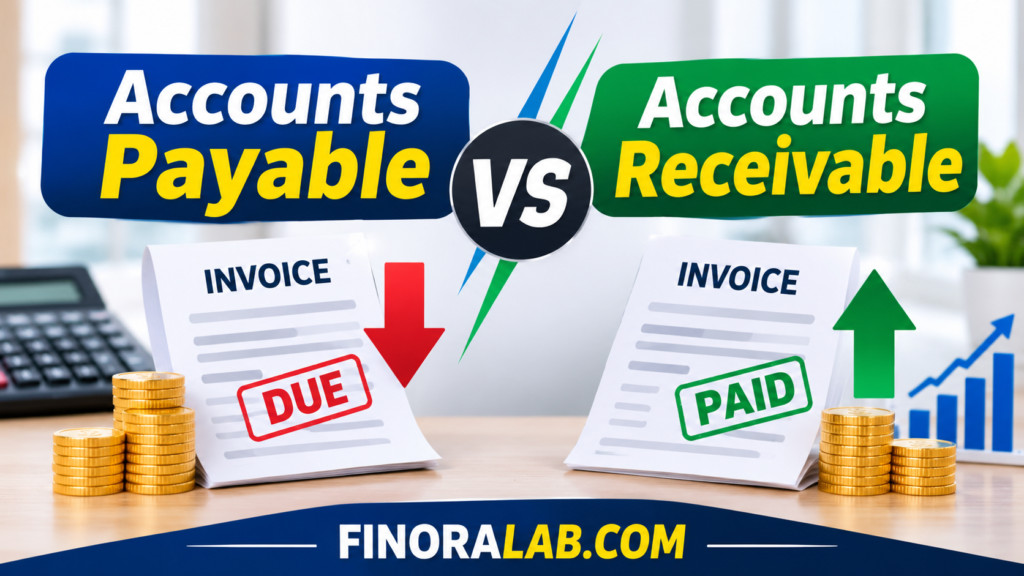
Accounts payable and accounts receivable are two essential parts of business accounting, but they represent opposite sides of a transaction. Accounts payable (AP) is money a business owes to suppliers or other creditors. Accounts receivable (AR) is money customers owe to the business for products or services already provided.
For example, if a company purchases $2,000 worth of supplies on credit, it records $2,000 in accounts payable. If that same company sells $3,000 worth of products to a customer on credit, it records $3,000 in accounts receivable.
Understanding accounts payable vs accounts receivable helps business owners track incoming and outgoing payments, manage working capital, prepare financial statements, and avoid cash flow problems.
Key Takeaways
- Accounts payable (AP) represents money your business owes. It is a liability.
- Accounts receivable (AR) represents money customers owe your business. It is an asset.
- Accounts payable increases when a business makes purchases on credit.
- Accounts receivable increases when a business makes credit sales.
- Managing both accounts helps businesses plan payments, collect outstanding invoices, and monitor cash flow.
What Is Accounts Payable?
Accounts payable (AP) refers to the short term amounts a business owes suppliers, vendors, and service providers for goods or services purchased on credit.
When a business receives products or services but agrees to pay later, the unpaid amount becomes an accounts payable balance.
For example, imagine a small retail store orders $1,500 worth of inventory from a supplier. The supplier allows the store to pay the invoice later.
The store now owes $1,500. Its accounting department records that amount as accounts payable.
Accounts payable is recorded as a current liability on the balance sheet when the obligation is expected to be settled within the normal operating cycle or within the applicable current liability classification period.
Examples of Accounts Payable
Common accounts payable transactions include
- Purchasing inventory from suppliers on credit.
- Receiving office supplies before making payment.
- Paying a contractor after receiving an invoice.
- Receiving business maintenance services with payment due later.
- Purchasing equipment or materials under short term supplier credit terms.
Not every unpaid expense is automatically classified as a trade payable. Businesses may use separate accounts for accrued expenses, loans, taxes, and other obligations.
How Does Accounts Payable Work?
A typical accounts payable process follows these steps
- A business orders goods or services from a supplier.
- The supplier delivers the goods or completes the service.
- The business receives an invoice.
- The accounting department checks the invoice against the purchase order and delivery records, where applicable.
- The invoice is recorded as accounts payable.
- The business pays the supplier according to the agreed payment terms.
- The accounts payable balance is reduced when the payment is properly recorded.
Example
A business purchases $2,000 in inventory on credit.
| Account | Debit | Credit |
| Inventory | $2,000 | — |
| Accounts Payable | — | $2,000 |
When the business pays the supplier
| Account | Debit | Credit |
| Accounts Payable | $2,000 | — |
| Cash | — | $2,000 |
These examples assume an inventory purchase under a perpetual inventory system and exclude sales tax, discounts, and other adjustments.
What Is Accounts Receivable?
Accounts receivable (AR) is the money customers owe a business for products or services they have received but have not yet paid for.
When a business makes a sale on credit, it records the amount due from the customer as accounts receivable.
For example, a marketing agency completes a $3,000 project for a client and sends an invoice with payment due later. Until the client pays, the $3,000 remains in accounts receivable.
Accounts receivable is generally classified as a current asset when the business expects to collect it within its normal operating cycle or applicable current asset period.
Examples of Accounts Receivable
Common accounts receivable transactions include
- Selling products to customers on credit.
- Providing professional services and invoicing clients afterward.
- Completing a construction project with payment due under an agreed schedule.
- Supplying wholesale inventory to retailers with deferred payment.
- Billing business customers for monthly services.
Not every sale creates accounts receivable. If a customer pays immediately by cash, debit card, or another payment method, the business generally records the payment rather than an outstanding customer receivable.
How Does Accounts Receivable Work?
A typical accounts receivable process follows these steps
- A business sells products or provides services to a customer.
- The business issues an invoice showing the amount owed.
- The customer receives the invoice and its payment terms.
- The business records the amount as accounts receivable.
- The customer makes a payment.
- The business records the payment and reduces the outstanding receivable balance.
Example
A consulting business completes a $3,000 project and invoices the customer.
| Account | Debit | Credit |
| Accounts Receivable | $3,000 | — |
| Service Revenue | — | $3,000 |
When the customer pays
| Account | Debit | Credit |
| Cash | $3,000 | — |
| Accounts Receivable | — | $3,000 |
These entries assume the service revenue is recognized when earned under accrual accounting and that the customer pays the full invoice without adjustments.
Accounts Payable vs Accounts Receivable Key Differences
The main difference between accounts payable and accounts receivable is the direction of the money.
Accounts payable represents money leaving the business when obligations are paid. Accounts receivable represents money the business expects to collect from customers.
Here is a side by side comparison
| Comparison | Accounts Payable (AP) | Accounts Receivable (AR) |
| Meaning | Money the business owes | Money customers owe the business |
| Accounting category | Liability | Asset |
| Appears on | Balance sheet | Balance sheet |
| Created by | Credit purchases | Credit sales |
| Involves | Suppliers and vendors | Customers and clients |
| Normal balance | Credit | Debit |
| Increases when | A payable is recorded | A receivable is recorded |
| Decreases when | The business pays its supplier | A customer pays the invoice |
| Main responsibility | Paying bills on time | Collecting customer payments |
| Cash flow effect | Payment uses cash | Collection brings in cash |
The SEC explains that a balance sheet reports a companys assets and liabilities at a particular point in time. Its glossary also identifies accounts receivable as a current asset and accounts payable as a current liability in the usual short term classifications.
Beginners Guide to Financial Statements+1
Simple Way to Remember the Difference
Think about the transaction from your businesss perspective
- If you receive a supplier invoice and still need to pay it, it is accounts payable.
- If you send a customer an invoice and are waiting for payment, it is accounts receivable.
Accounts payable = You owe money.
Accounts receivable = Money is owed to you.
Accounts Payable vs Accounts Receivable Examples
Consider a small electronics retailer that purchases products from wholesalers and sells them to customers.
During the month, the retailer makes these transactions
- Purchases $5,000 of inventory on credit.
- Sells $8,000 of products on credit.
- Pays the supplier $2,000.
- Collects $5,000 from customers.
The resulting balances are
| Transaction | Accounts Payable | Accounts Receivable |
| Initial credit purchase | +$5,000 | — |
| Initial credit sale | — | +$8,000 |
| Supplier payment | $2,000 | — |
| Customer payment | — | $5,000 |
| Remaining balance | $3,000 | $3,000 |
The retailer now has $3,000 remaining in accounts payable and $3,000 in accounts receivable.
This does not mean the retailer has $3,000 available in cash. The receivable has not yet been collected, and the payable still needs to be settled.
Why this matters A business can report positive sales and still experience cash shortages if customers pay slowly while suppliers require earlier payment.
How Do Accounts Payable and Accounts Receivable Affect Cash Flow?
Both accounts influence how money moves through a business, but they affect cash flow in different ways.
How Accounts Payable Affects Cash Flow
Accounts payable allows a business to receive goods or services before paying for them.
This can help preserve cash temporarily because the business does not have to pay immediately.
However, unpaid invoices create future payment obligations. If a business misses payment deadlines, it may face late fees, damaged supplier relationships, or interruptions in supply.
How Accounts Receivable Affects Cash Flow
Accounts receivable represents sales that have been recorded but not yet collected.
A business can generate revenue without immediately receiving cash.
For example, a company may complete a $10,000 project and issue an invoice. It can recognize the revenue under accrual accounting, but the cash will not enter its bank account until the customer pays.
If too many invoices remain unpaid, the business may struggle to cover payroll, rent, inventory, and supplier bills.
What Happens When Accounts Payable Is Higher Than Accounts Receivable?
A higher accounts payable balance than accounts receivable does not automatically mean a business is financially unhealthy.
It may indicate that the company purchases more on credit, has longer supplier payment arrangements, or collects customer payments quickly.
However, the business must have enough cash or other available resources to meet its obligations.
Likewise, having more accounts receivable than accounts payable does not automatically mean a company is financially strong. Some customer balances may be overdue or difficult to collect.
The key is to evaluate both balances alongside cash, inventory, other liabilities, and the timing of expected payments.
How to Manage Accounts Payable and Accounts Receivable Effectively
Good management helps businesses keep accurate records and plan their cash requirements.
1. Keep Supplier Invoices Organized
Record every supplier invoice with its invoice number, amount, issue date, due date, and payment status.
This makes it easier to identify upcoming obligations and avoid duplicate payments.
2. Monitor Outstanding Customer Invoices
Review unpaid customer invoices regularly. Identify overdue balances and follow up with customers using clear payment reminders.
3. Use an Accounts Payable and Receivable Aging Report
An aging report groups outstanding balances according to how long they have remained unpaid.
For example
| Aging category | Meaning |
| Current | Not yet overdue |
| 1–30 days overdue | Recently overdue |
| 31–60 days overdue | Moderately overdue |
| 61–90 days overdue | Significantly overdue |
| More than 90 days overdue | Long outstanding balance |
These are illustrative reporting categories. A business should use the aging intervals that match its invoice terms and collection policy.
An accounts receivable aging report helps identify customers who may need follow up. An accounts payable aging report helps businesses prioritize supplier payments.
4. Set Clear Payment Terms
Agree on payment deadlines before completing transactions.
For accounts receivable, communicate when customers must pay and which payment methods are accepted.
For accounts payable, understand supplier payment terms and any available early payment discounts.
Do not assume a discount is beneficial without checking its conditions and the effect on available cash.
5. Reconcile Records Regularly
Compare accounting records with supplier statements, customer statements, bank transactions, and supporting invoices.
Investigate differences rather than automatically changing account balances.
The IRS recommends maintaining supporting documents such as invoices, receipts, paid bills, and bank records to support business transactions.
Internal Revenue Service+1
Common Accounts Payable and Accounts Receivable Mistakes
Small accounting errors can create larger reporting and cash flow problems.
| Common mistake | Possible consequence | Better practice |
| Recording the same supplier invoice twice | Overstated liabilities and expenses or inventory | Check invoice numbers before posting |
| Forgetting to record customer payments | Overstated receivables | Update records when payments arrive |
| Delaying customer follow ups | More overdue invoices | Review aging reports regularly |
| Paying an invoice without checking it | Duplicate or incorrect payments | Match invoices with supporting documents |
| Ignoring overdue supplier bills | Late charges or supply problems | Maintain a payment calendar |
| Mixing business and personal transactions | Inaccurate accounting records | Keep separate business records |
| Failing to review disputed invoices | Incorrect account balances | Investigate discrepancies promptly |
Is Accounts Receivable the Same as Revenue?
No. Revenue and accounts receivable are related, but they are not the same thing.
Revenue represents income earned from selling products or providing services.
Accounts receivable represents the amount customers still owe for those transactions.
For example, if a business completes a $4,000 service project and invoices the customer, it may record $4,000 in revenue and $4,000 in accounts receivable.
When the customer pays, the business reduces accounts receivable and increases cash. It does not record the same $4,000 as new revenue a second time.
Is Accounts Payable the Same as an Expense?
No. Accounts payable is a liability, while an expense represents a cost incurred by a business.
For example, when a company receives an electricity bill for services already used, it may record an electricity expense and an accounts payable liability.
When it pays the bill, the payable decreases and cash decreases. The payment itself does not create a second electricity expense.
The exact accounting entry depends on what was purchased. Inventory, equipment, and services can have different accounting treatments.
How Do Accounts Payable and Accounts Receivable Work Together?
Accounts payable and accounts receivable are connected because most businesses both purchase from suppliers and sell to customers.
For example, a wholesale distributor might
- Purchase $6,000 of products from a manufacturer on credit.
- Record the $6,000 supplier obligation as accounts payable.
- Sell those products to a retailer for $9,000 on credit.
- Record the $9,000 customer obligation as accounts receivable.
- Collect payment from the retailer.
- Use available cash to pay the manufacturer.
The business earns revenue from its sale, but it must also manage the timing of its customer collections and supplier payments.
This is why businesses should not manage accounts payable and accounts receivable separately without considering their combined effect on cash flow.
Accounts Payable and Receivable in the Accounting Equation
The basic accounting equation is
Assets=Liabilities+Equity
Accounts receivable is generally included in assets, while accounts payable is generally included in liabilities.
For example
| Balance sheet item | Amount |
| Cash | $5,000 |
| Accounts receivable | $9,000 |
| Inventory | $6,000 |
| Total assets | $20,000 |
| Accounts payable | $6,000 |
| Other liabilities | $4,000 |
| Total liabilities | $10,000 |
| Owners equity | $10,000 |
The balance sheet balances because assets equal liabilities plus equity.
This example is illustrative and does not represent a real companys financial statements.
Beginners Guide to Financial Statements+1
Which Is More Important Accounts Payable or Accounts Receivable?
Neither account is automatically more important. Both serve different purposes.
Accounts payable is especially important when
- Your business depends on suppliers for regular inventory.
- You need to manage upcoming bills.
- You want to avoid missed payment deadlines.
- You need to maintain reliable supplier relationships.
Accounts receivable is especially important when
- Your business regularly sells products or services on credit.
- Customers frequently pay after receiving invoices.
- You have overdue customer balances.
- You need to forecast when sales will turn into cash.
A business that manages both accounts effectively can make better decisions about purchasing, payment schedules, collections, and working capital.
These are educational accounting explanations, not personalized financial or tax advice. Businesses with complex transactions or reporting requirements should consult a qualified accountant.
Conclusion
The difference between accounts payable vs accounts receivable comes down to who owes the money.Accounts payable tracks what your business owes suppliers, while accounts receivable tracks what customers owe your business. AP is generally a liability, and AR is generally an asset.Both accounts play an important role in financial reporting and cash flow management.
You may also read more blogs
percentage increase calculator
FAQs
What is the main difference between accounts payable and accounts receivable?
Accounts payable is money a business owes suppliers for purchases made on credit. Accounts receivable is money customers owe the business for products or services purchased on credit.
Is accounts payable an asset or a liability?
Accounts payable is a liability because it represents an amount the business must pay to suppliers or creditors.
Is accounts receivable an asset or a liability?
Accounts receivable is an asset because it represents money the business expects to collect from customers.
Which account has a debit balance, AP or AR?
Accounts receivable normally has a debit balance, while accounts payable normally has a credit balance. Adjustments and unusual transactions can create exceptions.
Can a business have both accounts payable and accounts receivable?
Yes. Most businesses that purchase goods or services from suppliers and sell to customers can have both accounts simultaneously.
How do accounts payable and accounts receivable affect cash flow?
Accounts payable affects cash flow when a business pays its outstanding bills. Accounts receivable affects cash flow when customers pay their outstanding invoices. Delayed collections and poorly timed supplier payments can create cash shortages.
What is an accounts payable aging report?
An accounts payable aging report organizes unpaid supplier invoices by how long they have been outstanding or overdue. It helps businesses identify upcoming payments and overdue obligations.
What is an accounts receivable aging report?
An accounts receivable aging report organizes unpaid customer invoices by their age. It helps businesses identify overdue accounts and decide which customers need payment reminders or additional collection attention.

Pingback: paycheck calculator new york: Estimate Your Take-Home Pay