Key Components of Successful Budgeting: 7 Smart Steps
Shanzay Arain·Aug 17, 2026
What are some key components of successful budgeting? At its core, successful budgeting requires a clear understanding of income, realistic spending limits, savings goals, debt obligations, and regular monitoring. A budget is not simply a list of expenses. It is a financial planning system that helps you decide where your money should go before you spend it. When designed properly, a budget can make everyday spending more predictable, reduce financial stress, improve cash flow, and create room for important goals such as building an emergency fund, paying down debt, investing, or preparing for retirement.
A successful budget also needs to reflect real life. Many budgets fail because they are too restrictive, ignore irregular expenses, or rely on unrealistic assumptions about spending behavior. A practical approach gives every dollar a purpose while leaving enough flexibility for unexpected costs and changing priorities. Whether you are managing a household on a modest income or coordinating a more complex financial situation, the fundamental principles remain similar know what comes in, understand what goes out, prioritize what matters, and review your plan consistently.
Understanding Income and Cash Flow
One of the most important components of successful budgeting is knowing exactly how much money you have available. Start by calculating your reliable take home income rather than using your gross salary. Take home pay is the amount that actually reaches your bank account after federal and state taxes, Social Security and Medicare taxes, retirement contributions, health insurance premiums, and other payroll deductions. If you receive irregular income from commissions, freelance work, overtime, or a business, consider using a conservative estimate so your budget does not depend on money that may not arrive.
Cash flow is equally important because the timing of income and expenses can affect your ability to pay bills. Someone may earn enough money annually but still experience problems if several large bills are due before the next paycheck. Review when your paychecks arrive and when major expenses are withdrawn. Mortgage payments, rent, utilities, insurance premiums, credit card payments, and loan installments should be matched against expected income. A cash flow focused budget can help prevent overdrafts, late payments, unnecessary credit card borrowing, and short term financial emergencies.
Tracking Expenses Before Setting Limits
Another key component is accurate expense tracking. Before deciding how much you should spend on groceries, transportation, entertainment, subscriptions, or dining out, determine what you are actually spending. Review several months of bank statements, credit card statements, receipts, and payment records. Categorize expenses into groups such as housing, transportation, food, insurance, healthcare, debt payments, personal spending, entertainment, savings, and investments. This process can reveal patterns that are easy to overlook when expenses are considered individually.
Expense tracking should include both fixed and variable costs. Fixed expenses generally remain relatively stable, such as rent, mortgage payments, and certain insurance premiums. Variable expenses can change from month to month, including groceries, gasoline, clothing, dining, and entertainment. You should also identify irregular expenses that occur only a few times a year. Car registration, annual insurance premiums, holiday spending, property taxes, school expenses, and home repairs can create budget problems if they are ignored. A realistic budget accounts for these expenses rather than treating them as unexpected surprises.
Separating Needs, Wants, and Financial Priorities
Successful budgeting requires more than cutting expenses. It requires understanding which expenses are essential, which are optional, and which support long term financial goals. Needs usually include housing, basic food, utilities, transportation required for work, insurance, healthcare, and minimum debt payments. Wants can include restaurant meals, entertainment, upgraded electronics, premium subscriptions, vacations, and other discretionary purchases. The distinction is not always absolute, but thinking in these categories helps you make deliberate decisions when income is limited.
Financial priorities should be considered separately from ordinary spending categories. Saving for an emergency fund, paying down high interest debt, contributing to a retirement account, or investing for a long term goal can be treated as planned financial obligations. For example, someone with $4,000 of monthly take home income might decide that $2,200 goes toward essential expenses, $600 toward flexible spending, $500 toward debt reduction, and $700 toward savings and investments. The exact percentages are not universal. What matters is creating a structure that matches your income, obligations, goals, and risk tolerance.
Creating Realistic Spending Limits
A budget becomes useful when it turns financial priorities into specific spending limits. Instead of saying you want to spend less, establish an amount you can reasonably afford for each category. For example, you might set a monthly grocery target of $500, transportation target of $300, entertainment target of $150, and dining out target of $200. These numbers should be based on your actual spending history and financial circumstances rather than arbitrary percentages copied from someone elses budget.
Flexibility is important because expenses do not behave perfectly every month. A strict budget that leaves no room for birthdays, medical costs, car maintenance, or social activities can become difficult to maintain. When one category exceeds its limit, the solution does not necessarily have to be abandoning the entire budget. You can review other discretionary categories and adjust them. The objective is to maintain control over your overall financial picture rather than achieving perfection in every individual category.
Building an Emergency Fund Into the Budget
An emergency fund is an important part of risk management and should be included in a successful budget. Its purpose is to provide accessible cash for unexpected expenses or temporary income disruptions. Common examples include vehicle repairs, medical bills, home maintenance, insurance deductibles, or a period of unemployment. Without emergency savings, households may rely on credit cards, personal loans, or other expensive borrowing when an unexpected expense occurs.
The appropriate emergency fund depends on your circumstances. A household with stable employment and relatively low fixed expenses may have different needs from a household with variable income, significant debt, or one primary earner. Instead of waiting until you can save a large amount, make emergency savings a recurring budget item. Someone who saves $250 per month will accumulate $3,000 in one year, excluding interest. Automating that transfer immediately after payday can make saving more consistent and reduce the temptation to spend the money elsewhere.
Managing Debt Within a Budget
Debt management is another major component of successful budgeting. Your budget should include at least the required minimum payments for credit cards, personal loans, student loans, auto loans, mortgages, and other obligations. However, simply making minimum payments may not be enough if you are carrying high interest debt. Once essential expenses and a reasonable emergency savings contribution are covered, additional cash flow can potentially be directed toward reducing expensive debt.
Two common debt repayment strategies are the debt avalanche and debt snowball methods. The avalanche approach prioritizes the debt with the highest interest rate, which can reduce interest costs over time. The snowball approach focuses on the smallest balance first, potentially creating psychological motivation as individual debts disappear. Consider a borrower with a $2,000 credit card balance at a high interest rate and a $10,000 lower rate personal loan. The avalanche method would generally prioritize the credit card because its borrowing cost is higher.
Making Savings a Planned Expense
Many people treat savings as whatever remains after spending. A more effective approach is to make savings part of the budget from the beginning. This concept is sometimes described as paying yourself first. Instead of spending your income and hoping there is money left over, determine how much you want to save and transfer that amount before discretionary spending occurs. Savings goals can include emergency reserves, a home down payment, education, vehicle replacement, travel, major purchases, or other medium term objectives.
Different goals may require different savings strategies. Money needed within a relatively short period generally should be managed differently from money intended for retirement decades in the future. Short term goals may prioritize accessibility and preservation of principal, while long term retirement goals may have greater capacity for investment risk depending on the investors circumstances. Keeping separate accounts or clearly labeled savings buckets can also make progress easier to track. The key principle is to connect each savings contribution to a specific financial objective rather than saving without a purpose.
Including Retirement and Investing Goals
A comprehensive budget should not focus exclusively on todays bills. Long term financial planning matters because your future financial needs can be significant. Retirement contributions can be incorporated into your financial plan alongside emergency savings and debt repayment. If your employer offers a retirement plan with matching contributions, understanding the matching structure can be particularly important because eligible contributions may provide additional compensation under the plans rules.
Investing also requires a realistic understanding of time horizon, risk, diversification, and liquidity. Money needed for an immediate expense generally should not be exposed to the same level of market volatility as money intended for a long term retirement objective. A budget can help identify how much surplus cash is genuinely available for investing after essential expenses, emergency savings, and high priority debt obligations. This prevents investors from committing money to volatile assets that they may unexpectedly need for ordinary living expenses.
Planning for Irregular and Annual Expenses
One of the most overlooked components of successful budgeting is planning for expenses that do not occur every month. A monthly budget may appear balanced until an annual insurance premium, holiday spending, property tax bill, professional membership, school expense, or major vehicle repair arrives. The problem is not necessarily that the expense was unpredictable. In many cases, it was simply excluded from the monthly planning process.
A sinking fund can solve this problem. Suppose you expect to spend $1,200 on annual vehicle maintenance, registration, and related costs. Instead of treating the full $1,200 as a surprise, you could set aside $100 each month. After twelve months, the fund would contain approximately $1,200 before any interest. The same method can be used for holiday expenses, home maintenance, insurance premiums, travel, tuition, and other predictable but irregular costs. This approach makes large expenses easier to absorb.
Using the Right Budgeting Method
There is no single budgeting method that works for everyone. Some people prefer zero based budgeting, where planned income is assigned to expenses, savings, debt repayment, and other financial goals until the available money has a specific purpose. Others prefer percentage based approaches that divide income among broad categories. The cash envelope method can be useful for people who want strict limits on discretionary categories, while a simpler spending plan may work better for someone with predictable income and relatively low financial complexity.
The best method is the one you can consistently maintain. A sophisticated spreadsheet is not automatically better than a simple budgeting app or written plan. If a system requires so much maintenance that you stop using it, it has failed its primary purpose. Start with a manageable framework and increase its detail when necessary. Your budgeting method should help you answer practical questions Can I afford this purchase? Am I saving enough? Which expenses can I reduce? How much debt can I repay? Am I progressing toward my financial goals?
Reviewing and Adjusting the Budget Regularly
A successful budget is not a document that you create once and never change. Income, expenses, interest rates, household circumstances, employment, insurance costs, and financial goals can all change. Reviewing your budget regularly helps you identify whether your assumptions remain accurate. A monthly review can compare planned spending with actual spending and highlight categories that consistently exceed expectations.
The review process should be analytical rather than judgmental. If groceries exceeded the target because food prices increased, the appropriate response may be adjusting the grocery budget. If entertainment spending repeatedly exceeds the limit because the original amount was unrealistic, you may need a more practical target. Conversely, if a category consistently comes in below budget, the difference could potentially be redirected toward savings, debt repayment, or another priority. The purpose of monitoring is to improve the plan, not to punish yourself for every deviation.
Using Technology Without Losing Financial Awareness
Digital banking, budgeting apps, spreadsheets, and automated transfers can make personal financial management significantly easier. Many financial institutions provide transaction histories that can help users categorize spending and identify recurring payments. Automation can also support consistent saving by transferring money into designated accounts on a scheduled basis. These tools reduce the amount of manual work involved in managing a household budget.
However, automation should not replace awareness. A person can have automatic bill payments, automatic savings, and automatic investments while still spending more than they can comfortably afford. Review account balances and transactions regularly. Check recurring subscriptions and identify services you no longer use. Monitor credit card balances rather than assuming the monthly payment will always be manageable. Technology is most effective when it supports sound financial decisions rather than encouraging people to stop paying attention to their money.
Considering Credit Scores and Financial Health
Budgeting and credit management are closely connected. A budget can help ensure that loan and credit card payments are made on time, which is important because payment history can affect credit scores. Keeping borrowing under control can also reduce financial pressure and make it easier to qualify for competitive credit terms when financing is necessary. While credit scores are important, they are only one part of overall financial health.
A strong financial position also includes manageable debt, sufficient liquidity, appropriate insurance, consistent savings, and progress toward long term goals. Someone with an excellent credit score but no emergency savings may still be financially vulnerable. Likewise, a person with a moderate credit score and strong cash reserves, low debt, and consistent retirement contributions may have a more stable overall financial position. Budgeting should therefore be viewed as a complete financial management tool rather than simply a technique for improving credit.
Avoiding Common Budgeting Mistakes
One common budgeting mistake is creating a plan based on ideal behavior instead of actual behavior. If you regularly spend $400 a month on restaurants but create a budget allowing only $100, the difference does not necessarily represent successful financial planning. It may simply mean the budget is unrealistic. A better approach might involve reducing the category gradually while redirecting the savings toward a specific goal. Sustainable improvement is usually more valuable than an aggressive plan that cannot be maintained.
Another mistake is ignoring irregular expenses and lifestyle changes. A new job, move, marriage, child, vehicle purchase, home purchase, or change in insurance costs can significantly affect the household budget. Failing to update the plan may cause unnecessary borrowing or depletion of savings. It is also important not to confuse cutting expenses with improving financial health. Eliminating every enjoyable purchase may make a budget miserable. A good plan balances present quality of life with future financial security.
Adapting a Budget to Income Changes
Income changes require immediate budget attention. If your income increases, avoid automatically increasing lifestyle expenses by the entire amount. Instead, consider dividing the additional income among several priorities, such as retirement savings, emergency reserves, debt repayment, and discretionary spending. For example, if a promotion increases monthly take home pay by $500, you might direct $250 toward long term savings, $150 toward debt reduction, and $100 toward lifestyle improvements.
A reduction in income requires a different response. Start by protecting essential expenses and minimum debt obligations. Review discretionary categories and temporarily reduce nonessential spending. If necessary, consider pausing certain goals while preserving emergency savings and critical insurance coverage. The goal is to respond quickly rather than waiting until cash reserves are depleted. A flexible budget provides a framework for making these decisions without having to reconsider every financial choice from scratch.
How Budgeting Supports Tax and Financial Planning
Taxes should also be considered when building a comprehensive financial plan. Your budget should generally be based on after tax income, but tax related obligations can still affect cash flow. Self employed individuals, freelancers, investors, homeowners, and people with multiple income sources may have tax considerations that differ from those of traditional employees. Setting money aside for expected tax obligations can prevent an otherwise manageable financial plan from being disrupted by a large payment.
Tax planning can also interact with retirement contributions, charitable giving, healthcare expenses, investment decisions, and other financial choices. The rules can be complex and change over time, so important tax decisions should be evaluated using current information and, when appropriate, qualified tax professionals. A budget does not replace tax advice. Instead, it provides the cash flow structure needed to accommodate taxes and other financial obligations without relying on last minute borrowing.
Balancing Budgeting With Quality of Life
Effective budgeting should make your financial life more intentional, not eliminate every source of enjoyment. Money has both practical and personal value. People may reasonably choose to spend more on travel, hobbies, dining, education, family experiences, or charitable giving because those activities align with their priorities. The important question is whether those choices fit within the broader financial plan.
A useful budget creates room for discretionary spending after essential obligations and important financial goals are addressed. This approach can reduce the feeling that budgeting means constant restriction. For example, if someone has stable income, adequate emergency savings, manageable debt, and consistent retirement contributions, spending a predetermined amount on entertainment may be perfectly reasonable. Financial discipline does not mean never spending money. It means spending deliberately and understanding the trade offs involved.
Putting the Key Components Together
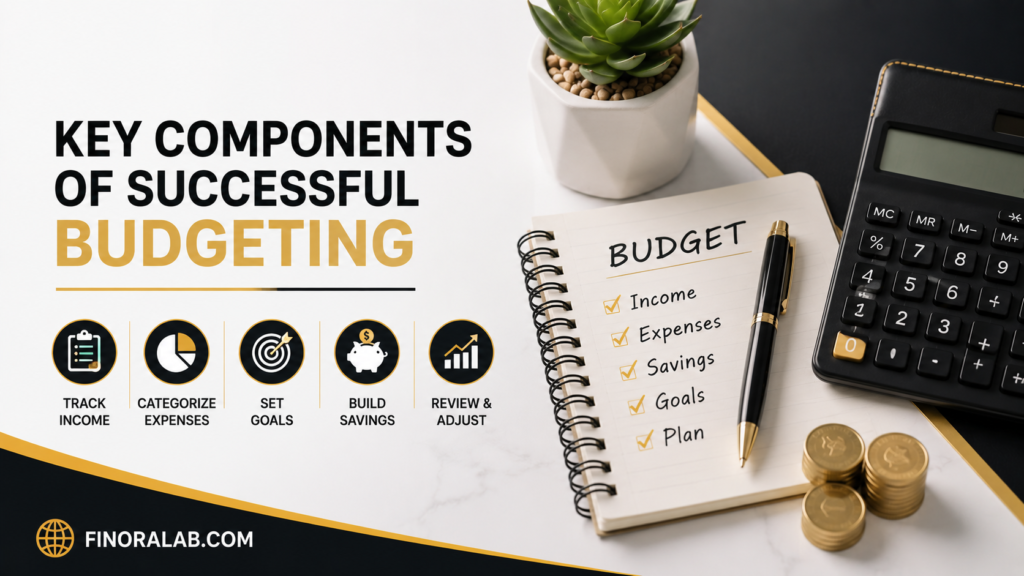
The key components of successful budgeting work together rather than operating independently. Income provides the available resources. Expense tracking shows where money currently goes. Spending limits establish boundaries. Savings and investment goals build future financial capacity. Debt management reduces borrowing costs and financial pressure. Emergency savings provide protection against unexpected events. Regular reviews keep the system aligned with changing circumstances.
Consider a household with $6,000 in monthly take home income. Suppose essential expenses total $3,200, debt payments equal $700, savings and retirement contributions total $1,200, and discretionary spending is $900. The household has assigned its income across immediate needs, obligations, future goals, and lifestyle spending. If a $500 monthly surplus remains, the household can decide whether to increase emergency savings, accelerate debt repayment, invest, or retain additional flexibility. The specific numbers will vary, but the structure demonstrates how budgeting turns income into intentional financial decisions.
A Practical Budgeting Routine You Can Start Today
A practical budgeting routine can begin with a simple financial inventory. List monthly take home income, recurring bills, debt payments, variable expenses, savings, investments, and irregular expenses. Then compare those numbers with your financial priorities. Identify one or two categories where spending can be improved without creating an unrealistic lifestyle restriction. At the same time, establish an automatic transfer toward an important goal, even if the initial amount is modest.
After creating the first version, review it at least monthly. Compare actual spending with planned spending, investigate large differences, and update future expectations. Once the basic system is working, consider adding sinking funds, debt payoff targets, retirement contributions, and more detailed financial goals. Over time, the budget becomes a financial dashboard that helps you make decisions before problems arise. Consistency is more important than complexity, and small improvements can compound into meaningful financial progress.
Conclusion
What are some key components of successful budgeting? The most important elements include accurate income tracking, detailed expense awareness, realistic spending limits, prioritization of needs, emergency savings, debt management, planned savings, retirement preparation, irregular expense planning, and regular reviews. Together, these components create a system for managing money with greater purpose and predictability.The strongest budget is not necessarily the most restrictive or complicated. It is the one that reflects your real financial situation and helps you make better decisions consistently. Start with the basics, track your actual behavior, create realistic targets, automate important savings where appropriate, and adjust the plan as your circumstances change. Budgeting is ultimately a form of financial planning it gives todays income a job while helping protect tomorrows financial security.
What are some key components of successful budgeting?
The major components include identifying reliable income, tracking expenses, separating needs from wants, setting realistic spending limits, saving for emergencies, managing debt, planning for irregular expenses, and contributing toward long term goals. Regular monitoring is also essential because a budget should change when income, expenses, or financial priorities change.
What is the most important part of creating a budget?
Accurate information is one of the most important starting points. Before setting spending limits, understand how much money you actually receive and where your money currently goes. A budget based on unrealistic income or underestimated expenses will usually fail regardless of how carefully it is organized.
How much should I save each month?
There is no single savings amount that applies to every household. The appropriate amount depends on income, expenses, debt, emergency reserves, retirement goals, and other priorities. A practical approach is to establish a recurring savings contribution that is sustainable and increase it when income rises or expenses decrease.
Should I pay off debt or save money first?
In many situations, it makes sense to maintain some emergency savings while aggressively addressing high interest debt. Completely eliminating savings can leave you vulnerable to unexpected expenses, potentially forcing you to borrow again. The right balance depends on interest rates, income stability, available cash, and the nature of the debt.
What is the 50/30/20 budgeting rule?
The 50/30/20 framework is a budgeting guideline that generally allocates approximately 50% of after tax income to needs, 30% to wants, and 20% to savings and debt repayment. It is not a universal requirement. Housing costs, income levels, family circumstances, debt obligations, and geographic differences can make these percentages unrealistic for some households.
How often should I review my budget?
A monthly review is a practical starting point for most households. Monthly reviews allow you to compare planned and actual spending, identify unusual expenses, update savings goals, and adjust categories. You may want to review your budget more frequently during periods of major income changes, relocation, debt repayment, or significant household changes.
What should I do if I keep going over my budget?
First, determine why you are exceeding the limit. The problem may be unrealistic spending targets, forgotten irregular expenses, rising prices, impulse purchases, or insufficient tracking. Rather than simply cutting everything, identify the categories causing the largest differences and make targeted adjustments. A budget should reflect realistic behavior while encouraging better financial choices.
How can budgeting help improve financial health?
Budgeting improves financial health by giving you greater control over cash flow. It can help prevent overspending, support emergency savings, reduce unnecessary debt, improve payment consistency, and create money for retirement or investment goals. Over time, these habits can strengthen financial resilience and make major financial decisions easier.
Is budgeting still useful if I have a high income?
Yes. Higher income does not automatically eliminate financial risk. Lifestyle inflation, large debt obligations, expensive housing, taxes, and insufficient savings can affect households at many income levels. A budget helps higher income households coordinate spending, investing, taxes, insurance, debt management, and long term financial goals rather than relying on income alone.
What is the easiest way to start budgeting?
Start with three steps calculate your monthly take home income, review the previous few months of transactions, and list your essential recurring expenses. Then create reasonable limits for flexible spending and establish one savings goal. Once the basic system is working, you can add detailed categories, sinking funds, debt payoff strategies, and retirement planning.
I am a professional finance content writer with expertise in personal finance investing, banking, loans, insurance, credit cards, budgeting, and market related topics. I create clear, SEO optimized, and reader friendly finance content that helps audiences understand complex financial concepts in simple words. My goal is to write trustworthy and engaging content that improves search visibility, builds credibility, and supports business growth.
I am a professional finance content writer with expertise in personal finance investing, banking, loans, insurance, credit cards, budgeting, and market related topics. I create clear, SEO optimized, and reader friendly finance content that helps audiences understand complex financial concepts in simple words. My goal is to write trustworthy and engaging content that improves search visibility, builds credibility, and supports business growth.