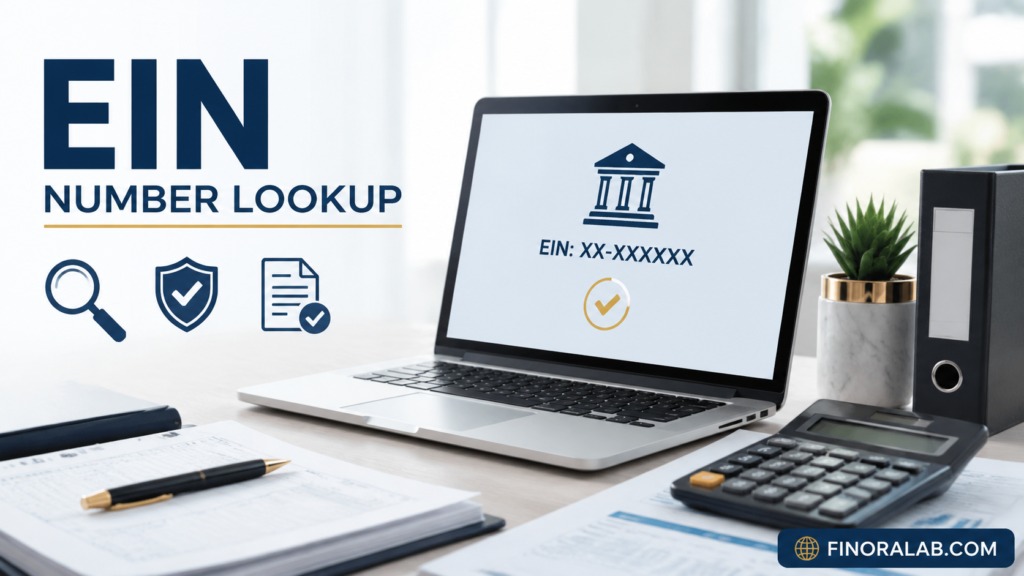
An ein number lookup is a common search for business owners, entrepreneurs, investors, accountants, lenders, and individuals who need to verify a company’s identity. An Employer Identification Number EIN also called a federal tax identification number or business tax ID is a unique nine digit number issued by the Internal Revenue Service IRS to identify businesses and certain organizations for tax purposes.
Finding an EIN can be necessary for opening a business bank account, completing tax documents, preparing financial records, verifying a company during a transaction, or confirming information before entering a business relationship. However, unlike personal Social Security numbers, EIN records are not always publicly searchable because they contain sensitive business information.
Understanding where to find an EIN, which sources are reliable, and what limitations apply can save time and prevent costly mistakes. Whether you are a business owner trying to recover a lost EIN or someone conducting business research, knowing the correct lookup methods is essential for accurate financial decision making.
What Is an EIN and Why Is It Important for Businesses?
An Employer Identification Number EIN is a federal identification number assigned by the IRS to businesses, nonprofit organizations, estates, trusts, and certain other entities. It functions similarly to a Social Security number but is used specifically for business related tax and financial activities. The IRS uses EINs to track employer tax obligations, payroll reporting, and other federal tax responsibilities.
Most businesses need an EIN before they can hire employees, pay certain business taxes, establish retirement plans, or operate as a corporation or partnership. Many banks also require an EIN when opening a business checking account because it helps verify the legal identity of the organization.
For example, if someone creates an LLC and wants to separate personal finances from business finances, obtaining an EIN is often one of the first steps. The EIN allows the company to build financial records, manage payroll, and interact with government agencies without using the owner’s personal Social Security number.
An EIN is also important during financial transactions. Investors, lenders, vendors, and customers may need to confirm a company’s identity before entering agreements. While an EIN does not reveal a company’s financial health or creditworthiness, it helps establish that a business exists as a recognized tax entity.
How Does an EIN Number Lookup Work?
An ein number lookup involves searching for a company’s Employer Identification Number through available business records, official documents, or authorized databases. The process depends on whether you are searching for your own EIN or trying to locate another company’s EIN.
For your own business, the easiest sources are usually existing financial and tax documents. Businesses commonly find their EIN on IRS confirmation letters, previously filed tax returns, payroll records, bank account documents, business loan applications, and accounting software records.
If you are searching for another company’s EIN, the process becomes more limited. The IRS generally does not provide a public EIN search tool similar to a business name search. However, certain publicly available documents may contain EIN information, especially for nonprofit organizations and publicly traded companies.
For example, nonprofit organizations often disclose their EIN on IRS Form 990 filings. Public companies may include tax identification details in regulatory filings submitted to the Securities and Exchange Commission SEC. Business credit reports, commercial databases, and official company documents may also contain EIN information.
The accuracy of an EIN lookup depends heavily on using trustworthy sources. Many websites claim to provide EIN searches, but some databases may contain outdated, incomplete, or incorrect information. Verifying information through official documents remains the safest approach.
How to Find Your Own EIN Number
If you own a business and need to recover your EIN, there are several reliable methods available. The IRS provides multiple ways for business owners to retrieve their EIN information, especially when they have lost the original confirmation notice.
The first place to check is your business records. Look through previous federal tax returns, payroll filings, business licenses, bank statements, accounting records, and loan documents. Many financial institutions require an EIN when setting up business services, making bank records a useful source.
You can also contact the IRS directly if you cannot locate your EIN. Business owners can call the IRS Business and Specialty Tax Line and complete an identity verification process. After confirming ownership information, the IRS can provide the EIN associated with the business.
Another option is checking your original IRS EIN assignment notice. When a business applies for an EIN online, by fax, or by mail, the IRS provides confirmation documentation. Keeping this document with important business records can prevent future problems.
Maintaining proper financial organization is an important part of business risk management. Business owners should store tax documents securely because EIN information is connected to important financial activities, including tax filings, payroll reporting, and banking relationships.
How to Perform an EIN Lookup for Another Business
Searching for another company’s EIN requires understanding privacy limitations. Unlike business names, addresses, or registration details, EIN EIN Number Lookup information is not universally available through public government search systems.
One of the best sources is the company itself. Businesses often provide their EIN on invoices, vendor forms, contracts, W9 forms, or official financial documents when there is a legitimate business purpose. If you are working with a supplier, client, or partner, requesting a completed Form W9 is a common professional practice.
For nonprofit organizations, EIN information is generally easier to locate. Nonprofits typically file Form 990 with the IRS, and these filings may include their employer identification number. Charity verification platforms and nonprofit databases often collect this information from public records.
For publicly traded companies, investors can review regulatory filings. Documents submitted to the SEC including annual reports and other corporate filings, may contain tax related identification information depending on the filing requirements.
When conducting business due diligence, an EIN lookup should be combined with additional verification methods. Checking state business registrations, financial statements, credit reports, and company history provides a more complete picture than relying on an EIN alone.
Difference Between an EIN, Tax ID Number, and Social Security Number
Many people confuse EINs with other identification numbers used in financial activities. Understanding the differences helps avoid errors when completing tax forms, opening accounts, or managing business finances.
An EIN is a type of federal tax identification number issued by the IRS to businesses and organizations. The terms EIN and federal tax ID number are often used interchangeably. Businesses use EINs for employment taxes income tax reporting, banking, and other official purposes.
A Social Security number SSN identifies individuals rather than businesses. Sole proprietors without employees may sometimes use their SSN for tax purposes, although many choose to obtain an EIN to protect personal information and create clearer separation between personal and business activities.
Some businesses may also have state tax identification numbers. These are separate from federal EINs and are issued by state tax agencies. For example, a company may need a state employer tax account number for payroll reporting while using its federal EIN for IRS filings.
Understanding these distinctions is important for financial planning and compliance. Using the wrong identification number on tax forms, banking applications, or business documents can create processing delays and reporting problems.
Common Reasons People Need an EIN Lookup
Businesses and individuals perform EIN searches for many financial and administrative reasons. One of the most common situations involves tax preparation. Accountants and tax professionals may need an EIN to accurately prepare federal and state filings.
Financial institutions also require EIN verification when businesses apply for banking services, loans, merchant accounts, or credit products. Banks use business identification information as part of their compliance procedures and customer verification processes.
Investors and entrepreneurs may use EIN information during due diligence. Before purchasing a company, forming partnerships, or investing in a business opportunity, verifying company records helps reduce financial risk. An EIN check is only one part of a larger evaluation process that may include revenue analysis, debt review, market research, and legal verification.
Vendors and contractors may also request EIN information when establishing payment relationships. A completed W 9 form allows businesses to collect taxpayer identification information for reporting purposes, especially when payments may require IRS Form 1099 reporting.
Using EIN verification as part of broader financial management can improve decision making. However, an EIN alone does not confirm whether a business is profitable, trustworthy, or financially stable.
Reliable Sources for EIN Information
Finding accurate EIN information requires using reliable sources. Official business documents remain the strongest source because they are directly connected to the companys legal and tax records.
For your own company, IRS documents are the most authoritative source. Tax returns, EIN confirmation letters and official IRS correspondence provide verified information. Business owners should keep these documents organized as part of their financial recordkeeping system.
Company provided documents are also valuable. Businesses frequently share EIN information through W9 forms, vendor agreements, invoices, and banking paperwork. When conducting professional transactions, requesting documentation directly from the company is often the fastest approach.
Public databases can sometimes help, especially for nonprofit organizations and publicly available corporate filings. However, users should verify information before relying on third party databases for important financial decisions.
A strong financial research process combines multiple sources. Similar to evaluating investments or managing personal finances, accuracy improves when information is confirmed through several trustworthy channels rather than a single database.
Common EIN Lookup Mistakes and How to Avoid Them
One common mistake is assuming that every EIN can be found through a simple online search. Unlike company names and business registrations, EIN information has privacy restrictions. Searching random websites may lead to incorrect or outdated results.
Another mistake is confusing an EIN with a company registration number. Businesses often have multiple identification numbers, including state registration numbers, sales tax permits, and federal EINs. Using the wrong number can cause problems with taxes, contracts, and financial accounts.
Business owners also sometimes lose their EIN confirmation documents because they do not maintain organized records. Good financial habits include storing tax documents, banking information, and legal paperwork in a secure digital or physical filing system.
A further risk involves sharing EIN information carelessly. Although EINs are not treated exactly like Social Security numbers, they are still sensitive business information. Companies should share tax identification details only when there is a legitimate business purpose.
Avoiding these mistakes supports better financial management, reduces administrative problems, and helps businesses maintain compliance with tax and reporting requirements.
How EIN Information Supports Business and Financial Planning
An EIN plays an important role in establishing a professional financial structure for a company. Separating business and personal finances is a fundamental principle of effective financial planning. An EIN helps businesses create independent banking relationships, manage payroll, and maintain accurate accounting records.
For entrepreneurs, obtaining an EIN can support long term growth strategies. A company with proper documentation is generally better positioned to apply for financing, negotiate with vendors, and build credibility with customers and partners.
EIN information is also connected to broader financial responsibilities. Businesses must consider budgeting, tax planning, debt management, cash flow forecasting, and risk management. EIN Number Lookup While an EIN does not directly affect credit scores or profitability, proper business identification supports accurate reporting.
For example, a growing company preparing for expansion may need business loans, additional employees, and new financial systems. Having organized tax records and verified company information makes these processes smoother.
Strong financial management involves more than tracking income and expenses. It requires maintaining accurate records, understanding tax obligations, protecting sensitive information and making informed decisions based on reliable data.
Conclusion
An ein number lookup is an important financial research process for business owners, professionals, investors, and organizations that need accurate company identification information. Whether recovering a lost EIN, verifying a business partner, or completing financial paperwork, using reliable sources is essential. The best approach depends on your situation. Business owners should begin with their own records, IRS documents, and financial statements. Individuals researching another organization should rely on company provided documents, public filings, and trusted verification sources. Understanding how EINs work also supports broader financial responsibility. Proper documentation, organized accounting, tax compliance, and effective risk management are key components of successful business operations. EIN Number Lookup. An EIN is only one piece of a company financial identity. EIN Number Lookup For meaningful business decisions, it should be considered alongside other factors such as financial performance, credit history, legal standing, and operational strength.
You may also read more blogs
FAQs
What is an EIN number lookup?
An EIN number lookup is the process of finding or verifying a company’s Employer Identification Number. It may involve checking business documents, IRS records, public filings, or company provided information.
Can I search for an EIN online for free?
There is no universal public IRS search tool that allows anyone to EIN Number Lookup every business EIN. Some nonprofit and public company records may include EIN information, but many private business EINs are not publicly searchable.
How can I find my business EIN if I lost it?
You can find your EIN by reviewing previous tax returns, IRS confirmation letters, payroll records, bank documents, or business loan paperwork. You can also contact the IRS and complete identity verification.EIN Number Lookup
Is an EIN the same as a tax ID number?
Yes, an EIN is a type of federal tax identification number. EIN Number Lookup The terms EIN and federal tax ID are often used to describe the same nine digit business identification number issued by the IRS.
Can someone find my EIN using my business name?
Sometimes, but not always. EIN Number Lookup EIN information for private companies is generally not publicly searchable. Nonprofits and publicly traded companies may have EIN information available through public filings.
Why does a bank need my EIN?
Banks use EINs to verify business identity and comply with financial regulations. EIN Number Lookup Businesses often need an EIN to open business accounts, apply for credit, and manage financial transactions.
Does an EIN affect business credit scores?
An EIN itself does not create a credit score. However, businesses often use EINs when establishing credit accounts, loans, and financial relationships that may contribute to business credit history.
Is it safe to share an EIN?
Sharing an EIN with legitimate business partners, financial institutions, or tax professionals is common. However, businesses should avoid sharing sensitive tax information with unknown individuals or unreliable sources.
Can I change my EIN?
In some cases, businesses may need a new EIN due to ownership changes, structural changes, or IRS requirements. Whether a new EIN is needed depends on the specific situation and business type.
What information can I verify besides an EIN?
Businesses should also verify legal registration, ownership details, financial records, licenses, credit information, and operational history when conducting due diligence. An EIN alone does not confirm business quality or financial health.

I am a professional finance content writer with expertise in personal finance investing, banking, loans, insurance, credit cards, budgeting, and market related topics. I create clear, SEO optimized, and reader friendly finance content that helps audiences understand complex financial concepts in simple words. My goal is to write trustworthy and engaging content that improves search visibility, builds credibility, and supports business growth.