Illinois Paycheck Calculator 2026: See Your Take-Home Pay After Taxes
Shanzay Arain·Jul 16, 2026
Your annual salary and the amount deposited into your bank account are rarely the same. Before you receive a paycheck, your employer may subtract federal income tax, Illinois income tax, Social Security, Medicare, health insurance, retirement contributions and other authorized deductions.
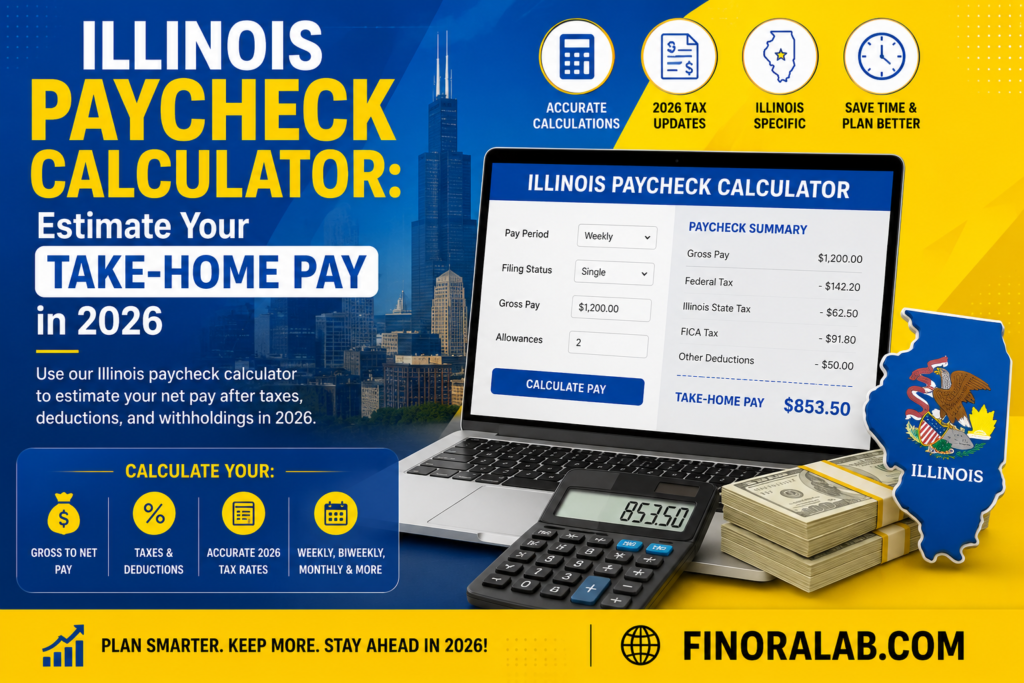
An Illinois paycheck calculator helps estimate what remains after these amounts are removed. It can be useful when accepting a job offer, comparing salaries, changing your Form W 4, planning a household budget or estimating how overtime may affect your next paycheck.
For 2026, Illinois continues to use a flat individual income tax rate of 4.95%. However, applying 4.95% directly to your full salary will not necessarily reproduce the exact amount on your pay stub. Illinois withholding allowances, pretax deductions, pay frequency and payroll rounding can affect the calculation.
Federal withholding is even more individualized. It depends on the information entered on Form W 4, including filing status, multiple jobs, dependents, deductions and additional withholding.
This guide explains every major Illinois paycheck deduction and shows you how to estimate take home pay without confusing tax withholding with your final annual tax liability.
Illinois Paycheck Calculator Quick Summary
Payroll item
2026 information
Illinois income tax rate
4.95%
Illinois personal exemption allowance
$2,925 per qualifying exemption
Employee Social Security rate
6.2%
2026 Social Security wage base
$184,500
Employee Medicare rate
1.45%
Medicare wage limit
No general wage cap
Additional Medicare withholding
0.9% on employer paid wages over $200,000
Federal withholding
Based primarily on Form W 4 and IRS tables
Illinois withholding form
Form IL W 4
Common pay frequencies
Weekly, biweekly, semimonthly and monthly
Gross pay
Earnings before taxes and deductions
Net pay
Amount remaining after deductions
Calculator limitation
Provides an estimate, not a guaranteed pay stub amount
How an Illinois Paycheck Calculator Works
An Illinois take home pay calculation starts with gross earnings. Payroll taxes and other deductions are then removed.
The basic formula is
Net pay = Gross pay − Pretax deductions − Payroll taxes − After tax deductions
A typical Illinois employee may see the following amounts on a pay stub
Federal income tax withholding
Illinois income tax withholding
Social Security tax
Medicare tax
Additional Medicare Tax when applicable
Health, dental or vision insurance
Retirement plan contributions
Flexible spending or health savings contributions
Wage garnishments
Union dues
Voluntary after tax deductions
Not every deduction applies to every worker. Your employment status, benefits and withholding forms determine what appears on your paycheck.
What You Need to Estimate an Illinois Paycheck
Before calculating take home pay, collect the following information
Gross salary or hourly wage
Hours worked during the pay period
Overtime hours
Pay frequency
Federal Form W 4 information
Illinois Form IL W 4 allowances
Pretax retirement contributions
Pretax insurance premiums
Health savings or flexible spending contributions
Bonuses or commissions
After tax deductions
Year to date Social Security wages
A calculator cannot produce a reliable result if these inputs are incomplete. Using annual salary alone will provide only a rough estimate.
Understanding Gross Pay
Gross pay is the amount earned before taxes and deductions.
For a salaried employee, gross pay is usually calculated by dividing annual salary by the number of pay periods.
Weekly Pay
Annual salary ÷ 52
An employee earning $62,400 annually would have weekly gross pay of
$62,400 ÷ 52 = $1,200
Biweekly Pay
Annual salary ÷ 26
For the same employee
$62,400 ÷ 26 = $2,400
Semimonthly Pay
Annual salary ÷ 24
$62,400 ÷ 24 = $2,600
Monthly Pay
Annual salary ÷ 12
$62,400 ÷ 12 = $5,200
The size of each paycheck changes with pay frequency, but total annual gross salary ordinarily remains the same.
Calculating Gross Pay for Hourly Employees
Hourly employees calculate gross pay using their hourly rate and hours worked
Gross pay = Hourly rate × Regular hours
Suppose an employee earns $24 per hour and works 80 regular hours during a biweekly period
$24 × 80 = $1,920
The gross biweekly pay is $1,920 before adding overtime, bonuses or other compensation.
If the employee has overtime, calculate qualifying hours separately. Overtime eligibility and rates depend on federal and Illinois labor requirements, occupation, classification and employer policies.
Do not assume that every salaried employee is exempt from overtime or that every payment above 40 hours is automatically treated in the same way.
Illinois State Income Tax in 2026
Illinois uses a flat individual income tax rate rather than graduated tax brackets.
For wages paid in 2026
Illinois withholding rate 4.95%
Illinois exemption allowance $2,925
The Illinois Department of Revenue explains that employers generally subtract applicable exemptions from wages and multiply the remaining amount by 4.95% when determining withholding. Official tables and payroll methods provide the exact calculation. Illinois 2026 Withholding Tables
The actual payroll calculation converts annual exemptions to the relevant pay period and considers the employees completed Form IL W 4.
For 2026, the Illinois personal exemption amount increased to $2,925. The state recommends checking its website for the latest information. Illinois Department of Revenue
What Is Form IL W 4?
Form IL W 4 is the Illinois Employees and Other Payees Withholding Allowance Certificate. Employees complete it so employers can determine how much Illinois income tax to withhold.
The amount withheld can depend partly on the number of allowances claimed. Claiming more valid allowances generally reduces Illinois withholding, while claiming fewer allowances may increase it.
Employees should not copy information automatically from the federal Form W 4 because the federal and state forms use different systems.
You may need to update Form IL W 4 following events such as
Marriage or divorce
Birth or adoption of a child
A change in dependents
Starting a second job
Significant change in income
A spouse beginning or ending employment
A recurring refund or balance due
The official form states that employees must complete it so the employer can withhold the correct amount of Illinois income tax. Form IL W 4
Federal Income Tax Withholding
Federal income tax withholding is not calculated using one flat percentage for every Illinois employee.
Employers use IRS withholding methods together with the workers Form W 4 information. Relevant details may include
Filing status
Whether the employee has multiple jobs
Qualifying child and dependent credits
Other income
Additional deductions
Extra withholding requested per paycheck
The IRS publishes updated withholding tables in Publication 15 T. The 2026 tables include adjustments reflecting current tax law and are used by employers to calculate federal withholding. IRS Publication 15 T
Withholding is a prepayment toward expected federal income tax. It is not necessarily the same as the employees final tax liability. When a tax return is filed, actual tax is compared with payments and credits. The taxpayer may receive a refund or owe an additional amount.
Federal Standard Deduction for 2026
The standard deduction can affect final annual federal taxable income, but it is not a deduction that simply appears as a separate line on each paycheck.
For tax year 2026, the standard deduction is
Filing status
2026 standard deduction
Single
$16,100
Married filing separately
$16,100
Married filing jointly
$32,200
Qualifying surviving spouse
$32,200
Head of household
$24,150
These figures are based on the latest IRS guidance available for 2026. IRS 2026 Tax Adjustments
Additional deductions or tax provisions may apply to individual taxpayers. A paycheck estimate should not be treated as a complete federal tax return calculation.
Social Security Tax
Social Security tax is part of the Federal Insurance Contributions Act, commonly called FICA.
For employees in 2026
Employee Social Security rate 6.2%
Employer Social Security rate 6.2%
Social Security taxable wage limit $184,500
The employees share is withheld from covered wages. The employer generally contributes a separate matching share rather than subtracting the employer portion from the employees paycheck.
The employee calculation is
Social Security withholding = Covered wages × 6.2%
Suppose an employee earns $2,400 in Social Security taxable wages during a biweekly period
$2,400 × 6.2% = $148.80
The Social Security deduction would be $148.80, assuming the employee has not exceeded the annual wage base.
Once an employees covered wages from that employer exceed the 2026 wage base of $184,500, regular Social Security withholding generally stops for additional covered wages from that employer for the rest of the year. Social Security Administration
Medicare Tax
The standard employee Medicare tax rate is 1.45% of covered wages. Unlike Social Security tax, regular Medicare tax does not have a general annual wage limit.
The employees regular Medicare withholding would be $34.80.
The employer generally contributes its own matching 1.45%. The IRS confirms that the employee Social Security rate is 6.2% and the standard employee Medicare rate is 1.45%. IRS Payroll Tax Rates
Additional Medicare Tax
Employers must generally begin withholding an additional 0.9% Medicare Tax when wages paid to an employee exceed $200,000 during the calendar year.
The employer applies this withholding based on wages it pays, without adjusting the employer withholding trigger for the employees filing status.
An individuals ultimate Additional Medicare Tax responsibility may depend on filing status and combined income. For example, a married couples liability calculation can differ from when an individual employer must begin withholding.
High income taxpayers and households with multiple jobs may need to review their withholding with a qualified tax professional.
Pretax and After Tax Deductions
Deductions do not all reduce the same taxes.
Common pretax deductions may include eligible contributions to
Traditional workplace retirement plans
Employer sponsored health insurance
Flexible spending accounts
Health savings accounts
Qualified transportation benefits
However, a deduction that reduces federal taxable income may not necessarily reduce Social Security, Medicare or Illinois taxable wages in exactly the same way.
After tax deductions may include
Roth retirement contributions
Certain insurance products
Union dues
Charitable payroll contributions
Wage garnishments
Repayment arrangements
To improve accuracy, a paycheck calculator should ask whether each deduction is pretax or after tax and which tax base it reduces.
Illinois Paycheck Calculator Example
Consider an Illinois employee with the following hypothetical biweekly paycheck
Annual salary $62,400
Gross biweekly pay $2,400
Pretax health insurance $100
Traditional retirement contribution $120
Federal withholding generated from Form W 4 $190
Illinois withholding generated through payroll $105
Social Security withholding $148.80
Medicare withholding $34.80
After tax deduction $20
A simplified calculation would be
Item
Amount
Gross pay
$2,400.00
Pretax deductions
−$220.00
Federal income tax withholding
−$190.00
Illinois income tax withholding
−$105.00
Social Security
−$148.80
Medicare
−$34.80
After tax deductions
−$20.00
Estimated net pay
$1,681.40
This example demonstrates the calculation structure. It is not a tax quote. The assumed federal and Illinois withholding figures are illustrative because exact results depend on withholding forms, taxable wage definitions, allowances and payroll methods.
Step by Step Illinois Paycheck Calculation
Determine Gross Pay
Convert annual salary into the correct pay period or multiply hourly wages by hours worked.
Add Overtime and Supplemental Earnings
Add qualifying overtime, commissions, tips, bonuses and other taxable compensation.
Subtract Eligible Pretax Deductions
Apply eligible insurance, retirement and benefit deductions according to their tax treatment.
Estimate Federal Withholding
Use the employees Form W 4 information and current IRS Publication 15 T method.
Calculate Illinois Withholding
Use Form IL W 4 allowances and the current Illinois withholding tables.
Calculate Social Security
Multiply covered wages by 6.2% until the annual wage base is reached.
Calculate Medicare
Multiply covered wages by 1.45%. Apply Additional Medicare withholding when required.
Subtract After Tax Deductions
Remove garnishments, Roth contributions and other applicable deductions.
Review the Net Result
The remaining amount is estimated take home pay.
How Different Pay Frequencies Affect Results
Pay frequency changes the amount received per paycheck and the number of checks issued annually.
Pay frequency
Typical pay periods per year
Weekly
52
Biweekly
26
Semimonthly
24
Monthly
12
A $72,000 employee would have approximate gross pay of
Weekly $1,384.62
Biweekly $2,769.23
Semimonthly $3,000
Monthly $6,000
Annual tax liability does not ordinarily change simply because wages are paid more frequently. However, withholding per check and payroll rounding may differ.
Bonuses and Overtime
Bonuses, commissions and overtime generally increase taxable wages. A bonus may be paid with regular wages or identified separately as supplemental wages.
The payroll method used can affect federal withholding on that particular check. A large withholding amount does not necessarily mean the bonus is ultimately subject to a permanently higher final income tax rate.
Illinois withholding and FICA taxes may also apply when the payment is taxable compensation. Because supplemental wage rules can change, verify current treatment with the employer, IRS and Illinois Department of Revenue.
Benefits and Limitations of a Paycheck Calculator
Benefits
An Illinois paycheck calculator can help you
Compare employment offers
Create a monthly budget
Estimate the effect of retirement contributions
Understand payroll deductions
Plan for overtime or bonuses
Review a pay stub
Estimate the effect of a Form W 4 update
Convert annual salary into take home pay
Limitations and Risks
A calculator may not accurately capture
Multiple jobs
Spouses income
Itemized deductions
Noncash compensation
Stock based compensation
Local or reciprocal tax issues
Tax credits
Midyear job changes
Wage garnishments
Special benefit arrangements
Employer specific payroll rules
The result should be presented as an estimate rather than a guaranteed paycheck.
Do Illinois Cities Charge Local Income Tax?
Illinois workers generally focus on federal income tax, Illinois income tax and FICA payroll taxes. Illinois does not commonly operate the same broad city wage tax structure found in certain other states and major cities.
However, employees may still encounter local costs, benefit deductions or taxes related to working or living in another jurisdiction. Remote work and interstate employment can create additional withholding questions.
If you live outside Illinois, work across state lines or moved during the year, ask your payroll department or a qualified tax professional which state should receive withholding.
Illinois Residents Working in Another State
Illinois has reciprocal arrangements with certain neighboring states. These arrangements can affect where income tax is withheld when an Illinois resident works in a reciprocal state.
The correct treatment depends on residency, work location and current agreements. Remote workers should not assume their employers physical office automatically determines all state tax obligations.
Because state reciprocity rules and forms may change, verify the latest instructions with the Illinois Department of Revenue and the other states tax authority.
Common Mistakes to Avoid
Applying 4.95% to Gross Salary Without Adjustments
Illinois uses a 4.95% rate, but actual withholding may consider exemptions and taxable wage adjustments.
Using Annual Salary as Take Home Pay
Annual salary is gross compensation before taxes and deductions.
Confusing Biweekly and Semimonthly Pay
Biweekly payroll ordinarily has 26 periods. Semimonthly payroll has 24.
Ignoring Pretax Benefits
Health insurance and retirement contributions may affect one or more taxable wage calculations.
Deducting the Employers FICA Share
Employees generally see only their own FICA portion removed. The employers matching contribution is separate.
Forgetting the Social Security Wage Base
The 6.2% employee tax applies only up to the annual covered wage limit.
Treating Withholding as Final Tax
Withholding is a prepayment. The final calculation happens when the tax return is prepared.
Using Outdated Rates
Payroll tax rates, wage limits, deductions and exemptions may change each year.
Entering Incorrect W 4 Information
An outdated or inaccurate withholding form can cause an unexpectedly large refund or balance due.
Latest Illinois Paycheck Update for 2026
The main verified payroll figures for 2026 include
Illinois income tax withholding rate remains 4.95%
Illinois exemption allowance increased to $2,925
Employee Social Security rate remains 6.2%
Social Security wage base increased to $184,500
Employee Medicare rate remains 1.45%
Regular Medicare tax continues without a general wage cap
Federal withholding tables were updated for 2026 tax provisions
The federal standard deduction increased for all major filing categories
These figures were current when this article was prepared. Tax legislation and administrative guidance can change, so users should verify current information through the IRS and Illinois Department of Revenue before relying on a calculation.
Expert Tips
Use gross taxable wages from your pay stub, not only annual salary.
Confirm whether you are paid biweekly or semimonthly.
Review both Form W 4 and Form IL W 4.
Recheck withholding after marriage, divorce or a new child.
Include all jobs when evaluating federal withholding.
Distinguish pretax deductions from after tax deductions.
Review year to date Social Security wages.
Compare calculator results with an actual pay stub.
Keep a copy of updated withholding forms.
Do not rely on one paycheck with a bonus as a normal pay estimate.
Use current 2026 tables rather than prior year tax figures.
Contact payroll quickly if hours, rates or deductions appear incorrect.
Consult a tax professional for multiple jobs, interstate work or complex income.
Conclusion
An Illinois paycheck calculator estimates take home pay by starting with gross wages and subtracting federal withholding, Illinois income tax, Social Security, Medicare, benefits and other deductions.For 2026, the Illinois withholding rate is 4.95%, the state exemption allowance is $2,925 and the Social Security wage base is $184,500. However, an accurate result still depends on Form W 4, Form IL W 4, pay frequency, filing circumstances and the tax treatment of employee benefits.Use the calculation as a budgeting estimate, compare it with your actual pay stub and confirm current tax information before making important financial decisions.
FAQs
What is the Illinois income tax rate in 2026?
Illinois uses a 4.95% individual income tax rate for 2026. Actual paycheck withholding also depends on taxable wages and Form IL W 4 allowances.
How much tax is deducted from an Illinois paycheck?
An employee may have federal income tax, Illinois income tax, Social Security and Medicare deducted. Benefits, retirement contributions and other authorized deductions may also apply.
Does Illinois have a progressive income tax?
Illinois currently applies a flat individual income tax rate rather than multiple graduated state brackets.
How do I calculate biweekly take home pay in Illinois?
Divide annual salary by 26 to find gross biweekly pay. Then subtract pretax deductions, federal withholding, Illinois withholding, Social Security, Medicare and after tax deductions.
Is Social Security tax included in Illinois income tax?
No. Social Security is a federal payroll tax separate from Illinois income tax. The employee rate is 6.2% on covered wages up to the annual limit.
Why is my actual paycheck different from the calculator?
Differences may result from W 4 information, Illinois allowances, insurance, retirement contributions, payroll rounding, bonuses, garnishments or employer specific benefit rules.
Are bonuses taxed differently in Illinois?
Bonuses are generally taxable compensation, but their withholding method may differ from a regular paycheck. Withholding on the payment does not necessarily equal its final tax liability.
I am a professional finance content writer with expertise in personal finance investing, banking, loans, insurance, credit cards, budgeting, and market related topics. I create clear, SEO optimized, and reader friendly finance content that helps audiences understand complex financial concepts in simple words. My goal is to write trustworthy and engaging content that improves search visibility, builds credibility, and supports business growth.
I am a professional finance content writer with expertise in personal finance investing, banking, loans, insurance, credit cards, budgeting, and market related topics. I create clear, SEO optimized, and reader friendly finance content that helps audiences understand complex financial concepts in simple words. My goal is to write trustworthy and engaging content that improves search visibility, builds credibility, and supports business growth.