High Yield Checking Account: Earn More Without Locking Your Money
Shanzay Arain·Jul 16, 2026
A checking account is normally used to receive income, pay bills, make debit card purchases and withdraw cash. It provides convenient access to money, but traditional checking accounts often pay little or no interest.
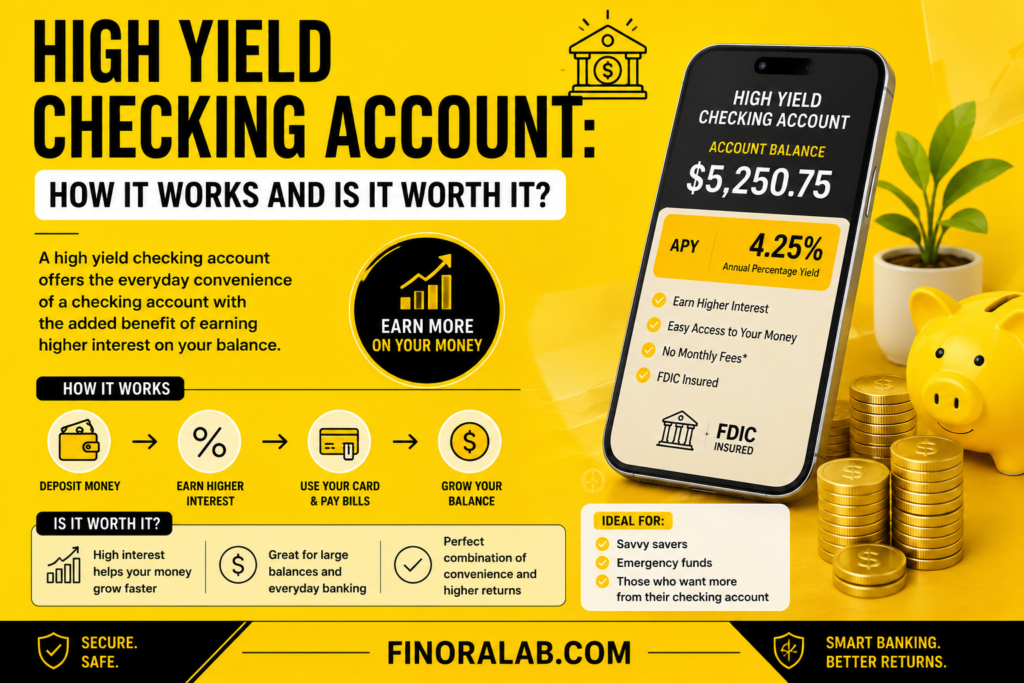
A high yield checking account attempts to combine the accessibility of everyday banking with the earning potential of an interest bearing deposit account. It may offer a significantly better annual percentage yield than a standard checking account, provided that the account holder completes certain monthly activities.
Those requirements may include receiving qualifying direct deposits, making a specific number of debit card purchases, enrolling in electronic statements or logging into online banking. If you fail to meet the conditions, you may receive a much lower rate for that statement cycle.
That makes the headline APY only one part of the decision. You also need to compare fees, eligible balance limits, ATM access, minimum deposits, digital banking features and deposit insurance.
This guide explains how these accounts work, what to check before applying and whether a high interest checking account fits your banking habits.
What Is a High Yield Checking Account?
A high yield checking account is a transactional bank or credit union account that pays interest on qualifying balances. It usually includes the standard services associated with checking accounts, such as
Direct deposit
Debit card purchases
Online bill payments
Electronic transfers
Check writing privileges
Mobile banking
ATM withdrawals
Recurring payment support
The major difference is its potential interest rate. A traditional checking account may pay no interest or a very low rate. A high yield account may advertise a more competitive APY, although the best rate is often conditional.
The FDIC describes a checking account as a transactional account designed for frequent deposits and withdrawals. It also notes that money held in a checking account may earn interest. Federal Deposit Insurance Corporation
These accounts may also be called
High interest checking accounts
Rewards checking accounts
Interest bearing checking accounts
Premium checking accounts
Dividend checking accounts at some credit unions
The names are not always interchangeable. A premium account, for instance, might offer benefits without paying a competitive yield. Always review the actual APY and account disclosures.
Quick Summary Table
Feature
Typical high yield checking account
Main purpose
Everyday spending while earning interest
Interest measurement
Annual percentage yield
Access to money
Debit card, ATM, checks and transfers
Common requirements
Direct deposit, debit purchases and electronic statements
Qualifying balance
High APY may apply only up to a specified limit
Nonqualifying rate
Often substantially lower
Monthly fee
May be free or charged unless conditions are met
Rate type
Usually variable and subject to change
Deposit insurance
Available when held at an eligible insured institution
Best for
People who can consistently satisfy monthly requirements
Main risk
Fees or missed conditions can reduce earnings
Alternative
High yield savings or money market deposit account
How a High Yield Checking Account Works
A financial institution establishes an advertised APY and a list of qualifying activities. The account holder must complete those requirements during each monthly qualification cycle.
A hypothetical account might require
At least one qualifying direct deposit
Twelve debit card purchases
Enrollment in electronic statements
Online or mobile banking access
A balance below a stated maximum to receive the highest APY
If all requirements are completed, the customer receives the higher rate on the eligible balance. If one requirement is missed, the account may pay a lower APY for that cycle.
The account normally remains open even when the requirements are not met. However, interest earnings may fall sharply, and certain ATM reimbursements or other rewards may also be lost.
Requirements differ significantly between institutions. One bank might count debit purchases when they are authorized, while another counts them only after they post. Pending transactions near the end of the cycle may not qualify in time.
Understanding APY
APY stands for annual percentage yield. It estimates how much an account could earn over one year when interest remains in the account and compounds according to the institutions terms.
The Consumer Financial Protection Bureau explains that APY reflects the total interest paid based on the interest rate and compounding frequency. It does not necessarily include the value of an account opening bonus. Consumer Financial Protection Bureau
APY makes it easier to compare deposit accounts with different compounding methods. However, it should not be confused with the simple interest rate.
A higher advertised APY does not guarantee that you will earn the full amount because
The rate may be variable
Monthly requirements may apply
Only part of the balance may qualify
The account may have tiered rates
Fees can reduce net earnings
Money may move in and out during the year
Therefore, compare the likely dollar earnings—not just the headline percentage.
Practical High Yield Checking Account Example
Suppose a checking account offers a hypothetical 4.00% APY on balances up to $15,000 when all monthly conditions are completed.
The conditions are
One qualifying direct deposit
Fifteen debit card purchases
Enrollment in electronic statements
You maintain an average eligible balance of $10,000 and satisfy the requirements every month.
A simplified annual estimate would be approximately
$10,000 × 4.00% = $400
The actual amount may differ because APY incorporates compounding and your daily balance can change.
Now suppose you keep $25,000 in the account, but the 4.00% APY applies only to the first $15,000. The remaining $10,000 may earn a lower rate or no interest, depending on the account terms.
This is why the balance cap can matter as much as the advertised APY.
The rate in this example is hypothetical and is not a current account recommendation. Verify all current rates and requirements directly with the institution before applying.
Common Qualification Requirements
Direct Deposit
Many accounts require at least one qualifying electronic deposit during each statement or qualification cycle.
The institution may define qualifying direct deposit narrowly. Employer payroll and government benefit payments may count, while personal transfers from another bank may not.
Some accounts require a minimum direct deposit amount. Others require multiple deposits or a specific total during the cycle.
Debit Card Transactions
Rewards checking accounts frequently require a minimum number of debit card purchases.
Read the rules carefully because the following transactions may not qualify
ATM withdrawals
Cash advances
Peer to peer transfers
Debit card refunds
Transactions that remain pending
Purchases processed after the cycle closes
Payments made through certain digital wallets
Do not make unnecessary purchases merely to satisfy the requirement. The cost of extra spending can easily exceed the interest earned.
Electronic Statements
Customers may need to receive statements electronically rather than through the mail. This requirement is normally easy to satisfy but requires regular monitoring of account notifications.
Online Banking Activity
Some institutions require the customer to log into online or mobile banking at least once during the cycle.
Minimum or Maximum Balance
A minimum balance may be required to avoid a monthly fee. In other cases, the account pays the highest APY only up to a maximum balance.
For example
High APY on the first $10,000
Lower APY on amounts above $10,000
Base rate if monthly qualifications are missed
Account Relationship
A bank may require another product, such as a savings account, investment relationship or qualifying credit card. Evaluate the total cost rather than opening several products solely for a checking rate.
How Interest Is Calculated
Banks and credit unions may use a daily balance or average daily balance method.
Under the daily balance method, the institution applies a periodic rate to the account balance each day. Under the average daily balance method, it calculates an average over the statement cycle.
The account disclosure should explain
The APY
Interest rate
Compounding frequency
Crediting frequency
Balance calculation method
Minimum balance required to earn interest
When interest begins to accrue
Whether the rate is fixed or variable
Federal Truth in Savings rules require covered institutions to disclose information such as APY, interest rates, minimum balance requirements and fee schedules. CFPB Regulation DD
Benefits of a High Yield Checking Account
Earn Interest on Spending Money
The central benefit is earning interest on funds that remain accessible for ordinary transactions.
Instead of keeping a large checking balance that earns nothing, a qualifying customer may generate some interest without transferring money constantly between checking and savings.
Convenient Access
Most accounts support debit cards, ATMs, electronic transfers, bill payments and checks. This makes the money easier to access than funds held in a certificate of deposit.
Potential ATM Reimbursements
Certain rewards checking accounts reimburse out of network ATM fees when monthly qualifications are met. This can be valuable for people who regularly use ATMs.
However, check whether reimbursements have monthly limits and whether international ATM fees are included.
Encourages Regular Account Monitoring
Requirements such as electronic statements and online activity may encourage customers to monitor balances and detect unauthorized transactions sooner.
Deposit Insurance Protection
Eligible checking deposits at an FDIC insured bank are covered within applicable limits. The standard FDIC coverage is $250,000 per depositor, per insured bank, for each account ownership category. FDIC Deposit Insurance
Credit union customers should confirm that the institution is federally insured by the National Credit Union Administration or another applicable insurer.
Deposit insurance protects eligible deposits if an insured institution fails. It does not protect against fraud caused by sharing credentials, investment losses or funds held with a company that is not an insured depository institution.
Risks and Disadvantages
Complicated Monthly Conditions
The advertised yield may depend on several requirements. Missing just one debit purchase or direct deposit can reduce the rate for the entire cycle.
Balance Caps
A high APY may apply only to a relatively small portion of your balance. Money above the cap may earn a significantly lower rate.
An account advertising an attractive APY on only $5,000 may produce less total interest than an account offering a lower APY on the full balance.
Variable Interest Rates
Most interest bearing checking accounts offer variable rates. The institution may increase or decrease the APY in response to market conditions or business decisions.
An advertised APY is not a permanent guarantee.
Monthly Maintenance Fees
Some accounts charge a monthly fee unless you meet balance, deposit or relationship requirements.
The CFPB warns that interest bearing checking accounts may have higher fees or require a larger minimum monthly balance than non interest bearing accounts. Consumer Financial Protection Bureau
Overdraft Fees
Interest earnings can be quickly erased by one overdraft or returned payment charge.
Before opening an account, review
Overdraft policy
Nonsufficient funds fees
Overdraft transfer fees
Optional overdraft coverage
Low balance alerts
Transaction ordering policy
Encouragement to Overspend
A debit purchase requirement can motivate customers to make unnecessary transactions. Earning a few dollars of interest is not worthwhile if it leads to excessive spending.
Limited Branch or ATM Access
Some of the most competitive accounts come from online banks or smaller credit unions. They may provide limited branch service or a smaller ATM network.
Promotional Rates
A high rate may be introductory or temporary. Check whether the APY expires after a certain period or changes after the balance reaches a specific tier.
High Yield Checking vs. High Yield Savings
Feature
High yield checking
High yield savings
Primary use
Spending and transactions
Saving money
Debit card
Usually included
May be limited or unavailable
Check writing
Common
Usually unavailable
High APY requirements
Often activity based
Usually fewer activity requirements
Balance cap
Common on rewards accounts
Less common, but possible
Monthly transactions
Designed for frequent use
Intended primarily for saving
ATM access
Usually available
Depends on institution
Best for
Everyday cash with a stable cushion
Emergency funds and savings goals
A high yield checking account may be better for money needed for bills and purchases. A high yield savings account may be more suitable for an emergency fund or money that does not need frequent access.
Many consumers can benefit from using both
Checking for bills and spending
Savings for emergency reserves and financial goals
High Yield Checking vs. Money Market Account
A money market deposit account is designed primarily for saving but may offer certain transactional features, such as checks or a debit card.
According to the CFPB, money market deposit accounts offered by insured banks and credit unions are deposit accounts and may receive FDIC or NCUA coverage within applicable limits. Consumer Financial Protection Bureau
A money market account may work well for larger savings balances that require occasional access. High yield checking is generally more appropriate for frequent purchases and monthly payments.
Do not confuse a money market deposit account with a money market mutual fund. A mutual fund is an investment product and is not protected by FDIC deposit insurance.
High Yield Checking vs. Traditional Checking
A traditional checking account normally has fewer earning requirements but may pay little or no interest.
Traditional checking may be preferable if
You keep a low checking balance
You do not receive direct deposit
You rarely use a debit card
You want simple account rules
The high yield alternative charges fees
You prefer local branch access
A high yield option may be more valuable if
You maintain a consistent eligible balance
You already make the required debit purchases
You receive regular direct deposits
You can avoid monthly fees
You are comfortable with digital banking
The institution offers suitable ATM access
How to Compare High Yield Checking Accounts
Compare the APY
Check the current annual percentage yield and determine whether it is variable, promotional or tiered.
Identify the Eligible Balance
Find the maximum balance that earns the highest rate. Calculate potential earnings based on your actual balance rather than the maximum advertised benefit.
Review the Base Rate
The base or nonqualifying rate is what you may earn when monthly requirements are missed. It can be much lower than the headline APY.
Calculate Monthly Fees
List all possible charges, including
Maintenance fees
ATM fees
Overdraft charges
Returned payment fees
Paper statement fees
Check ordering fees
Wire transfer fees
Early account closing fees
Consumer deposit rules require relevant fees and the conditions under which they may be imposed to be disclosed. CFPB Account Disclosures
Evaluate Qualification Requirements
Choose an account whose requirements align naturally with your habits. An account requiring 15 debit purchases may be inconvenient if you prefer credit cards or cash.
Use the FDICs BankFind tools for banks or the appropriate NCUA resources for credit unions. A financial technology app may work through a partner bank, so identify exactly where the deposits are held and how insurance coverage is structured.
Review Customer Service
Look for telephone support hours, secure messaging, fraud assistance and procedures for a lost debit card.
Step by Step Guide to Opening an Account
Review Your Banking Habits
Estimate your average balance, monthly debit transactions, direct deposits and ATM usage.
Compare Several Institutions
Compare the full account structure—not only the highest advertised APY.
Read the Deposit Agreement
Review the qualification cycle, transaction posting rules, fees, balance tiers and interest calculation method.
Verify Insurance Status
Confirm that the bank or credit union is insured and that your ownership structure remains within coverage limits.
Gather Required Information
You may need
Government issued identification
Taxpayer identification number
Physical address
Contact details
Employment information
Opening deposit
Source of funds information
Requirements vary by institution and jurisdiction.
Submit the Application
Applications may be completed online or at a branch. Approval can be subject to identity verification and account screening procedures.
Fund the Account
You may fund it through an electronic transfer, direct deposit, check or cash deposit, depending on the institution.
Set Up Qualifications
Enroll in electronic statements, establish direct deposit and activate the debit card if required.
Move Payments Carefully
Do not close your previous account immediately. First transfer direct deposits, recurring bills and subscriptions. Keep enough money in both accounts until all transactions have moved successfully.
Common Mistakes to Avoid
Choosing an Account Based Only on APY
A high advertised rate means little if it applies to a small balance or requires costly behavior.
Ignoring the Qualification Cycle
The qualification period may not match the calendar month. Learn its exact starting and closing dates.
Making Debit Purchases Too Late
Transactions may need to post before the cycle ends. A pending purchase might not count.
Keeping Too Much Above the Balance Cap
Funds above the qualifying limit may earn very little. Consider placing excess savings in another suitable insured deposit account.
Paying Fees to Earn Interest
A monthly maintenance or overdraft fee can eliminate several months of interest.
Overspending to Meet Transaction Requirements
Never spend $50 unnecessarily to earn a few additional dollars in interest.
Assuming the Rate Is Fixed
Most checking APYs can change. Monitor statements and rate notices.
Failing to Verify Insurance
A banking style app is not necessarily a bank. Confirm which insured institution holds the money.
Forgetting About Taxes
Interest earned on a checking account may be taxable under applicable law. Keep tax documents and verify current requirements with the relevant tax authority.
Latest High Yield Checking Account Update
Deposit rates remain variable and can change as market conditions and bank funding needs evolve. As of the FDICs June 2026 national data, the average interest checking rate for the measured tier remained low compared with rates commonly promoted by selected rewards accounts. The FDIC reported a national interest checking rate of approximately 0.07% for the relevant $2,500 product tier. FDIC National Rates and Rate Caps
That national average does not represent every available account. Individual banks and credit unions may offer rates above or below it, often with requirements or balance limits.
Rates can change without much notice, so confirm the current APY, qualification rules and effective date directly on the institutions website before applying. Do not rely on an old comparison table or search result.
Expert Tips
Calculate earnings in dollars, not percentages alone.
Choose requirements you can meet through normal spending.
Set alerts for the end of each qualification cycle.
Complete debit purchases early enough to post.
Keep a small buffer to prevent overdrafts.
Avoid accounts where monthly fees exceed expected interest.
Move excess money above the APY cap to an appropriate savings option.
Review statements for rate or fee changes.
Confirm whether ATM reimbursements have limits.
Use two factor authentication and unique passwords.
Never share one time banking verification codes.
Review deposit insurance when balances grow.
Keep records of account disclosures and promotional terms.
Compare access, service and security along with yield.
Conclusion
A high yield checking account can help you earn interest without giving up everyday access to your money. It may be useful when you maintain a steady checking balance, receive direct deposits and can satisfy the monthly requirements without changing your normal spending behavior.However, the advertised APY should not be your only consideration. Balance limits, maintenance fees, debit purchase requirements, overdraft policies and the lower nonqualifying rate can materially affect the accounts real value.Calculate your likely annual earnings, subtract potential fees and verify deposit insurance before opening an account. The best account is one that combines a competitive return with practical requirements, reliable access and strong consumer protection.
FAQs
What is a high yield checking account?
It is a transactional account that pays interest while allowing everyday activities such as debit purchases, bill payments, checks and ATM withdrawals. The highest APY may require specific monthly activities.
Are high yield checking accounts safe?
They can be safe when offered by a properly insured bank or credit union. Confirm the institutions insurance status and keep deposits within applicable coverage limits.
What is a good APY for a checking account?
A competitive APY depends on current market rates, balance limits, fees and qualification requirements. Compare current offers rather than using a fixed percentage as a permanent benchmark.
Can a high yield checking account lose money?
The balance does not normally fluctuate like an investment, but fees, overdrafts, fraud or spending can reduce it. Interest rates can also fall, and missed qualifications may result in a lower yield.
Do I pay taxes on checking account interest?
Interest may be taxable depending on your country and circumstances. U.S. institutions may issue applicable tax documentation when reporting thresholds and rules are met. Verify current requirements with the IRS or a qualified tax professional.
Is high yield checking better than high yield savings?
High yield checking is generally better for frequent transactions. High yield savings may be more suitable for emergency funds and money that does not need regular spending access.
How many debit card purchases are usually required?
Requirements vary by account. Some require no debit purchases, while rewards accounts may require a specific number during each qualification cycle. Review what counts as an eligible posted transaction.
I am a professional finance content writer with expertise in personal finance investing, banking, loans, insurance, credit cards, budgeting, and market related topics. I create clear, SEO optimized, and reader friendly finance content that helps audiences understand complex financial concepts in simple words. My goal is to write trustworthy and engaging content that improves search visibility, builds credibility, and supports business growth.
I am a professional finance content writer with expertise in personal finance investing, banking, loans, insurance, credit cards, budgeting, and market related topics. I create clear, SEO optimized, and reader friendly finance content that helps audiences understand complex financial concepts in simple words. My goal is to write trustworthy and engaging content that improves search visibility, builds credibility, and supports business growth.