Mortgage Calculator: The Complete Beginner’s Guide to Home Loan Planning
Shanzay Arain·May 18, 2026
A mortgage calculator is one of the most useful financial tools for anyone planning to buy a home refinance a property or understand long-term housing costs. In today’s real estate market where property prices and interest rates continue to change rapidly understanding your monthly mortgage payment before taking a loan is more important than ever.
Buying a home is often the biggest financial commitment people make during their lifetime. However many buyers focus only on the property price and overlook additional costs such as interest taxes insurance and loan duration. This is where a mortgage calculator becomes incredibly valuable. It helps borrowers estimate monthly payments compare loan options and make smarter financial decisions before signing a mortgage agreement.
Whether you are a first-time homebuyer a real estate investor or simply exploring housing affordability a mortgage calculator provides clarity and confidence. Instead of relying on guesswork you can see exactly how factors like loan amount interest rate and repayment term affect your monthly payments and total borrowing cost.
This guide explains everything you need to know about mortgage calculators including how they work the formulas behind them practical examples real-world applications and common mistakes to avoid.
Key Takeaways
A mortgage calculator estimates monthly home loan payments based on loan amount interest rate and loan term.
It helps buyers understand affordability before applying for a mortgage.
Mortgage calculators simplify complex loan calculations and financial planning.
Factors such as taxes insurance and down payments significantly affect monthly mortgage costs.
Comparing different loan terms can help reduce total interest expenses.
Mortgage calculators work alongside tools like EMI Calculators ROI Calculators Loan Calculators and Tax Calculators.
What Is a Mortgage Calculator?
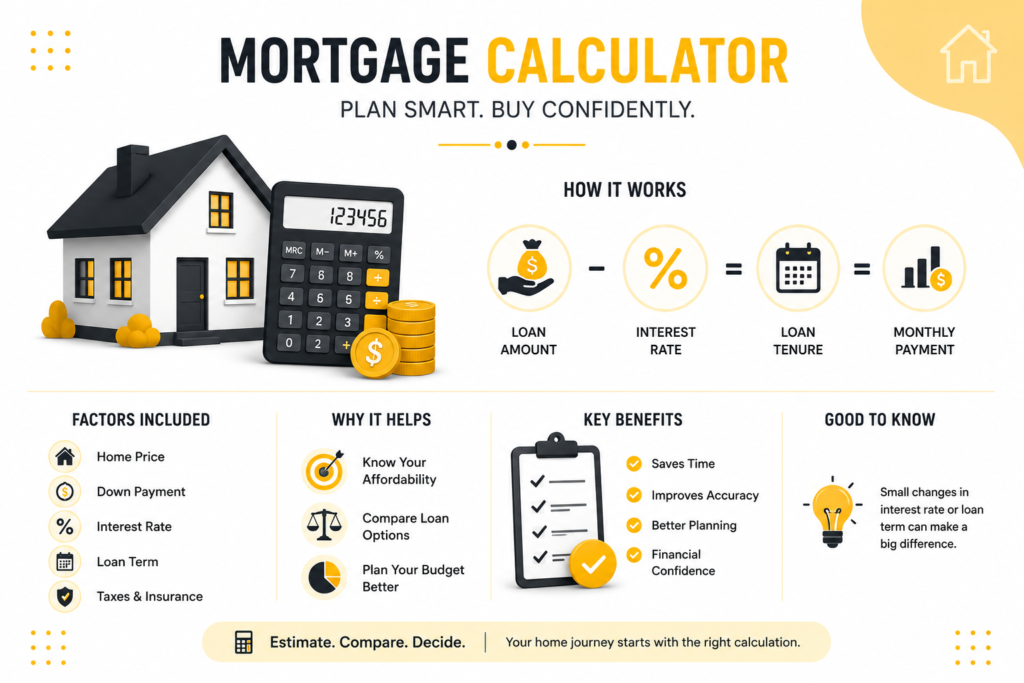
A mortgage calculator is an online financial tool used to estimate monthly mortgage payments and total loan costs. It helps borrowers understand how much they will pay each month for a home loan based on several financial factors.
Most mortgage calculators require users to enter:
Home price
Down payment
Interest rate
Loan term
Property taxes
Insurance costs
After entering the information the calculator instantly estimates monthly payments and total repayment costs.
Without a mortgage calculator manually calculating long-term home loan costs can become complicated and time-consuming.
Why Mortgage Calculators Matter
Better Financial Planning
One of the biggest benefits of using a mortgage calculator is financial clarity. Homebuyers can estimate monthly obligations before committing to a property purchase.
This helps prevent situations where buyers purchase homes beyond their budget.
Smarter Loan Comparisons
Different lenders may offer varying interest rates and loan terms. A mortgage calculator allows borrowers to compare multiple scenarios quickly.
For example:
A lower interest rate may reduce monthly payments
A shorter loan term may save interest costs
A larger down payment may reduce loan size
Understanding these differences helps borrowers make more informed decisions.
Reducing Financial Stress
Many people underestimate long-term mortgage costs. A calculator provides realistic expectations and helps borrowers prepare financially for homeownership.
How a Mortgage Calculator Works
Mortgage calculators use mathematical formulas to estimate monthly loan repayments.
The standard mortgage payment formula is:
M = P \times \frac{r(1+r)^n}{(1+r)^n-1}
Where:
M = Monthly mortgage payment
P = Loan principal amount
r = Monthly interest rate
n = Total number of monthly payments
This formula calculates equal monthly payments over the life of the loan.
Understanding the Mortgage Formula
The mortgage formula may look intimidating at first but it becomes much easier when broken into simple parts.
Loan Principal
The principal is the amount borrowed after subtracting the down payment.
Example:
Home price: $400000
Down payment: $80000
Loan principal = $320000
Interest Rate
Mortgage lenders charge interest for lending money. Interest rates significantly affect monthly payments and total borrowing costs.
Even a small interest rate difference can save or cost thousands of dollars over time.
Loan Term
The loan term refers to how long borrowers have to repay the mortgage.
Common terms include:
15 years
20 years
30 years
Longer terms reduce monthly payments but increase total interest costs.
Mortgage Calculator Example
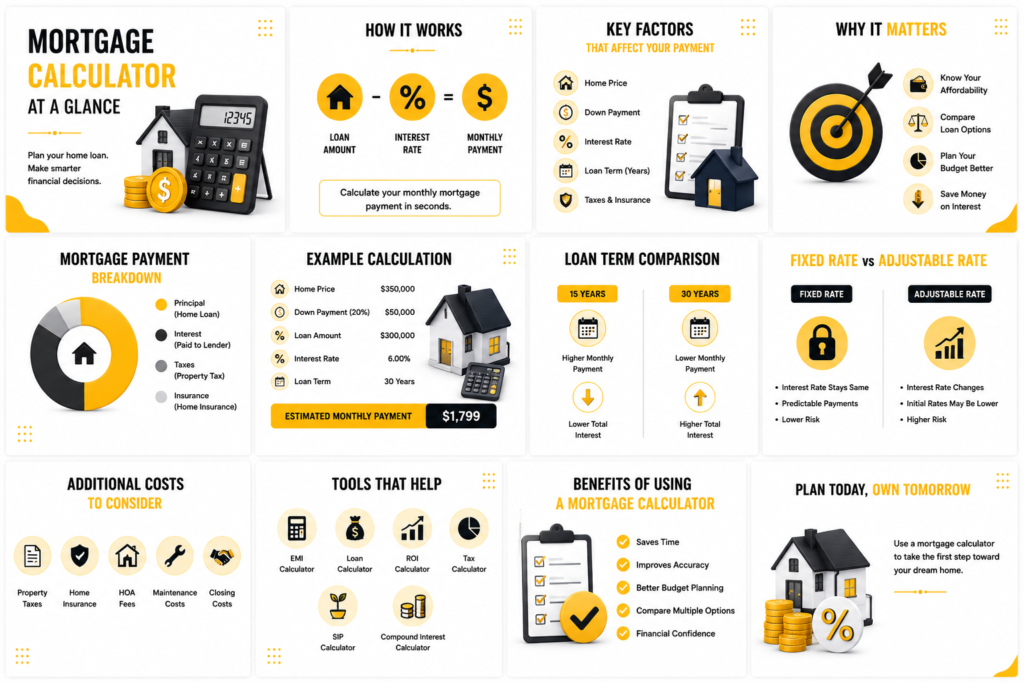
Suppose you are buying a home with:
Home price: $350000
Down payment: $50000
Loan amount: $300000
Interest rate: 6%
Loan term: 30 years
Using a mortgage calculator the estimated monthly payment would be approximately $1799 excluding taxes and insurance.
This simple estimate helps buyers evaluate affordability before speaking with lenders.
Components Included in Mortgage Calculations
Principal
The principal is the original loan amount borrowed from the lender.
Interest
Interest is the fee charged for borrowing money. Mortgage interest accumulates over time and represents a large portion of total repayment costs.
Property Taxes
Most mortgage payments include property taxes collected monthly by lenders.
Home Insurance
Lenders usually require homeowners insurance to protect the property against damage or loss.
Private Mortgage Insurance (PMI)
Borrowers who make smaller down payments may need PMI which increases monthly costs.
Fixed-Rate vs Adjustable-Rate Mortgages
Mortgage calculators often allow users to compare different loan types.
Feature
Fixed-Rate Mortgage
Adjustable-Rate Mortgage
Interest Rate
Stays constant
Changes over time
Monthly Payment
Predictable
Variable
Risk Level
Lower
Higher
Best For
Long-term stability
Short-term flexibility
Fixed-rate mortgages are more predictable while adjustable-rate mortgages may offer lower starting rates but higher future uncertainty.
Why Interest Rates Matter So Much
Interest rates dramatically influence total mortgage costs.
For example:
Loan Amount
Interest Rate
Monthly Payment
$300000
5%
Lower payment
$300000
7%
Much higher payment
Over 30 years even a 1% increase can add tens of thousands of dollars in additional interest.
This is why buyers often monitor market rates carefully before locking in mortgages.
The Role of Down Payments
A down payment reduces the amount borrowed and lowers overall mortgage costs.
These tools collectively improve financial planning and long-term decision-making.
Advantages of Using a Mortgage Calculator
Mortgage calculators offer several practical benefits.
Saves Time
Manual mortgage calculations can be complicated. Calculators provide instant estimates.
Improves Accuracy
Automated calculations reduce human error.
Encourages Better Budgeting
Buyers gain a realistic understanding of monthly obligations.
Supports Financial Confidence
Knowing estimated payments before applying for loans reduces uncertainty and stress.
Limitations of Mortgage Calculators
Although useful mortgage calculators also have limitations.
Estimates Only
Actual mortgage payments may differ depending on lender fees and changing taxes.
Excludes Some Costs
Some calculators may not include:
Maintenance expenses
HOA fees
Closing costs
Interest Rate Changes
Rates may fluctuate between calculation and final loan approval.
Therefore calculators should be viewed as planning tools rather than guaranteed loan offers.
Historical Growth of Mortgage Lending
Mortgage financing has existed for centuries but modern mortgage systems expanded significantly during the 20th century.
As housing demand increased banks and financial institutions developed more structured lending systems. Today digital mortgage calculators allow buyers to analyze complex financing scenarios instantly from smartphones or computers.
This technology has made home financing more transparent and accessible than ever before.
Things to Know Before Applying for a Mortgage
Before applying for a mortgage borrowers should:
Check credit scores
Compare lenders
Understand interest rates
Calculate total ownership costs
Maintain emergency savings
Review loan terms carefully
Preparation improves approval chances and helps borrowers secure better rates.
Conclusion
A mortgage calculator is one of the most valuable tools for anyone planning to buy a home or refinance a property. It transforms complicated loan calculations into clear easy-to-understand estimates that help borrowers make smarter financial decisions.
By understanding how mortgage payments work comparing loan scenarios and evaluating affordability carefully buyers can reduce financial stress and plan more confidently for the future. Mortgage calculators also work alongside financial tools like EMI Calculators ROI Calculators SIP Calculators Tax Calculators and Compound Interest Calculators to create a complete financial planning strategy.
In today’s housing market knowledge and preparation are essential. A mortgage calculator provides both by helping borrowers understand the true cost of homeownership before committing to long-term debt.
FAQs
What is a mortgage calculator?
A mortgage calculator is a financial tool that estimates monthly home loan payments based on loan amount interest rate and repayment term.
How accurate are mortgage calculators?
Mortgage calculators provide strong estimates but actual loan costs may vary depending on lender fees taxes and insurance.
What information do I need for a mortgage calculator?
Most calculators require:
Home price
Down payment
Interest rate
Loan term
Taxes and insurance estimates
Can a mortgage calculator help with refinancing?
Yes. Mortgage calculators help homeowners compare refinancing options and estimate potential savings.
Does a mortgage calculator include property taxes?
Many advanced mortgage calculators include property taxes and insurance costs.
What is the best mortgage term?
The best mortgage term depends on budget financial goals and interest rate preferences. Common options are 15-year and 30-year mortgages.
Why does interest rate matter in a mortgage?
Interest rates significantly affect monthly payments and total borrowing costs over time.
Is a mortgage calculator useful for real estate investors?
Yes. Investors use mortgage calculators to analyze financing costs cash flow and profitability
I am a professional finance content writer with expertise in personal finance investing, banking, loans, insurance, credit cards, budgeting, and market related topics. I create clear, SEO optimized, and reader friendly finance content that helps audiences understand complex financial concepts in simple words. My goal is to write trustworthy and engaging content that improves search visibility, builds credibility, and supports business growth.
I am a professional finance content writer with expertise in personal finance investing, banking, loans, insurance, credit cards, budgeting, and market related topics. I create clear, SEO optimized, and reader friendly finance content that helps audiences understand complex financial concepts in simple words. My goal is to write trustworthy and engaging content that improves search visibility, builds credibility, and supports business growth.