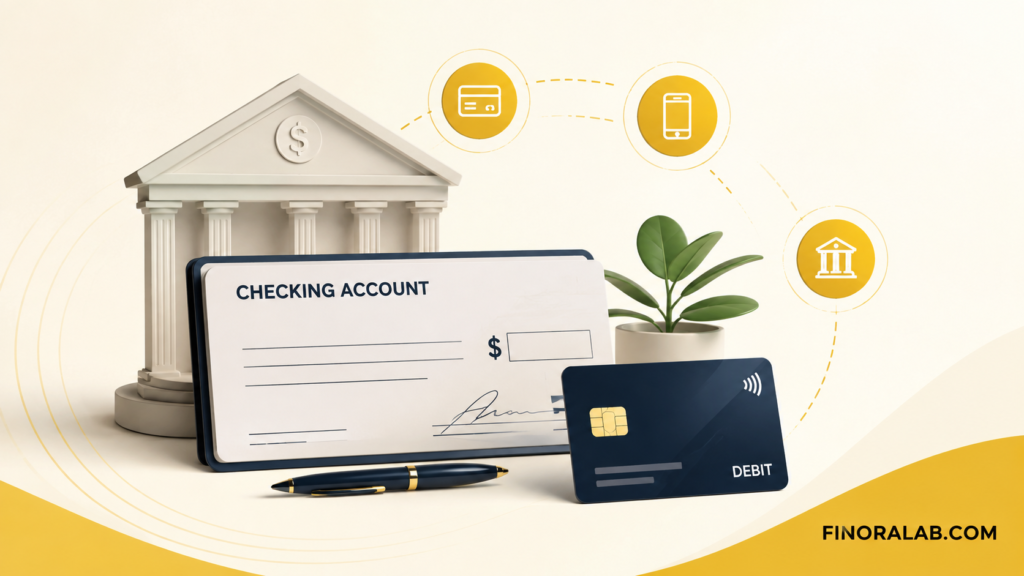
If you are learning how to manage money, understanding what is a checking account is one of the most useful places to start. A checking account is a bank or credit union deposit account designed primarily for everyday transactions. People commonly use checking accounts to receive paychecks, pay bills, withdraw cash, transfer money, and make purchases with a debit card. Unlike a long term investment account, a checking account focuses on accessibility and liquidity, meaning you can generally access your money quickly when you need it.
Checking accounts are a central part of personal finance because they connect income with everyday spending. Your paycheck may arrive through direct deposit, your mortgage or rent may be paid electronically, and your debit card transactions may come directly from the account. Understanding fees, overdrafts, account minimums, ATM access, FDIC or NCUA insurance, and available banking features can help you avoid unnecessary costs and build better financial habits.
What Is a Checking Account?
A checking account is a deposit account that allows you to store money and use it for frequent financial transactions. Banks and credit unions offer checking accounts for individuals, families, and businesses. Depending on the account, customers can typically deposit cash or checks, receive direct deposits, write checks, make electronic payments, transfer money, withdraw cash, and use a debit card. The account is generally intended for money you expect to spend relatively soon rather than money reserved exclusively for long term savings.
The key characteristic of a checking account is accessibility. If you receive a $4,000 monthly paycheck, you might deposit it into checking and then use that balance to pay rent, utilities, groceries, insurance premiums, transportation costs, and other expenses. The remaining amount can be transferred to savings, invested, or used for discretionary spending. This makes checking accounts an important cash flow management tool within a broader financial plan.
Unlike an investment account, a checking account generally does not expose your balance to stock market price fluctuations. Your deposited funds are held by the financial institution under the accounts terms. However, checking accounts are not completely risk free. Fraud, overdrafts, account fees, unauthorized transactions, and poor money management can create financial losses. Consumers should therefore understand both the protections and responsibilities associated with their account.
Checking accounts can also vary considerably between financial institutions. Some accounts have monthly maintenance fees, while others waive fees when you maintain a minimum balance or receive qualifying direct deposits. Some offer interest or rewards, while others focus on low fees and convenient ATM access. Comparing these features can help you choose an account that fits your actual banking behavior.
How Does a Checking Account Work?
When you open a checking account, you deposit money with a bank or credit union. The institution records the balance and allows you to access your funds through approved transaction methods. These may include debit cards, checks, electronic transfers, mobile banking, online bill pay, ATM withdrawals, and person to person payment services. Every transaction changes the available balance according to the institutions processing and transaction posting rules.
For example, suppose you deposit $3,000 into your checking account. You spend $600 on rent, $150 on utilities, $500 on groceries and transportation, and $250 on other expenses. Assuming all transactions have posted and there are no additional charges, you would have $1,500 remaining. You might then transfer $500 to savings, leaving $1,000 in checking for upcoming expenses. This simple process illustrates how checking can serve as the hub of a monthly household budget.
Modern checking accounts are increasingly managed through mobile and online banking. Customers can check balances, deposit checks using mobile capture, transfer funds, schedule payments, freeze debit cards, and receive transaction alerts without visiting a branch. These tools can make banking more convenient, but they also require good security practices. Strong passwords, multifactor authentication, device protection, and careful review of transactions can reduce the risk of unauthorized activity.
The timing of transactions is also important. A debit card purchase may reduce your available balance before it formally posts to the account. Checks and electronic payments may take different amounts of time to clear. Because of these differences, you should avoid treating the displayed balance as unlimited spending capacity. Reviewing both pending and posted transactions helps prevent accidental overdrafts.
What Can You Use a Checking Account For?
A checking account is primarily designed for everyday financial activity. Common uses include receiving wages through direct deposit, paying rent or mortgage payments, paying utilities, purchasing groceries, making debit card purchases, withdrawing cash, sending electronic payments, and transferring money to other accounts. Businesses may use business checking accounts for customer payments, payroll, operating expenses, taxes, and vendor payments.
Direct deposit is particularly convenient because employers can electronically deposit wages into an employees account. Government benefits and other recurring payments may also be deposited electronically when eligible. This reduces the need to receive and deposit paper checks. Once funds are available, the account owner can use them for expenses or move money into savings and investment accounts according to their financial plan.
Checking accounts can also support automated financial management. You might schedule an automatic transfer of $500 from checking to savings after every paycheck. Another $300 could go toward an individual retirement account or investment account, while recurring bills are paid automatically. Automation can make budgeting easier because financial priorities are addressed before discretionary spending consumes available cash.
However, a checking account should not necessarily hold all of your money. Keeping excessive cash in a low interest checking account can create an opportunity cost because some funds may earn more in an appropriate savings or investment vehicle. A sensible strategy often separates money based on its purpose checking for near term spending, savings for emergency reserves and short term goals, and investments for longer term objectives.
Checking Account vs. Savings Account
The biggest difference between checking and savings accounts is their intended purpose. Checking accounts are designed for frequent transactions and easy access. Savings accounts are generally designed to hold money for future needs while potentially earning more interest. Savings accounts can therefore be better suited to emergency funds, upcoming large purchases, or money that does not need to be accessed for everyday spending.
Suppose you earn $5,000 per month after taxes and spend approximately $3,500 on regular household expenses. Keeping the entire $5,000 in checking might make transactions easy, but it could leave too much cash earning little or no interest. Instead, you might maintain a checking balance sufficient for near term expenses and move excess cash into an appropriate savings account while maintaining a separate emergency reserve.
Savings accounts may have different transaction policies and features than checking accounts. Although modern regulations and account terms have changed over time, financial institutions can still impose specific limits or conditions on certain savings account transactions. Always review the institutions current terms rather than relying on old rules or general assumptions.
The two account types work well together. Checking provides liquidity for regular expenses, while savings creates a place for money that should remain available but does not need to be spent immediately. Using both accounts can improve budgeting discipline because it separates spending money from money reserved for future goals.
Types of Checking Accounts
There are several types of checking accounts, and the best choice depends on how you use banking services. Traditional checking accounts are offered by many banks and may provide branch access, debit cards, checks, online banking, and other standard services. Some traditional accounts charge monthly maintenance fees unless the customer meets specific requirements, such as receiving direct deposits or maintaining a minimum balance.
Online checking accounts are offered primarily or entirely through digital platforms. Because online banks may have lower physical branch costs, some can offer competitive fees, ATM arrangements, or other features. However, customers who frequently deposit cash or need face to face service may find a traditional institution more convenient. ATM availability and cash deposit options should be evaluated before opening an online account.
Interest bearing checking accounts pay interest on eligible balances. These accounts can be attractive if you regularly maintain a meaningful checking balance, but the interest rate may come with conditions such as minimum balances, direct deposits, transaction requirements, or tiered rates. Compare the actual annual percentage yield and requirements rather than choosing an account simply because it advertises interest.
Student checking accounts and other specialized accounts may offer features designed for particular groups. Some accounts waive monthly fees or have lower minimum requirements. Joint checking accounts allow multiple owners and are commonly used by couples or family members managing shared expenses. Business checking accounts are designed for commercial activity and should generally be kept separate from personal accounts for accounting and legal purposes.
How Much Money Should You Keep in Checking?
There is no universal checking account balance that works for everyone. The appropriate amount depends on your income schedule, monthly expenses, financial obligations, account features, and emergency savings. A practical starting point is to keep enough money in checking to cover upcoming bills and normal spending while maintaining a modest buffer for unexpected timing differences.
For example, imagine your household spends approximately $3,000 each month and receives two paychecks. You might keep $3,500 to $4,000 available in checking depending on your cash flow pattern and upcoming obligations. The additional buffer could help absorb a larger than normal utility bill or a delayed transaction. Someone with highly predictable income may need a smaller buffer than someone with irregular freelance income.
Avoid keeping too little cash simply because you want to maximize interest elsewhere. A checking account with a $20,000 balance might not be efficient if the same household has only $500 available for emergency expenses in savings. Conversely, keeping only $50 in checking when $2,500 of payments are pending creates unnecessary overdraft risk.
Your checking balance should also reflect the timing of automatic payments. Review your upcoming rent, mortgage, utilities, credit card payments, insurance premiums, loan payments, and subscriptions. A cash flow calendar can be more useful than a simple monthly budget because it shows when money enters and leaves your account.
Checking Account Fees and Costs
Checking account fees can reduce your available money over time, especially when they occur repeatedly. Common fees may include monthly maintenance charges, overdraft fees, out of network ATM fees, wire transfer charges, returned payment fees, and stop payment fees. The exact fees vary by financial institution and account type, so consumers should review the current fee schedule before opening an account.
Monthly maintenance fees deserve particular attention. Suppose an account charges $12 per month and you do not qualify for a waiver. Over one year, those charges total $144. That may not seem substantial in isolation, but it is money that could otherwise contribute to an emergency fund, debt repayment, or retirement savings. A no fee account may therefore be more valuable than a promotional reward that is difficult to qualify for.
ATM fees can also add up. If your bank charges $3 for using an out of network ATM and the ATM operator charges another $3, one withdrawal could cost $6. Making four such withdrawals per month would cost $24, or $288 annually. Consumers who frequently use cash should prioritize an account with convenient fee free ATM access.
Always examine the accounts conditions. A bank may advertise no monthly fee if you receive qualifying direct deposits or maintain a minimum balance. If you do not meet those requirements consistently, the account may become expensive. The best account is the one whose requirements naturally match your financial habits.
Overdrafts and Checking Account Risks
An overdraft occurs when a transaction exceeds the available funds in an account, although the exact treatment depends on the banks policies and transaction type. Some financial institutions may decline certain transactions, while others may approve them under an overdraft program or other arrangement. Fees and eligibility rules vary. Consumers should read their account agreement rather than assuming every bank handles overdrafts in the same way.
Consider an account with $800 available. You make a $500 payment and later use your debit card for $350. Depending on how transactions are processed and whether other pending charges exist, you could exceed the available balance. An overdraft can trigger fees or cause payments to be rejected. Keeping a cash buffer and monitoring pending transactions can reduce this risk.
Overdraft protection can sometimes connect checking to another deposit account or credit product. Some arrangements transfer available funds automatically when the checking balance is insufficient, potentially subject to fees or other conditions. While protection can reduce declined payments, it does not make overspending financially harmless. Consumers should understand the cost and source of the funds being used.
Fraud is another important risk. Debit card information, account credentials, and payment details can be targeted by criminals. Enable transaction notifications, review statements regularly, and report suspicious activity promptly. If you see an unauthorized transaction, contact your financial institution and follow its fraud reporting process.
Are Checking Accounts FDIC Insured?
For deposits held at an FDIC insured bank, checking accounts are generally eligible for federal deposit insurance up to applicable limits and subject to the FDICs rules. FDIC insurance is designed to protect covered depositors if an insured bank fails. It generally covers qualifying deposit products, including checking and savings accounts, certificates of deposit, and certain other deposits.
Credit unions have a separate federal insurance system administered by the National Credit Union Administration, or NCUA, for qualifying accounts at federally insured credit unions. Consumers should distinguish between bank deposit insurance and credit union share insurance. Both systems provide important protections, but they are administered by different organizations and have specific coverage rules.
Deposit insurance is different from investment protection. Money held in a checking account at an insured institution is subject to deposit insurance rules, while stocks, bonds, mutual funds, and ETFs are investments whose values can fluctuate. Securities are not protected against market losses simply because they are held through a financial institution.
Consumers with substantial cash balances should review how ownership categories and accounts affect insurance coverage. Someone holding large amounts across multiple accounts at the same institution should not assume that every account receives a completely separate insurance limit. The applicable rules depend on ownership category and other factors.
How a Checking Account Fits Into Personal Finance
A checking account should be viewed as the operating center of your short term financial plan. Income enters the account, regular expenses leave it, and excess cash can be directed toward savings, debt reduction, or investments. This makes checking an important part of cash flow management, but it is not the same as a complete financial plan.
A healthy financial system usually separates immediate spending from longer term goals. For example, your checking account might cover one month of expected expenses, while a high yield savings account holds your emergency fund. Retirement accounts can support long term goals, while taxable investment accounts may provide additional flexibility. The exact allocation depends on income, age, risk tolerance, debt, and financial objectives.
Debt management should also be integrated with checking. Automatic minimum payments can help prevent missed due dates, while additional payments can target high interest debt. However, consumers should ensure sufficient cash remains available for essential expenses before sending excessive amounts toward debt. A financial plan should balance debt reduction with liquidity and emergency savings.
Taxes also affect cash flow planning. Employees may have taxes withheld from paychecks, while self employed individuals may need to make estimated tax payments. Checking accounts can be used to reserve money for upcoming tax obligations. Separating tax reserves from everyday spending can help prevent a large tax bill from disrupting household cash flow.
How to Open a Checking Account
Opening a checking account is usually straightforward. Financial institutions commonly request identifying information such as your legal name, address, date of birth, Social Security number or taxpayer identification number, and government issued identification. The bank or credit union may also review information as part of its account opening procedures.
Before applying, compare fees and requirements. Look at the monthly maintenance fee, minimum opening deposit, minimum balance requirement, direct deposit requirements, ATM access, overdraft policies, check availability, mobile banking features, and customer support. If you frequently deposit cash, confirm that the institution provides a convenient way to do so without excessive fees.
Once the account is open, establish security settings immediately. Create strong credentials, enable multifactor authentication where available, activate transaction alerts, and consider account notifications for low balances and large purchases. Add only the payment methods and authorized users you actually need.
Finally, organize your account around your financial plan. Set up direct deposit, automate essential bills, schedule transfers to savings, and review transactions regularly. If you switch from another bank, leave enough money in the old account to cover outstanding checks and pending payments before closing it.
Checking Accounts and Credit Scores
A checking account is not generally a traditional credit account, so ordinary checking activity does not work like a credit card or installment loan when calculating conventional credit scores. Simply opening a checking account does not typically build your credit score. This distinction is important because consumers sometimes assume that having a bank account automatically establishes strong credit.
Credit scores are generally influenced by information associated with credit accounts. Factors can include payment history, amounts owed, credit utilization, length of credit history, types of credit, and recent credit applications, depending on the scoring model. Therefore, someone can have an excellent checking account history but a limited credit history if they have little experience with credit products.
Checking accounts can still indirectly affect financial stability. Repeated overdrafts, unpaid bank fees, or account problems can create financial stress and may potentially lead to collections or other consequences. Maintaining a positive cash balance and avoiding unnecessary fees can preserve money that could otherwise be used for debt payments and savings.
A strong personal finance strategy therefore treats banking and credit as separate but connected systems. Use checking for cash flow, manage credit responsibly, maintain emergency savings, and review credit reports for accuracy. Together, these practices create a stronger financial foundation than relying on a checking account alone.
Common Checking Account Mistakes to Avoid
One common mistake is choosing an account based only on a promotional bonus. A $300 bonus may look attractive, but if the account charges $15 per month and you cannot consistently meet the fee waiver conditions, the long term cost could outweigh the promotion. Always calculate the ongoing cost and consider whether the account fits your normal banking behavior.
Another mistake is failing to monitor transactions. Even with automatic payments, errors and fraudulent charges can occur. Reviewing your account at least weekly can help identify unexpected withdrawals, duplicate charges, subscriptions you no longer use, and unusual spending. Early detection can make financial problems easier to address.
Consumers also sometimes confuse available balance with safe to spend money. Pending transactions, automatic payments, checks, and scheduled transfers may not all be reflected in exactly the same way at every institution. Maintaining a buffer and tracking upcoming obligations can reduce the chance of spending money that is already committed.
Finally, avoid treating checking as a long term savings vehicle unless the account offers a competitive rate and you have a specific reason to do so. Money intended for retirement or long term wealth creation generally needs a different strategy. Checking should support your broader financial plan rather than replace savings, investing, insurance, or retirement planning.
How to Choose the Right Checking Account
Start by evaluating how you actually use banking services. If you receive direct deposit, use your debit card frequently, rarely use cash, and prefer mobile banking, an online checking account with low fees may be attractive. If you deposit cash regularly or need in person assistance, a bank with nearby branches may be more practical.
Next, calculate your likely annual banking costs. Add monthly fees, expected ATM charges, wire fees, and other recurring costs. Then subtract any realistic interest earnings or rewards. For example, an account costing $5 per month has a basic annual cost of $60 before other fees. A different account with no monthly fee may therefore be financially superior even if it has fewer promotional benefits.
Evaluate technology and customer support as well. A strong mobile app can make transfers, mobile check deposits, card controls, and account monitoring easier. But technology cannot replace responsive customer service when a fraud incident or account problem occurs. Consider how you prefer to communicate with your financial institution.
Finally, read the terms before opening the account. Pay attention to fee waivers, transaction limits, deposit availability, overdraft policies, ATM rules, interest requirements, and account closure procedures. The best checking account is not necessarily the one with the most features. It is the one that provides the services you need at a reasonable total cost.
Conclusion
Understanding what is a checking account is fundamental to managing personal finances effectively. A checking account is primarily designed for everyday transactions such as receiving direct deposits, paying bills, making purchases, transferring money, and withdrawing cash. Its greatest advantage is liquidity and convenience, allowing you to access money when needed without the market risk associated with investments.However, choosing and managing a checking account requires more than simply opening the first account available. Fees, overdraft policies, ATM access, digital banking features, minimum balance requirements, deposit insurance, and customer service can all affect the accounts value. Reviewing these factors can help you avoid unnecessary expenses and choose an account that matches your financial behavior.A checking account should also work alongside savings, debt management, investing, retirement planning, insurance, and tax planning. Keep enough money available for near term expenses, maintain an appropriate emergency reserve, and direct longer term funds toward suitable financial goals. When used thoughtfully, a checking account becomes more than a place to store spending money it becomes the foundation of an organized cash flow system.
You may also read more blogs
FAQs
What is a checking account in simple terms?
A checking account is a bank or credit union account designed for everyday money management. You can generally use it to receive paychecks, pay bills, make purchases, withdraw cash, write checks, and transfer money. Unlike an investment account, its primary purpose is accessibility rather than long term growth.
What is the difference between a checking and savings account?
Checking accounts are generally designed for frequent transactions and easy access, while savings accounts are intended for money you want to set aside for future needs. Savings accounts may pay more interest, although rates and terms vary. Many people use checking for monthly expenses and savings for emergency funds and financial goals.
Is money in a checking account safe?
Money held at an FDIC insured bank is generally covered by FDIC deposit insurance within applicable limits and ownership categories. Eligible deposits at federally insured credit unions generally receive NCUA share insurance. However, consumers still face risks such as fraud, unauthorized transactions, overdrafts, and fees.
Does a checking account build credit?
A checking account does not generally build traditional credit history in the same way a credit card or loan does. However, responsible checking account management can support overall financial stability. Avoiding overdrafts and keeping sufficient cash available can make it easier to pay credit obligations on time.
How much money should I keep in my checking account?
There is no universal amount. A reasonable balance should cover upcoming bills and normal spending while maintaining a cash buffer for unexpected expenses or transaction timing. Your ideal amount depends on your income schedule, monthly expenses, emergency savings, and financial obligations.
Can I have more than one checking account?
Yes. Many consumers maintain multiple checking accounts for different purposes. For example, one account might receive salary and pay household bills, while another could be used for discretionary spending. Multiple accounts can help with budgeting, but make sure you understand the fees and minimum requirements for each account.
Are checking accounts taxable?
Simply depositing your paycheck or other money into a checking account does not create a new tax merely because the funds are deposited. However, interest earned on an interest bearing checking account can generally be taxable income under applicable rules. Tax treatment depends on the source and nature of the money.
Can I open a checking account with bad credit?
Often, yes. Checking accounts are deposit accounts rather than traditional credit products, so approval does not necessarily depend on your credit score. However, financial institutions may review specialized consumer banking reports or other information when deciding whether to open an account. Requirements vary by institution.
Should I keep my emergency fund in checking?
Usually, an emergency fund is better kept in a suitable savings account or another highly liquid deposit vehicle rather than an everyday checking account. Keeping emergency money separate can reduce accidental spending while preserving access when needed. You should still maintain an appropriate checking buffer for routine expenses.
What should I look for in a checking account?
Focus on the total cost and features you actually use. Compare monthly fees, fee waiver requirements, ATM access, overdraft policies, direct deposit, mobile banking, cash deposit options, customer service, interest or rewards, and deposit insurance. The best account is one that fits your banking habits without unnecessary costs.

I am a professional finance content writer with expertise in personal finance investing, banking, loans, insurance, credit cards, budgeting, and market related topics. I create clear, SEO optimized, and reader friendly finance content that helps audiences understand complex financial concepts in simple words. My goal is to write trustworthy and engaging content that improves search visibility, builds credibility, and supports business growth.