Accountant Salary in 2026: A Complete Earnings Guide
Shanzay Arain·Jul 10, 2026
Choosing a career is not only about finding work you enjoy. It also involves understanding how much you may earn, how quickly your income could grow, and whether the profession offers long term financial stability.
The average accountant salary depends on several factors, including experience, education, certification, industry, location, employer size, specialization, and job responsibilities. A recent graduate working as a staff accountant may earn considerably less than a CPA, accounting manager, controller, tax specialist, or senior auditor.
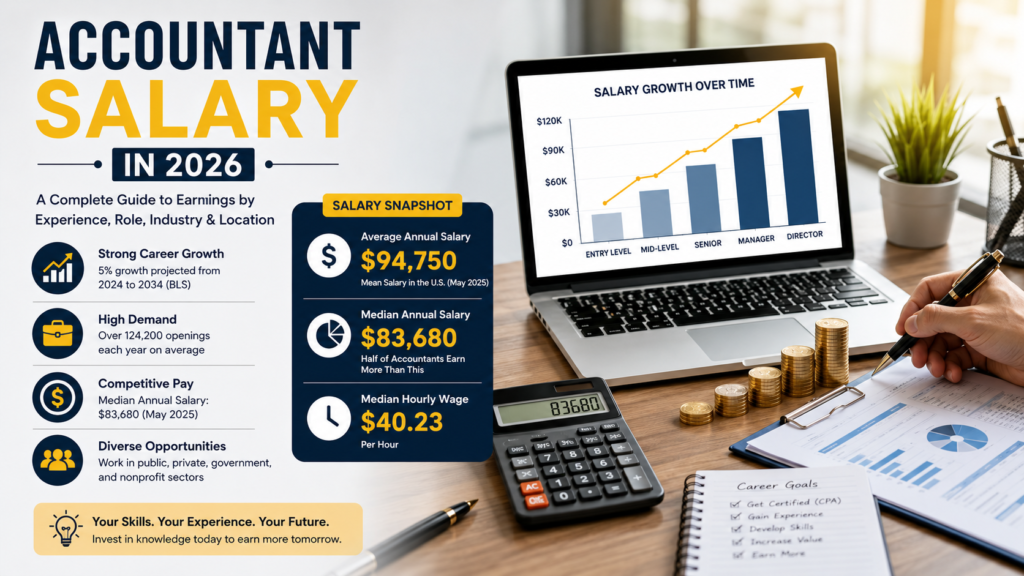
According to the latest available U.S. occupational wage data, accountants and auditors earned a median annual salary of $83,680 in May 2025. The mean, or average, annual wage was approximately $94,750. The median is usually the more useful benchmark because it is less affected by a relatively small number of very highly paid professionals. these national figures do not represent a guaranteed salary. Your actual compensation could be lower or higher depending on your qualifications and local job market.
This guide explains accountant pay ranges, CPA earnings, salary factors, career benefits, potential disadvantages, and practical ways to improve your earning potential.
Quick Summary Table
Category
Latest U.S. benchmark
Median annual accountant salary
$83,680
Average annual wage
$94,750
Approximate median monthly gross pay
$6,973
Approximate median weekly gross pay
$1,609
Median hourly wage
$40.23
Lower 10th percentile
$56,020 or less
25th percentile
$67,020
75th percentile
$109,810
Upper 10th percentile
$144,090 or more
Typical entry level education
Bachelors degree
Projected employment growth
5% from 2024 to 2034
Average annual job openings projected
Approximately 124,200
The 2025 wage figures are based on national occupational data for accountants and auditors. The job growth and annual opening projections cover the 2024–2034 period. and weekly amounts are gross estimates calculated from the annual median. They do not represent take home pay after taxes, health insurance, retirement contributions, or other payroll deductions.
What Does an Accountant Do?
An accountant prepares, organizes, reviews, and analyzes financial information. Accountants help businesses, government agencies, nonprofit organizations, and individuals understand where money comes from, where it goes, and whether financial records comply with applicable rules.
Common responsibilities include
Preparing financial statements
Maintaining and reviewing accounting records
Reconciling bank and ledger accounts
Calculating taxes and preparing tax returns
Reviewing internal financial controls
Identifying errors, unusual transactions, or fraud risks
Preparing budgets and financial forecasts
Supporting audits
Explaining financial results to managers or clients
Recommending ways to control costs and improve profitability
The Bureau of Labor Statistics explains that accountants and auditors examine financial records, assess financial operations, identify risks, ensure taxes are handled properly, and help organizations operate more efficiently. y accountant performs the same duties. The accounting profession includes public accountants, tax accountants, management accountants, government accountants, internal auditors, external auditors, cost accountants, forensic accountants, and financial reporting specialists.
Average Accountant Salary in 2026
The latest U.S. national wage estimates available in 2026 are based on May 2025 employment and salary data.
The median accountant salary was $83,680 per year, or approximately $40.23 per hour. This means half of accountants and auditors earned less than $83,680, while the other half earned more. The average annual wage was higher, at approximately $94,750. distribution was broad
The lowest 10% earned approximately $56,020 or less.
The 25th percentile earned approximately $67,020.
The median was $83,680.
The 75th percentile earned approximately $109,810.
The highest 10% earned approximately $144,090 or more. les should not be treated as exact experience levels. For example, the 10th percentile is not automatically an entry level salary. It may include accountants working in lower cost regions, smaller companies, lower paying industries, or roles with fewer responsibilities.
Similarly, the highest paid group may include experienced CPAs, senior managers, directors, partners, specialists, and professionals working in high cost markets.
Accountant Salary by Experience Level
Experience is one of the biggest factors affecting accounting compensation.
Entry Level Accountant Salary
Entry level accountants commonly work under the supervision of senior accountants, accounting managers, or controllers. Their responsibilities may include journal entries, account reconciliation, invoice processing, basic financial reporting, and audit support.
A reasonable lower end national benchmark is the 10th to 25th percentile range of approximately $56,020 to $67,020, although actual starting offers may fall outside this range. raduates may improve their starting position through internships, accounting software experience, strong Excel skills, and progress toward professional certification.
Mid Level Accountant Salary
Mid level accountants usually have several years of relevant experience. They may prepare complete financial statements, supervise junior employees, manage month end closing, handle more complex reconciliations, or communicate directly with clients and auditors.
Many mid level professionals may earn around the national median or between the 25th and 75th percentiles. Based on the latest wage distribution, that broad range is approximately $67,020 to $109,810. t salary depends heavily on job title and responsibilities. A corporate accountant, tax accountant, internal auditor, and financial reporting accountant may receive different offers despite having similar years of experience.
Senior Accountant Salary
Senior accountants often manage complex reporting, review junior employees work, support audits, improve accounting processes, and work directly with senior management.
Experienced professionals may earn near or above the 75th percentile of $109,810, especially when they possess a CPA license, industry specialization, management responsibility, or advanced technical knowledge. The highest paid 10% of accountants and auditors earned more than approximately $144,090 in the latest national data. range may also include accounting managers, directors, partners, controllers, and professionals whose duties extend beyond a standard senior accountant position.
CPA Salary Versus Accountant Salary
A Certified Public Accountant is a licensed accounting professional who has completed the education, examination, experience, and jurisdiction specific requirements established by the relevant state accountancy authority.
All CPAs are accountants, but not every accountant is a CPA.
CPA professionals may qualify for positions involving audits, assurance services, advanced tax work, financial reporting, consulting, and leadership. A CPA license can also help candidates compete for promotions and positions with greater responsibility.
AICPA career guidance published in 2025 provided the following broad CPA salary ranges
CPA career stage
Illustrative annual salary
Entry level CPA
$60,000–$75,000+
Mid career CPA
$85,000–$110,000+
Senior, partner, or CFO level professional
$120,000+, with some above $200,000
These are broad career estimates rather than guaranteed salaries. Compensation varies by location, specialization, employer, performance, and leadership responsibility. nsing requirements also vary by jurisdiction and can change. Candidates should confirm current education, examination, experience, ethics, and renewal requirements with their state board of accountancy or another official licensing authority. ntant Salary by Industry
The industry in which an accountant works can affect compensation.
BLS industry data for May 2024 showed the following median annual wages among major employers of accountants and auditors
Industry
Median annual wage
Finance and insurance
$87,980
Management of companies and enterprises
$86,010
Government
$81,120
Accounting, tax preparation, bookkeeping, and payroll services
$80,510
These figures are industry medians, not starting salaries. They also reflect May 2024 data, so readers should verify current local salary information before comparing job offers. ccounting firms can provide strong training and exposure to multiple clients, but workload may rise significantly during tax or audit season. Corporate accounting positions may offer more predictable responsibilities, although closing periods and reporting deadlines can still require longer hours.
Government and nonprofit accounting positions may offer lower cash compensation than some private sector roles but could provide attractive benefits, retirement plans, job stability, or work life balance. Benefits should always be evaluated alongside base salary.
Factors That Affect an Accountants Salary
Education
A bachelors degree in accounting or a related field is the typical entry level education for accountants and auditors in the United States. s degree may help in specialized or competitive roles, but it does not automatically guarantee a higher salary. Employers generally consider education together with experience, technical skills, certification, and job performance.
Professional Certification
Credentials such as the CPA can strengthen professional credibility and may improve access to senior positions. Other qualifications may be relevant for management accounting, internal auditing, fraud examination, information systems auditing, or financial analysis.
Before paying for a certification, compare the cost, study time, renewal requirements, and career value within your intended specialization.
Location
Accountant salaries are generally higher in large metropolitan areas and locations with a high cost of living. However, a higher nominal salary does not always produce greater purchasing power.
For example, an accountant earning $100,000 in an expensive city may have less disposable income than someone earning $80,000 in a lower cost region. Housing, transportation, taxes, healthcare, and childcare costs should be considered when comparing offers.
Industry and Specialization
Technical areas such as financial reporting, international tax, forensic accounting, regulatory compliance, mergers and acquisitions, audit, data analytics, and accounting systems may command higher salaries when qualified professionals are difficult to find.
Employer Size
Large corporations and major accounting firms may offer higher salaries, bonuses, training, and promotion pathways. Smaller employers may offer broader responsibilities, greater flexibility, or faster access to leadership.
Neither option is automatically better. The right choice depends on career goals, workload expectations, benefits, and professional development opportunities.
Technology Skills
Modern accountants increasingly use cloud accounting platforms, enterprise resource planning systems, data visualization tools, automation software, and artificial intelligence.
The BLS expects automation to reduce some routine work while increasing the importance of analytical, advisory, and higher level responsibilities. It does not currently project that technology will eliminate overall demand for accountants and auditors. nts who understand both financial principles and technology may be better positioned for process improvement, systems, analytics, and advisory roles.
How an Accountant Salary Works
Suppose an accountant receives a gross annual salary of $83,680, equal to the latest national median.
The approximate gross compensation would be
$6,973 per month
$3,218 twice per month
$1,609 per week
$40.23 per hour, based on 2,080 working hours per year
These figures describe gross pay before deductions.
The accountants actual paycheck may be reduced by
Federal income tax
State or local income tax
Social Security and Medicare contributions
Health insurance premiums
Retirement plan contributions
Flexible spending or health savings contributions
Other voluntary employee benefits
Tax rules and payroll deductions can change. Workers should verify current requirements through official federal and state resources or consult a qualified tax professional.
A person should build a household budget around expected net pay, not the advertised gross salary.
Benefits and Risks of an Accounting Career
Potential Benefits
Above average earnings The 2024 median wage for accountants and auditors was substantially higher than the median for all U.S. occupations. employment opportunities** Accountants work in nearly every industry, including banking, healthcare, manufacturing, government, retail, technology, education, insurance, and professional services.
Clear career progression A professional may advance from junior accountant to senior accountant, manager, controller, director, partner, or chief financial officer.
Transferable financial skills Accounting knowledge can support careers in budgeting, compliance, business analysis, financial operations, consulting, and entrepreneurship.
Continued demand Employment of accountants and auditors is projected to grow 5% from 2024 to 2034, with approximately 124,200 openings expected each year on average. ible Disadvantages and Risks
Busy seasons Tax deadlines, audit periods, month end closing, and year end reporting can require longer working hours.
Certification costs CPA preparation, examinations, licensing, and continuing education can require substantial time and money.
High responsibility Errors in tax, audit, or financial reporting work may create serious consequences for employers and clients.
Routine work may be automated Basic data entry and repetitive bookkeeping tasks are increasingly handled by software. Accountants must continue developing analytical, communication, and technology skills. varies significantly** Earning a degree or certification does not guarantee a particular salary. Local demand, experience, economic conditions, and employer budgets all influence compensation.
Step by Step Guide to Increasing Your Accountant Salary
Step 1 Establish a Strong Accounting Foundation
Understand financial statements, journal entries, reconciliations, internal controls, taxation basics, and generally accepted accounting principles relevant to your role.
Step 2 Gain Practical Experience
Internships, trainee positions, and junior accounting roles help translate academic knowledge into workplace skills. Keep a record of measurable achievements, such as faster closing times, reduced errors, improved reporting, or successful audit support.
Step 3 Learn High Value Software
Build proficiency in spreadsheets, accounting platforms, enterprise systems, reporting tools, and data analysis software used by employers in your target industry.
Step 4 Choose a Specialization
Specializing in tax, audit, financial reporting, forensic accounting, compliance, systems, or management accounting may improve your value compared with remaining limited to basic transaction processing.
Step 5 Evaluate Professional Certification
Research whether a CPA or another recognized credential is required or strongly preferred for your target positions. Compare the total cost with the realistic career benefit.
Step 6 Research Market Salaries
Use recent government wage data, current job postings, professional associations, and reputable salary surveys. Compare positions with similar responsibilities rather than relying only on job titles.
Step 7 Negotiate the Complete Compensation Package
Consider base salary, annual bonus, health insurance, retirement contributions, paid leave, remote work options, education assistance, overtime expectations, and promotion opportunities.
Step 8 Continue Developing Advisory Skills
Communication, problem solving, business understanding, leadership, and data interpretation are increasingly important as routine accounting work becomes automated.
Common Mistakes to Avoid
Comparing salaries without considering location A higher salary may be offset by higher housing, transportation, and tax costs.
Confusing average and median pay The average can be pulled upward by highly paid professionals. The median often gives a more realistic picture of the middle of the market.
Treating percentiles as guaranteed experience bands A lower percentile is not always entry level, and an upper percentile is not always a senior role.
Ignoring employee benefits Retirement contributions, health coverage, paid leave, and bonuses may add substantial value to an offer.
Assuming a CPA guarantees high income Certification may improve opportunities, but salary still depends on experience, responsibility, specialization, performance, and market demand.
Failing to update technical skills Professionals who rely only on manual bookkeeping may face greater pressure from automation.
Budgeting from gross salary Personal expenses should be planned using estimated take home income after taxes and deductions.
Latest Accountant Salary Update
The latest available national occupational wage estimates were released by the Bureau of Labor Statistics on May 15, 2026 and cover wages from May 2025.
The updated data places the national median wage for accountants and auditors at $83,680 per year, while the mean annual wage is approximately $94,750. Around 1.45 million accountants and auditors were included in the national employment estimate. arison, the previous Occupational Outlook Handbook figure showed a median of $81,680 in May 2024. gests an increase in the reported nominal national median, but it should not automatically be interpreted as an increase in purchasing power. Inflation, regional cost changes, and differences in the underlying occupational sample can affect how salary growth feels in practice.
Salary data is updated periodically. Readers should verify the newest figures before publishing compensation research, negotiating a job offer, or making relocation decisions.
Expert Tips for Better Career and Financial Decisions
Compare at least three reliable salary sources rather than depending on one job website.
Ask recruiters whether a posted range includes bonuses, overtime, or other variable compensation.
Calculate your expected net income before accepting a position in a different state.
Evaluate the cost of certification against the positions it could realistically help you obtain.
Build skills in financial analysis, communication, data tools, automation, and business decision making.
Document measurable achievements before requesting a raise.
Avoid changing jobs based only on salary. Workload, management quality, benefits, promotion potential, and job stability also matter.
Increase retirement contributions carefully when your salary rises, but maintain an adequate emergency fund and manageable monthly cash flow.
Conclusion
The national median accountant salary is approximately $83,680 per year based on the latest May 2025 U.S. wage data available in 2026. However, accountant earnings can range from below $56,020 to more than $144,090 depending on experience, location, industry, certification, specialization, and management responsibility. ng can provide above average earnings, transferable financial skills, and a clear path toward senior business roles. At the same time, professionals must prepare for deadlines, ongoing education, technological change, and significant responsibility.The most effective way to improve earning potential is to combine strong accounting knowledge with practical experience, professional credibility, technology skills, business understanding, and careful salary negotiation.
Frequently Asked Questions About Accountant Salary
What is the average accountant salary in the United States?
The average accountant salary in the United States is approximately $94,750 per year, while the median annual salary is about $83,680. Actual earnings depend on experience, location, industry, qualifications, and job responsibilities.
How much does an accountant earn per hour?
The median hourly wage for accountants and auditors is approximately $40.23. Entry level accountants may earn less, while experienced accountants, CPAs, managers, and specialists may earn significantly more.
What is the starting salary for an entry level accountant?
An entry level accountant may earn approximately $56,000 to $67,000 per year. However, starting salaries vary depending on the employer, city, education, internship experience, and accounting software skills.
Do CPAs earn more than regular accountants?
CPAs often have higher earning potential because they can qualify for advanced roles in auditing, taxation, consulting, financial reporting, and management. However, a CPA license does not guarantee a specific salary.
Can accountants earn more than $100,000 per year?
Yes. Senior accountants, accounting managers, controllers, tax specialists, auditors, and CPAs can earn more than $100,000 per year. Professionals in the highest paid positions may earn over $140,000 annually.
What factors affect an accountants salary?
The main factors include experience, education, professional certifications, industry, location, employer size, specialization, management responsibilities, and technical skills.
Which accounting jobs pay the most?
Some of the highest paying accounting roles include financial controller, accounting director, tax manager, audit manager, forensic accountant, finance director, partner, and chief financial officer.
Is accounting a good career?
Accounting can be a good career for people who enjoy working with numbers, financial information, problem solving, and business operations. It offers stable demand, transferable skills, and opportunities for career progression.
Does location affect accountant salary?
Yes. Accountants working in major cities or high cost areas may receive higher salaries. However, housing, transportation, taxes, and other living expenses should also be considered when comparing job offers.
How can an accountant increase their salary?
Accountants can improve their earning potential by gaining experience, earning professional certifications, learning advanced accounting software, developing data analysis skills, choosing a specialization, and applying for senior or management positions.
I am a professional finance content writer with expertise in personal finance investing, banking, loans, insurance, credit cards, budgeting, and market related topics. I create clear, SEO optimized, and reader friendly finance content that helps audiences understand complex financial concepts in simple words. My goal is to write trustworthy and engaging content that improves search visibility, builds credibility, and supports business growth.
I am a professional finance content writer with expertise in personal finance investing, banking, loans, insurance, credit cards, budgeting, and market related topics. I create clear, SEO optimized, and reader friendly finance content that helps audiences understand complex financial concepts in simple words. My goal is to write trustworthy and engaging content that improves search visibility, builds credibility, and supports business growth.