Bid Rent Theory: Understanding How Land Value Shapes Cities and Economic Behavior
Shanzay Arain·May 14, 2026
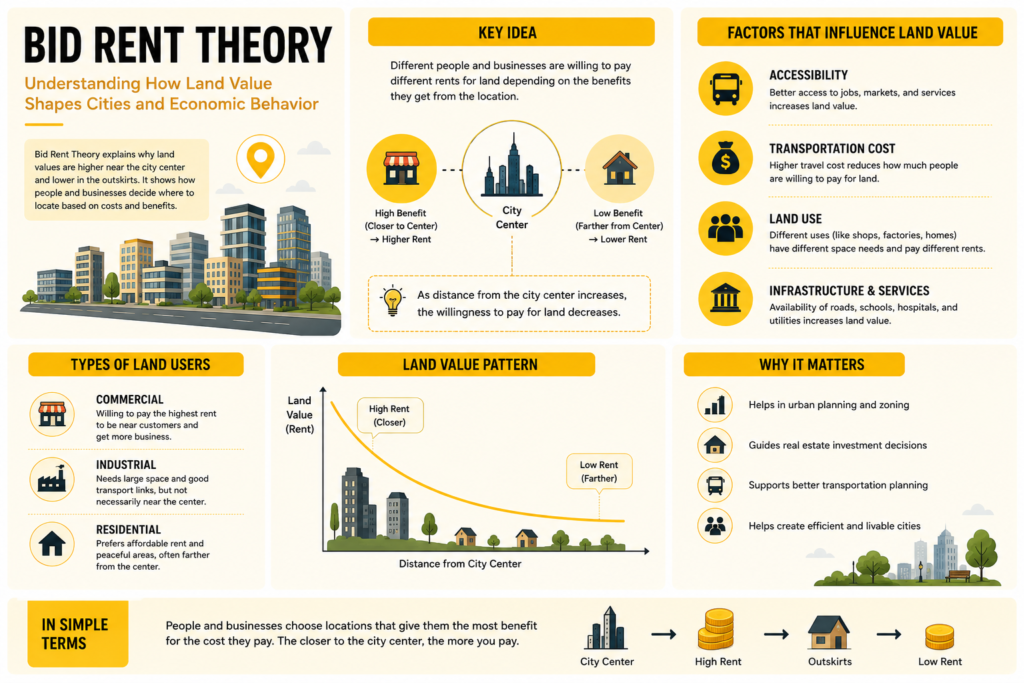
Urban landscapes are not random collections of buildings and infrastructure; they are carefully shaped by economic forces, social dynamics, and spatial relationships. One of the most influential concepts used to explain how cities organize themselves is Bid Rent Theory. This theory provides a framework for understanding why land prices vary across different locations and how individuals and businesses decide where to locate within a city.
At its core, Bid Rent Theory: Understanding and explains how the willingness to pay for land changes based on distance from a central point, typically the central business district. It highlights the trade offs between accessibility and cost, showing how different land users compete for space. By understanding this concept, we gain valuable insights into urban planning, real estate markets, transportation systems, and economic geography.
The Origins and Evolution of Bid Rent Theory
Bid Rent Theory has its roots in classical economic thought, particularly in the work of early economists who studied land use and agricultural productivity. The concept was later adapted to urban settings, where it became a cornerstone of urban economics. It emerged as a way to explain how land values decrease as one moves away from the city center, reflecting changes in accessibility and transportation costs.
Over time, the theory has evolved to incorporate modern economic realities, including technological advancements and changes in transportation systems. While the original model assumed a monocentric city with a single central business district, contemporary interpretations recognize the complexity of modern cities, which often have multiple centers of activity. Despite these changes, the fundamental principles of Bid Rent Theory remain highly relevant in understanding spatial economic patterns.
Core Principles of Bid Rent Theory
The central idea behind Bid Rent Theory is that different land users are willing to pay different amounts of rent based on their needs and the benefits they derive from a location. Businesses that rely heavily on accessibility, such as retail stores, are willing to pay higher rents to be closer to the city center. In contrast, residential users may prefer locations further away where land is more affordable.
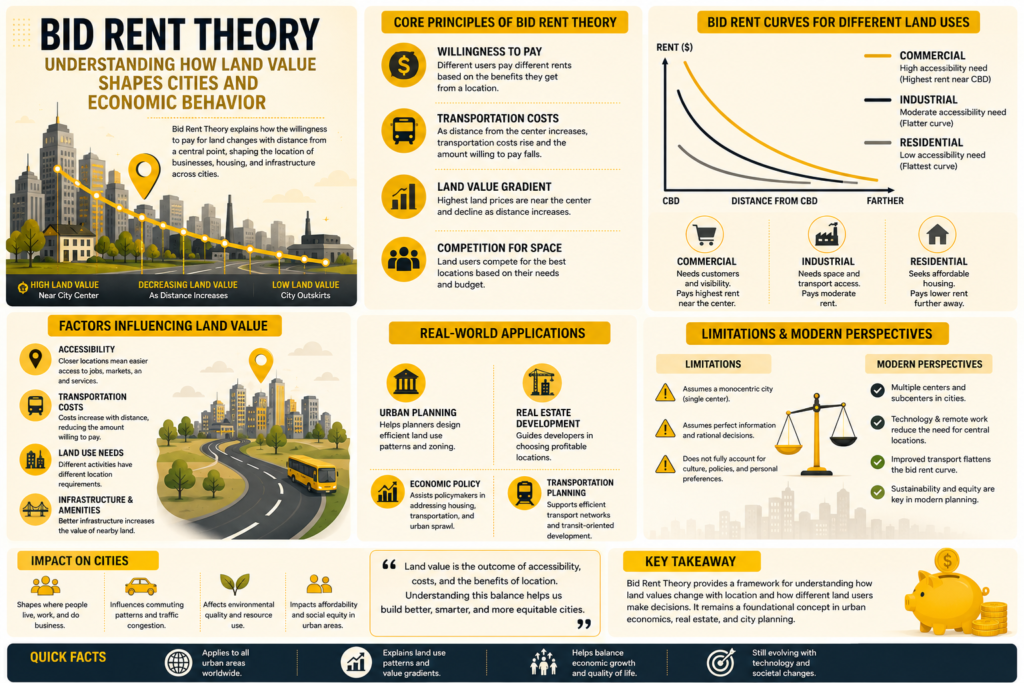
Another key principle is the relationship between transportation costs and land value. As distance from the city center increases, transportation costs also rise, reducing the amount that individuals and businesses are willing to pay for land. This creates a gradient of land values, with the highest prices near the center and lower prices in the outskirts. This gradient is a defining feature of urban spatial structure.
The Role of the Central Business District
The central business district, often referred to as the CBD, plays a crucial role in Bid Rent Theory. It is typically the area with the highest concentration of economic activity, including offices, retail establishments, and financial institutions. Because of its importance, land in the CBD is in high demand, leading to significantly higher rents compared to other areas.
The CBD’s influence extends beyond just high land prices. It also shapes transportation networks, commuting patterns, and urban development. People and businesses make location decisions based on their proximity to the CBD, balancing the benefits of accessibility with the costs of higher rents. This dynamic interaction is a key aspect of how cities grow and evolve.
Different Land Uses and Their Bid Rent Curves
One of the most insightful aspects of Bid Rent Theory is its ability to explain how different types of land use are distributed across a city. Each type of land user, whether commercial, industrial, or residential, has its own bid rent curve, which represents how much they are willing to pay for land at different distances from the city center.
Commercial users typically have the steepest bid rent curve because they rely heavily on customer access and visibility. They are willing to pay a premium for central locations. Industrial users, on the other hand, require more space and may prioritize access to transportation routes over centrality, resulting in a flatter curve. Residential users usually have the flattest curve, as they are more sensitive to rent costs and willing to live further away to save money.
Transportation Costs and Accessibility
Transportation costs are a critical factor in Bid Rent Theory, influencing how land values are distributed across a city. The theory assumes that the cost of commuting increases with distance from the city center, which affects how much individuals and businesses are willing to pay for land. This relationship creates a balance between rent and transportation expenses.
Advancements in transportation technology have significantly impacted this dynamic. Improved public transit systems, highways, and remote work opportunities have reduced the importance of proximity to the city center for some users. However, accessibility remains a key determinant of land value, as locations with better connectivity tend to command higher rents.
Real-World Applications of Bid Rent Theory
Bid Rent Theory is not just a theoretical concept; it has practical applications in urban planning, real estate development, and economic policy. Urban planners use the theory to design efficient land use patterns, ensuring that different activities are located in areas that maximize their economic potential.
In the real estate market, developers rely on the principles of Bid Rent Theory to determine where to build residential, commercial, or industrial properties. By understanding how land values change with location, they can make informed investment decisions. Policymakers also use the theory to address issues such as urban sprawl, housing affordability, and transportation planning.
Limitations and Criticisms of the Theory
While Bid Rent Theory provides valuable insights, it is not without its limitations. One of the main criticisms is its assumption of a monocentric city, which does not accurately reflect the complexity of modern urban areas. Many cities today have multiple centers of activity, making the traditional model less applicable.
Another limitation is the assumption that all individuals and businesses have perfect information and make rational decisions. In reality, factors such as personal preferences, cultural influences, and government policies can significantly affect location choices. Despite these limitations, the theory remains a useful tool for understanding general patterns in land use and urban development.
The Impact of Technology and Remote Work
The rise of digital technology and remote work has introduced new dynamics into the framework of Bid Rent Theory. With more people able to work from home, the importance of proximity to the central business district has decreased for certain types of jobs. This shift has led to changes in housing demand and land values in many cities.
However, technology has not eliminated the need for physical proximity altogether. Many industries still rely on face to face interactions, collaboration, and access to specialized infrastructure. As a result, while the bid rent curve may have flattened in some cases, the fundamental principles of the theory continue to apply, albeit in a modified form.
Environmental and Social Implications
Bid Rent Theory also has important environmental and social implications. The distribution of land uses across a city can affect factors such as traffic congestion, air quality, and access to amenities. For example, high density development near the city center can reduce the need for long commutes, leading to lower emissions.
On the social side, the theory highlights issues of inequality and access. High land prices in central areas can make it difficult for lower income individuals to live close to employment opportunities. This can lead to longer commutes and reduced quality of life. Understanding these implications is essential for creating more equitable and sustainable urban environments.
Bid Rent Theory in Modern Urban Planning
Modern urban planning increasingly incorporates the principles of Bid Rent Theory while adapting them to contemporary challenges. Planners recognize the importance of creating mixed use developments that combine residential, commercial, and recreational spaces. This approach helps to reduce the need for long commutes and promotes more efficient land use.
In addition, the concept of transit oriented development aligns closely with the theory. By focusing development around transportation hubs, cities can maximize accessibility and reduce transportation costs. This not only supports economic growth but also enhances the overall quality of life for residents.
Global Perspectives and Variations
The application of Bid Rent Theory varies across different regions and countries, depending on factors such as economic development, cultural norms, and government policies. In rapidly growing cities, particularly in developing countries, the theory can help explain patterns of urban expansion and land use.
In developed countries, where infrastructure is more advanced, the theory is often used to analyze changes in land values and urban structure. Despite regional differences, the core principles of Bid Rent Theory remain applicable, providing a universal framework for understanding how land is allocated in urban areas.
Conclusion
Bid Rent Theory offers a powerful lens through which we can understand the spatial organization of cities and the economic forces that shape them. By examining how land values change with distance from the city center, the theory provides insights into the behavior of businesses, residents, and policymakers.
While it has its limitations, the theory continues to be a valuable tool in urban economics and planning. As cities evolve in response to technological advancements and changing societal needs, the principles of Bid Rent Theory will remain relevant. By applying these insights, we can create more efficient, sustainable, and equitable urban environments.
FAQs
What is Bid Rent Theory in simple terms?
Bid Rent Theory explains how land prices vary based on distance from a central location, such as a city center. It shows how different users compete for land and how accessibility influences value.
Why is the central business district important in Bid Rent Theory?
The central business district is the focal point of economic activity, making it highly desirable. This leads to higher land prices and influences how land is used throughout the city.
How does transportation affect Bid Rent Theory?
Transportation costs increase with distance from the city center, reducing the amount people are willing to pay for land. This creates a gradient of land values across the city.
What are bid rent curves?
Bid rent curves represent how much different land users are willing to pay for land at various distances from the city center. Each type of user has a unique curve based on their needs.
Is Bid Rent Theory still relevant today?
Yes, although modern cities are more complex, the theory still provides valuable insights into land use patterns, real estate markets, and urban planning.
What are the limitations of Bid Rent Theory?
The theory assumes a single city center and rational decision making, which may not reflect real world complexities. It also does not fully account for cultural and policy influences.
How does remote work impact Bid Rent Theory?
Remote work reduces the need to live close to the city center, potentially flattening the bid rent curve. However, accessibility still plays an important role in many cases.
I am a professional finance content writer with expertise in personal finance investing, banking, loans, insurance, credit cards, budgeting, and market related topics. I create clear, SEO optimized, and reader friendly finance content that helps audiences understand complex financial concepts in simple words. My goal is to write trustworthy and engaging content that improves search visibility, builds credibility, and supports business growth.
I am a professional finance content writer with expertise in personal finance investing, banking, loans, insurance, credit cards, budgeting, and market related topics. I create clear, SEO optimized, and reader friendly finance content that helps audiences understand complex financial concepts in simple words. My goal is to write trustworthy and engaging content that improves search visibility, builds credibility, and supports business growth.